


Healthcare contracts represent the foundation of payer-provider relationships, yet they remain some of the most complex documents in the industry. A single provider contract often spans hundreds of pages, includes multiple amendments, and contains nested tables and rate sheets that rarely follow consistent formatting. This complexity creates significant operational challenges for healthcare organizations trying to manage their contracts effectively.
Despite these challenges, a modern approach to contract lifecycle management can materially improve speed, accuracy, and operational control in contracting for healthcare organizations. With the right systems and processes in place, these complex agreements can become structured, analyzable, and operationally aligned. Modern healthcare contract management software combines automation, artificial intelligence, and purpose-built workflows to address the unique requirements of healthcare contracts.
This guide outlines a structured approach to healthcare contract management. You'll learn about the essential stages of contract lifecycle management, common pitfalls to avoid, and how enterprise contract management software such as HiLabs® MCheck® ContractsAI can help you achieve better compliance, reduce risk, and increase operational efficiency.
What Is Healthcare Contract Management?
Healthcare contract management is the structured administration of payer–provider agreements across their lifecycle—from creation and negotiation to implementation and renewal. It includes the creation, negotiation, execution, storage, and performance monitoring of all healthcare contracts that govern payer-provider relationships.
In the healthcare sector, contracts are particularly complex, often running hundreds of pages with multiple amendments, intricate payment terms, and various performance clauses. A robust healthcare contract management system allows organizations to reduce interpretation and implementation risk and make it easier to translate contract terms into the actual pricing rules, reimbursement logic, and operational configurations required by downstream systems.
At its core, healthcare contract management involves several interconnected processes:
Contract Creation and Negotiation
Developing standardized templates, customizing terms for specific provider relationships, and facilitating collaborative negotiations between parties.
Contract Execution and Implementation
Securing approvals, obtaining signatures, and configuring systems to operationalize contract terms.
Contract Storage and Accessibility
Maintaining secure, searchable repositories where authorized personnel can quickly locate and reference contract details.
Contract Monitoring and Renewal
Tracking performance against contractual obligations, managing amendments, and handling timely renewals.
What distinguishes healthcare contracts from other business agreements is their direct impact on patient care, revenue cycles, and regulatory compliance. For instance, a single pricing error in a provider contract can result in significant financial leakage across thousands of claims.
Furthermore, healthcare contract management represents a critical business function that directly affects organizational efficiency and financial performance. In practice, inefficient contract management processes can lead to substantial revenue leakage through pricing errors, missed renewal opportunities, and compliance penalties.
Modern healthcare contract management software addresses these challenges by automating key processes. Advanced solutions utilize healthcare-specific AI to extract complex contract terms, analyze language variations across proposals, and support structured comparison across versions during negotiations. These capabilities allow contract teams to move beyond manual document management toward strategic contract optimization.
Contract lifecycle management (CLM) in healthcare extends beyond basic document storage by treating contracts as living assets requiring continuous attention from creation through renewal or termination. Effective CLM enables healthcare organizations to:
- Accelerate contract turnaround times
- Reduce administrative burden on specialized contract teams
- Minimize pricing errors and implementation delays
- Improve provider satisfaction through transparent, consistent negotiations
- Enhance compliance with evolving healthcare regulations
Additionally, healthcare contract management software can integrate with claims systems, benchmarking datasets, and contract repositories to deliver comprehensive insights. This integration allows organizations to align contract language with actual claims outcomes, a critical capability unique to the healthcare sector.
Overall, healthcare contract management provides the framework, processes, and tools needed to effectively handle the complex contractual relationships that underpin the healthcare delivery system. As contract volumes grow and regulatory requirements increase, implementing structured management approaches becomes increasingly vital for operational success.
Why Contract Lifecycle Management Matters in Healthcare
Contract lifecycle management (CLM) has evolved from a nice-to-have into a mission-critical capability for healthcare organizations. With health plans managing thousands of payer-provider contracts across multiple states and lines of business, effective CLM delivers substantial improvements in risk management, operational performance, and stakeholder relationships.
Impact on Compliance and Risk
The regulatory environment for healthcare contracts continues to intensify, making comprehensive contract management increasingly important. Effective healthcare contract management significantly reduces compliance risks by ensuring contract terms align with current regulations.
Contract management software with AI-powered capabilities can analyze contract language using advanced scoring systems, highlighting deviations and risk areas earlier in the review process. This proactive approach helps healthcare organizations avoid costly penalties and litigation that often result from non-compliant contract terms.
Moreover, the No Surprises Act has shifted financial risk to health plans when members rely on inaccurate information. Strong contract lifecycle management supports audit readiness by improving traceability of contract terms, implementation timing, and change control—reducing compliance exposure and downstream rework.
Contract management systems that incorporate automated compliance checks can flag provisions that contradict regulatory requirements, allowing legal teams to address issues before contracts are executed. This capability proves especially valuable as healthcare regulations evolve, ensuring organizations maintain compliance even as requirements change.
Operational Efficiency and Cost Savings
Healthcare contract management software, such as HiLabs® ContractsAI, delivers material operational improvements by automating manual, time-intensive processes. The financial impact is substantial:
- Cuts pricing configuration time from 6 days for a new agreement ID or ~1 hour for an existing agreement ID to minutes with over 80% automation
- Reduces configuration costs by 60-80%
- Delivers customer-reported ROI of at least 4:1 within the first year
Beyond these direct savings, healthcare CLM solutions streamline workflows across the organization. Furthermore, with negotiation workflow support—such as with creating new contracts, renewing existing agreements, and managing amendments—AI-first contract management solutions offer a comprehensive approach that eliminates bottlenecks and accelerates contract turnaround.
Healthcare organizations with effective contract lifecycle management benefit from faster implementation of negotiated terms. Consequently, providers begin seeing patients under new agreements sooner, improving network accessibility while reducing administrative friction.
Healthcare contract management software that includes automated data extraction can transform how organizations handle their agreements. Each module performs specialized extraction—from NLP-based extraction to clause identification—enabling teams to focus on strategic decisions rather than manual document review.
Improved Payer-Provider Relationships
Contract management software significantly enhances payer-provider relationships through increased transparency and consistency. When contracts are negotiated with clear visibility into proposed changes, both parties can collaborate more effectively.
Rate benchmarking capabilities allow payers to make data-driven offers based on market conditions and competitive rates. This approach makes negotiations more objective and helps providers understand how proposed rates compare to alternatives. As a result, contract discussions shift from adversarial encounters to collaborative business conversations.
Negotiation support capabilities can help teams create and review contracts, track redlines, and compare terms against templates and other agreements. This capability reduces negotiation cycle time and simplifies contract administration by promoting more standardized language.
Contract simulation tools further improve relationships by modeling the financial impact of proposals in real time. Both parties can visualize outcomes before finalizing agreements, preventing surprises that might otherwise damage relationships. This transparency builds trust between payers and providers.
Healthcare contract management platforms also ensure consistent application of negotiated terms. When contracts are properly implemented in claims systems, providers receive correct reimbursements without the need for appeals or adjustments. This consistency dramatically reduces provider abrasion while building confidence in the payer's administrative capabilities.
At the same time, centralized contract repositories with search capabilities ensure that all stakeholders have access to the same information. This shared understanding eliminates miscommunication and helps resolve disputes quickly when questions arise about contract interpretation.
Common Challenges in Healthcare Contract Management
Despite advances in healthcare technology, managing provider contracts remains one of the most challenging aspects of healthcare administration. Healthcare organizations frequently struggle with outdated processes that hinder efficiency and impact financial performance. A closer look at these challenges reveals why healthcare contract management software has become essential for modern healthcare operations.
Manual Workflows and Data Silos
Healthcare contracts are notoriously difficult to manage when scattered across multiple systems and formats. Currently, many organizations store contracts in various locations—from shared drives to email archives and physical filing cabinets—creating significant information bottlenecks.
This fragmentation leads to several operational challenges:
- Contract teams spend excessive time searching for the most current versions of agreements
- Knowledge becomes isolated within specialized departments
- Critical contract information remains inaccessible to stakeholders who need it
These data silos create substantial organizational friction. According to industry reports, contract turnaround times often exceed 10 days when organizations rely on disconnected systems. Similarly, when contract management processes remain manual, healthcare organizations typically require 1-2 full-time employees per 1,000 contracted providers just to handle configuration, benchmarking, and approvals.
However, the impact extends beyond mere inefficiency. Manual workflows introduce significant risk of human error during critical processes such as contract interpretation and implementation. Unfortunately, even small mistakes in interpreting complex reimbursement terms can have outsized financial consequences.
Pricing Errors and Value Leakage
Value leakage represents one of the costliest challenges in healthcare contract management. Without specialized healthcare contract management software, organizations struggle to accurately configure pricing terms from complex agreements.
The financial impact is substantial—contract implementation errors frequently lead to:
- Incorrect payments to providers
- Increased provider abrasion from payment disputes
- Extended delays in provider onboarding
- Unnecessary administrative costs for reconciliation
The root causes often lie in the complexity of healthcare contracts themselves. Complicated contract language and payment terms cause delays during both the interpretation and configuration phases, while tedious, error-prone pricing configuration creates downstream problems throughout the claims process.
Manual pricing configuration can take up to 6 days for new provider IDs or approximately one hour for existing IDs—a process that intelligent contract management solutions can reduce to minutes while improving accuracy.
Regulatory Compliance Risks
Healthcare contracts operate within an increasingly complex regulatory framework. Dependence on small, specialized contracting teams creates bottlenecks, burdens, and compliance vulnerabilities that can expose organizations to significant risk.
The No Surprises Act has intensified scrutiny around provider information accuracy, shifting financial risk from providers and patients to health plans when members rely on inaccurate directory information. Since the act came into effect, manual contract management processes have been inadequate for maintaining accurate provider directories and demonstrating compliance during audits.
Organizations without robust healthcare contract lifecycle management face several compliance challenges:
- Difficulty tracking obligations across thousands of agreements
- Inconsistent application of regulatory requirements
- Inability to quickly respond to regulatory changes
- Limited visibility into potential compliance gaps
Furthermore, healthcare organizations must balance compliance requirements against operational realities. Contract teams are frequently overworked and understaffed, yet expected to maintain perfect accuracy across growing contract volumes.
Advanced healthcare contract management platforms address these challenges through automation and AI-driven analysis. For instance, healthcare-specific AI can analyze contract language using PADU scoring (“Preferred, Acceptable, Discouraged, and Unacceptable”—a structured method for evaluating deviations across proposal versions) helping teams prioritize review and reduce interpretation drift across versions.
The complexity of healthcare contracting demands specialized solutions. Generic contract management approaches often fall short in addressing the unique challenges of healthcare agreements, particularly around regulatory compliance and pricing accuracy.
The 5 Stages of Contract Lifecycle Management
Breaking down healthcare contract management into distinct stages helps organizations gain control over their complex contracting processes. By understanding each phase of the contract lifecycle, you can identify bottlenecks, implement targeted improvements, and ultimately build a more efficient contracting operation. The sections below outline the five key stages of contract lifecycle management that form the backbone of any effective healthcare contracting strategy.
1. Contract Creation
The lifecycle begins with contract creation, where standardized templates serve as the foundation for consistent agreements. This stage frequently involves selecting appropriate templates based on provider type and service category, then customizing terms to fit specific relationships.
Advanced healthcare contract management software significantly enhances this phase through:
- Automated clause suggestions based on past successful contracts
- Language optimization to reduce ambiguity and value leakage
- Integration with benchmarking data to inform pricing terms
ContractsAI Language Assist and Rate Benchmarking are designed to support contract creation by optimizing language and pricing to minimize value leakage. Organizations typically start by selecting a provider and choosing to initiate a new contract, renew an existing one, or amend a current agreement—often using predefined templates as the starting point.
2. Contract Negotiation and Collaboration
Once drafted, contracts enter the negotiation phase, where stakeholders from both organizations review, revise, and align on terms. This stage is traditionally time-consuming yet critical for establishing mutually beneficial relationships.
Modern contract lifecycle management tools transform negotiations through side-by-side redlining and tabular summaries highlighting changes between versions. Negotiation support capabilities compare counterproposals against prior versions, analyzing both language and pricing differences. Additionally, advanced systems provide clause suggestions to improve overall contract consistency and maximize value to the payer.
Throughout negotiations, teams can leverage AI-powered analysis to score contract language, evaluate rate sheets against competitors, and assess financial impact across multiple pricing scenarios—making negotiations data-driven rather than purely subjective.
3. Contract Approval and Execution
After negotiations conclude, contracts require formal approval and execution. This stage often involves role-based review workflows where different stakeholders (legal, finance, network management) review and sign off on the final agreement.
Enterprise contract management software streamlines this process through:
- Role-based access controls that route contracts to appropriate approvers based on content, value, or risk profile.
- Configurable approval hierarchies that ensure appropriate oversight without creating unnecessary bottlenecks.
- Electronic signature workflows that accelerate final execution once all approvals are secured.
Multi-stakeholder review represents a critical operational requirement in healthcare contracting, where agreements often require specialized review from clinical, financial, and legal perspectives.
4. Contract Storage, Access, and Querying
Once executed, contracts must be securely stored and made accessible to authorized users. While many health plans already maintain contract repositories, proper storage goes beyond basic document management. Effective healthcare contract management solutions provide:
- Centralized storage with version control to maintain definitive records
- Advanced search capabilities to quickly locate specific terms or clauses
- Role-based access controls to protect sensitive information
Additionally, intelligent query tools, such as ContractsAI IQT, enable users to retrieve and summarize information from large, complex contract documents using simple natural language queries—delivering answers in real-time and reducing dependency on specialized contract teams.
5. Contract Renewal and Performance Tracking
The final stage involves monitoring contract performance, identifying improvement opportunities, and managing renewals. Rather than treating this as a reactive process, leading organizations approach renewals strategically.
Contract lifecycle management platforms support this approach by:
- Tracking key performance indicators against contractual requirements.
- Providing proactive alerts for upcoming renewals and termination options.
- Enabling comparison of actual performance against contracted terms to inform future negotiations.
This ongoing monitoring closes the loop in the contract lifecycle, generating insights that improve future contracts. Ultimately, the renewal stage transforms an administrative burden into a strategic opportunity for relationship optimization.
By implementing specialized healthcare contract management software across these five stages, organizations can achieve substantial operational improvements—including >80% workflow automation, 60-80% reduction in configuration costs, and an estimated 400% ROI within first year.
Healthcare CLMs vs Generic Contract Management Software
While the market offers numerous contract management solutions, not all are equipped to handle the unique complexities of healthcare agreements. The differences between healthcare-specific contract lifecycle management (CLM) and generic alternatives can significantly impact your organization's operational efficiency and financial performance.
Unique Needs of Healthcare Organizations
Healthcare organizations face distinct contracting challenges that general-purpose CLM solutions often struggle to address. In contrast to standard business agreements, healthcare contracts contain complex reimbursement methodologies, regulatory compliance requirements, and provider-specific language that demand specialized handling.
Generic CLM platforms typically manage repositories and workflows but often cannot interpret complex reimbursement structures or connect contract terms to claims operations. This limitation creates a critical gap between contract storage and actual contract intelligence—precisely where most healthcare organizations need support. A healthcare CLM bridges this gap through specialized capabilities that address sector-specific challenges.
Generic CLM platforms typically manage repositories and workflows, but often cannot interpret complex reimbursement structures or connect contract terms to claims operations. This limitation creates a critical gap between contract storage and actual contract intelligence—precisely where most healthcare organizations need support. A healthcare CLM bridges this gap through specialized capabilities that address sector-specific challenges.
Specialized Features for Payer-Provider Contracts
Healthcare contract management software offers distinct advantages through purpose-built features designed specifically for payer-provider agreements:
AI-Powered Language Analysis
Unlike generic solutions, healthcare CLM employs domain-specific AI trained on thousands of healthcare contracts. ContractsAI delivers >95% accuracy in contract language extraction. The negotiation support capabilities analyze contract language using PADU scoring across proposal versions and finalized contracts.
Rate Benchmarking
Healthcare CLM solutions integrate benchmarking capabilities that evaluate proposed rates against Medicare and market standards—a critical feature absent from generic platforms. This capability ensures rate decisions are defensible and competitive within specific markets.
Contract Simulation
In addition to basic contract creation, healthcare-specific platforms offer financial impact modeling. Contract Simulation modules assess potential outcomes across multiple pricing scenarios, allowing stakeholders to evaluate proposals before implementation.
The following table illustrates key differences between healthcare-specific and generic CLM solutions:
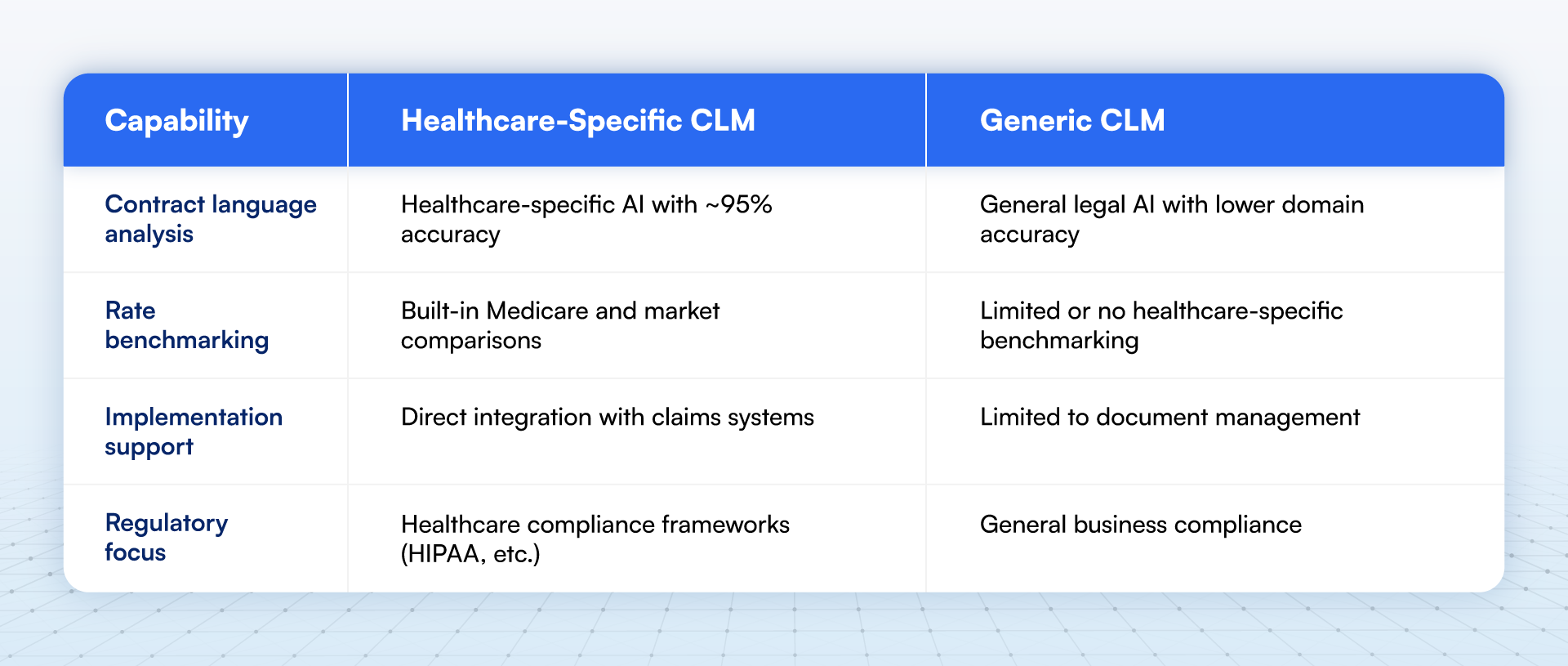
In the healthcare ecosystem, contracts don't exist in isolation—they directly influence claims processing, provider credentialing, and network management. A critical limitation of generic contract management software is its inability to connect contract terms with actual operational outcomes.
Effective healthcare CLM connects contract terms with provider and claims realities, allowing organizations to pass terms directly into claims adjudication systems—preventing the substantial revenue leakage that occurs when contracts and claims systems misalign.
For instance, healthcare-specific CLM can extract reimbursement terms from contracts and automatically configure them in claims systems, cutting configuration time from 6 days to minutes with over 80% automation. This level of integration simply isn't available in general-purpose solutions.
Beyond claims, healthcare CLM platforms can integrate with credentialing and provider data management systems. This cross-functional integration ensures consistency between contracted providers, credentialed providers, and network directories—addressing a major pain point in healthcare operations.
As health plans manage increasingly complex provider networks across multiple states, the ability to connect contract data with operational systems becomes not just beneficial but essential for maintaining accuracy, compliance, and financial integrity.
AI and Automation in Healthcare Contract Management
Artificial intelligence has fundamentally changed the landscape of healthcare contract management, enabling capabilities that were previously impossible with traditional methods. The integration of AI technologies into contract lifecycle management platforms is creating unprecedented opportunities for efficiency, accuracy, and strategic decision-making across healthcare organizations.
Automated Clause Suggestions
AI-powered healthcare contract management software can now analyze thousands of historical agreements to generate intelligent clause recommendations. These systems identify preferred language patterns based on previous successful contracts and organizational preferences.
When drafting new agreements or reviewing counterproposals, the software automatically suggests alternative clauses that may:
- Better protect the organization's interests
- Reduce potential compliance risks
- Align more closely with standardized language
- Close loopholes that could lead to revenue leakage
Negotiation support capabilities can extend this approach by promoting more standardized language across agreements. These suggestions help standardize language across agreements, resulting in more consistent interpretation and implementation.
AI-based Risk Scoring and Redlining
Modern contract management platforms employ sophisticated scoring systems to evaluate contract language. The PADU scoring methodology analyzes contracts across various dimensions, highlighting potential risks in proposed language.
This technology transforms the redlining process through:
- Side-by-side comparison of contract versions
- Automatic identification of substantive changes
- Tabular summaries highlighting both language and pricing differences
- Risk assessments based on deviation from preferred terms
Coupled with these capabilities, Rate Benchmarking modules evaluate proposed rates against competitors and market alternatives, while Contract Simulation modules assess financial impact across multiple pricing scenarios before implementation.
Natural Language Search and Summarization
One of the most powerful AI applications in healthcare contract management is natural language processing. The Intelligent Query Tool (IQT) enables users to retrieve and summarize information from complex contract documents using conversational queries.
Given that healthcare contracts often span hundreds of pages with complex language, this capability dramatically improves information accessibility. Users can simply ask questions like "What are the termination provisions in our contract with Provider X?" and receive precise answers in seconds rather than spending hours manually reviewing documents.
This technology delivers answers in real-time, improving compliance, supporting reporting needs, and reducing dependency on specialized contract teams. Under those circumstances, contract information becomes a true organizational asset rather than knowledge siloed within specific departments.
How AI-Powered CLM Improves Compliance, Accuracy, and Speed
The impact of AI-powered contract lifecycle management on healthcare operations is substantial:
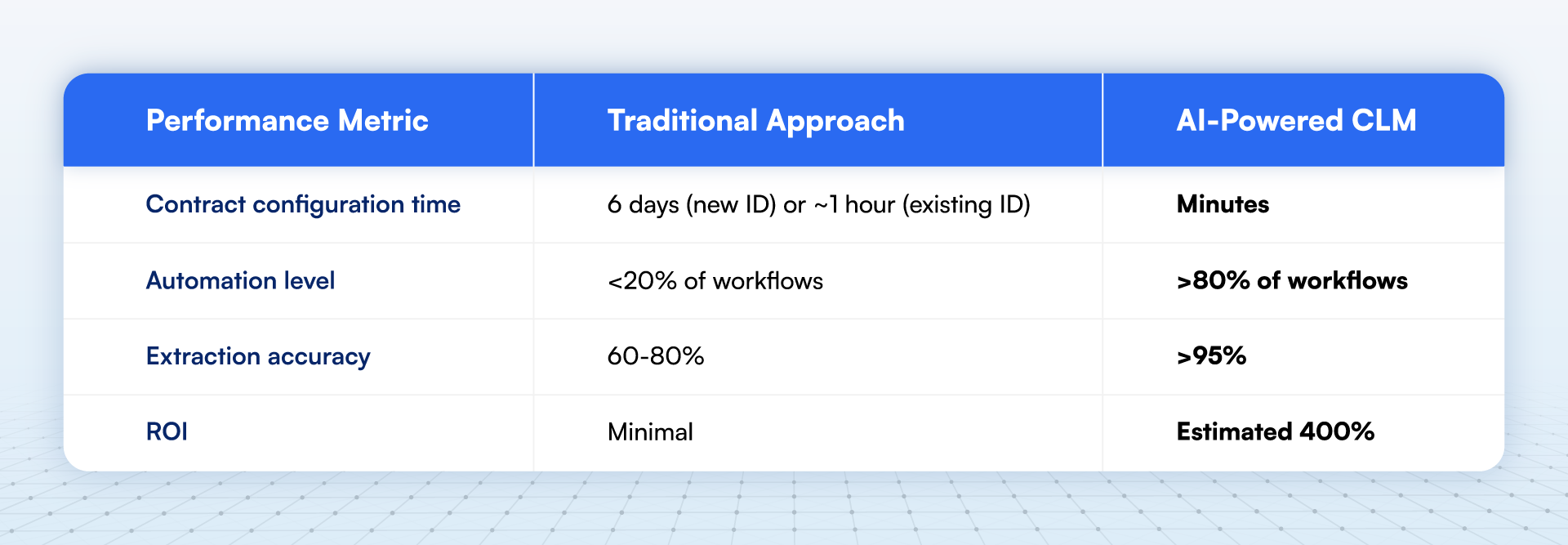
In essence, AI-powered contract management software delivers transformative improvements by eliminating manual effort in processes such as pricing configuration while enabling real-time contract analysis and language assistance. The technology integrates with claims systems, benchmarking datasets, and contract repositories to deliver comprehensive insights that were previously unattainable.
Prior to the adoption of ContractsAI, certain healthcare organizations struggled with the volume and complexity of contracts. Now they can manage over 500,000 contracts across 30+ states while maintaining over 95% accuracy in contract language extraction and achieving more than 80% automation.
Best Practices for AI-Powered Healthcare Contract Management
Implementing an effective healthcare contract management solution requires strategic planning and thoughtful execution. Even with powerful AI capabilities at your disposal, success still depends on establishing fundamental best practices that maximize your technology investment. Here are four essential approaches to optimize your healthcare contract management processes.
Centralize Contract Data
The foundation of effective contract lifecycle management begins with centralization. By creating a unified repository for all contract documents, healthcare organizations eliminate the fragmentation that typically causes delays and errors. Centralization reduces time spent locating the correct contract version and improves consistency in access across stakeholders.
Primarily, centralization offers these advantages:
- Provides a single source of truth for all stakeholders
- Enables comprehensive search capabilities across entire contract portfolios
- Creates audit trails that track all document interactions and changes
- Supports integration with other operational systems like claims and credentialing
As seen with ContractsAI, centralized repositories enable natural language queries across contracts and manuals, delivering answers in real-time and reducing dependency on contract teams.
Standardize Contract Templates and Clauses
Standardization serves as a powerful tool for improving both efficiency and compliance. Start by creating a library of pre-approved contract templates and clauses specific to different provider types and agreement categories.
When developing these resources, focus on standardizing language around high-risk areas like termination rights, payment terms, and compliance requirements. Subsequently, AI-powered contract management tools can compare new proposals against these standards, identifying potential issues before they become problems.
Negotiation support capabilities can provide side-by-side redlining and tabular summaries highlighting changes between versions. This capability helps maintain consistency while still allowing necessary customization.
Set Up Role-Based Contract Workflows
Thoughtful workflow design dramatically improves contract throughput while maintaining appropriate controls. Implement role-based access that directs contracts to appropriate stakeholders based on content, value, or risk profile.
Role-based review workflows can be extended to multi-level approvals as needed, where different teams (legal, finance, network management) review agreements based on predefined criteria. This approach simultaneously maintains governance while eliminating unnecessary bottlenecks.
Once negotiations are finalized, electronic signature workflows streamlines execution, avoiding the delays typically associated with paper-based processes.
Track Contract Performance and Compliance Metrics
Continuous measurement forms the backbone of ongoing optimization. Implement monitoring systems that track key performance indicators across your contract portfolio, including metrics like, contract turnaround time, pricing accuracy rates, renewal timeliness, and compliance adherence scores.
Use this performance data to identify improvement opportunities and refine your contracting processes. By tracking compliance metrics specifically, you can demonstrate readiness during audits and reduce regulatory exposure.
Leading healthcare contract management software enables performance tracking at both individual contract and portfolio levels, providing insights that drive continuous improvement throughout your contract ecosystem.
How HiLabs® ContractsAI Enables Intelligent Healthcare CLM
HiLabs® MCheck® ContractsAI stands at the forefront of healthcare contract management innovation, offering a comprehensive suite of AI-powered tools designed exclusively for the healthcare sector. This platform tackles the unique complexities of healthcare contracts through several specialized modules that work together to create an intelligent contract lifecycle management ecosystem.
At the core of the ContractsAI solution is an AI-driven data extraction engine that captures and structures information from complicated healthcare agreements. The Intelligent Query Tool (IQT) allows users to retrieve and summarize information from large contract documents through simple natural language queries, reducing manual review time.
Throughout the contract creation process, ContractsAI's Language Assist and Rate Benchmarking modules are designed to optimize both contract language and pricing to minimize value leakage. Negotiation Assist is designed to support negotiation workflows, including creating new contracts, renewing agreements, and managing amendments.
During negotiation workflows, ContractsAI can compare counterproposals against prior versions, examining both language and pricing differences. It provides side-by-side redlining alongside tabular summaries highlighting changes between versions. It can also support clause suggestions to promote more standardized language across agreements.
To accelerate financial analysis, the Rate Benchmarking module evaluates proposed rates against competitors and alternatives, whereas the Contract Simulation tool assesses potential financial outcomes across multiple pricing scenarios before implementation.
After finalizing terms, ContractsAI is designed to support role-based review workflows with role-based access controls, directing contracts to appropriate stakeholders based on predefined criteria. Further, electronic signature workflows integrate seamlessly into the execution stage, enabling faster and fully digital contract finalization.
The measurable impact of ContractsAI on healthcare contract management is substantial:
- Reduces pricing configuration time from 6 days to minutes
- Achieves over 80% automation of workflows
- Delivers approximately 400% return on investment
- Maintains exceptional accuracy (>95%) even with high volumes
By integrating AI-driven analysis with healthcare-specific functionality, HiLabs® ContractsAI transforms complex contract management into a strategic advantage for healthcare organizations.
Conclusion
Healthcare contract management directly influences financial performance, operational efficiency, and compliance across payer organizations. As contract portfolios grow in size and complexity, generic contract management approaches often fall short. Effective contract lifecycle management introduces structure through automation, healthcare-specific analysis, and operational workflows that reduce manual interpretation, pricing errors, and fragmented contract storage. The five stages of the contract lifecycle provide a practical framework for improving contracting operations, especially when supported by healthcare contract management software that enables structured review, clause analysis, and accessible contract intelligence.
Organizations that combine enterprise contract management software with disciplined operational practices—such as centralized contract repositories, standardized templates, role-based workflows, and performance tracking—gain measurable operational improvements. These approaches reduce configuration time, increase automation, and strengthen compliance readiness. As regulatory requirements expand and provider networks grow more complex, contract management healthcare software becomes essential infrastructure for payers seeking to manage agreements accurately, implement contract terms efficiently, and maintain operational control across contracting workflows.