



Why provider verification, continuous data intelligence and directory governance are becoming essential to network integrity, member access and regulatory compliance.
Introduction: The Network That Exists on Paper, but Not in Practice
A health plan may report thousands of participating providers across its network. Its directory may show specialists accepting new patients, multiple practice locations and broad geographic coverage. Yet when members attempt to schedule appointments, they discover that some providers have left the network, moved locations, stopped accepting new patients or never had an active contractual relationship with the plan.
These are the symptoms of a ghost network.
Ghost networks are not simply outdated provider directories. They represent a disconnect between a health plan's reported network and the actual availability of healthcare services to its members.
For health plans, the consequences extend well beyond inaccurate listings. They affect member access, provider experience, network adequacy assessments, regulatory exposure and the credibility of the organization's provider data.
The challenge is becoming more pressing as federal regulators increase their focus on provider directory accuracy and transparency. The U.S. Department of Health and Human Services (HHS) Office of Inspector General (OIG) has identified inactive providers in Medicare Advantage and Medicaid managed care directories, reinforcing the need for stronger network monitoring and provider verification.
Eliminating ghost networks requires a shift from periodic directory maintenance to continuous provider data intelligence.
1. Understanding Ghost Networks: A Growing Health Plan Challenge
A ghost network consists of providers listed as participating in a health plan's network who are, in practice, unavailable to members or do not meet the conditions represented in the directory.
Ghost providers may include:
- Physicians who have retired, relocated or left a participating practice.
- Providers whose contracts have expired or been terminated.
- Specialists who are listed as accepting new patients but are not.
- Providers who no longer practice at their published locations.
- Providers whose listed specialties or services are inaccurate.
- Practitioners who are technically affiliated with a group but do not accept the health plan's members.
- Duplicate provider records that artificially inflate network size.
The problem is particularly significant in behavioural health, where provider availability, appointment capacity and participation in insurance networks can be difficult to establish.
What the evidence tells us
A 2025 HHS OIG evaluation examined behavioural health provider networks across Medicare Advantage and Medicaid managed care plans.
The report found that:
- Many plans had limited behavioural health provider networks.
- Inactive providers were included in network directories, making networks appear larger than they were.
- Approximately 72% of the inactive behavioural health providers identified should not have been listed as network providers.
- Providers cited administrative burden and low payment rates among the reasons for not participating in managed care networks.
The report recommended that CMS use data to monitor provider networks and take additional steps to improve directory accuracy.
This highlights an important distinction: A provider's presence in a directory does not establish that the provider is available to deliver care to plan members.
2. Why Ghost Networks Persist: Five Root Causes
Ghost networks are rarely caused by a single system failure. They emerge from fragmented provider data, disconnected workflows, inconsistent verification practices and limited visibility into real-world provider availability.
A. Fragmented provider data across multiple systems
Health plans typically maintain provider information across credentialing platforms, provider data management systems, claims platforms, contracting applications, delegated entity databases and directory publishing tools.
When these systems are not synchronized, provider records can become inconsistent.
For example, a physician may have an updated practice address in the credentialing system while the public-facing directory continues displaying an outdated location.
Health plans need a unified provider data foundation that reconciles information across internal systems and external sources.
B. Manual and periodic provider verification
Many organizations rely on scheduled outreach, spreadsheets, emails and manual provider attestations to validate directory information.
These processes are inherently reactive. By the time a provider's information is confirmed, the underlying information may already have changed.
A 2024 study published in Health Affairs Scholar illustrates the persistence of this problem. Researchers re-examined 5,170 provider listings previously identified as inaccurate:
- 44.8% continued to show at least one inaccuracy.
- Only 11.6% were accurate at follow-up.
- 24.6% of providers could not be reached.
- Just 19% of the inaccurate listings had been removed.
The follow-up occurred 117–280 days after the initial survey.
Health plans need a continuous verification rather than relying exclusively on periodic outreach campaigns.
C. Limited visibility into provider participation
A provider may have an active NPI and valid professional license but may no longer accept a particular health plan’s member.
Similarly, a physician may remain affiliated with a medical group while no longer practicing at a specific location.
This distinction matters because provider identity, credential validity, contractual participation and actual appointment availability are separate data points.
Health plans need a multi-dimensional provider validation that checks participation status, practice locations, specialties, affiliations and patient acceptance.
D. Inconsistent data from delegated entities and provider groups
Health plans frequently depend on delegated credentialing organizations, medical groups, IPAs and other provider organizations to supply updated provider information.
When updates arrive in different formats, at different intervals and through different channels, maintaining a consistent provider directory becomes difficult.
Changes to provider participation may not propagate promptly across all downstream systems.
Health plans need a standardized provider data exchange, automated reconciliation and centralized visibility into delegated network changes.
E. Inadequate monitoring of provider availability
A directory can contain accurate names, addresses and specialties while still misleading members about actual access.
For example, a behavioural health specialist may be correctly listed at a practice but have no appointment availability for several months.
This exposes a critical limitation in traditional directory management: verifying that a provider exists is not the same as confirming that members can access that provider.
Health plans need a provider directory verification combined with access and availability monitoring.
3. Regulatory Pressure: Provider Directory Accuracy Is No Longer Optional
Provider directory accuracy is an important component of health plan compliance, particularly under the No Surprises Act and Medicare Advantage requirements.
Health plans must distinguish between directory accuracy, network adequacy and actual appointment availability. These are related but separate regulatory and operational responsibilities.
Key regulatory requirements
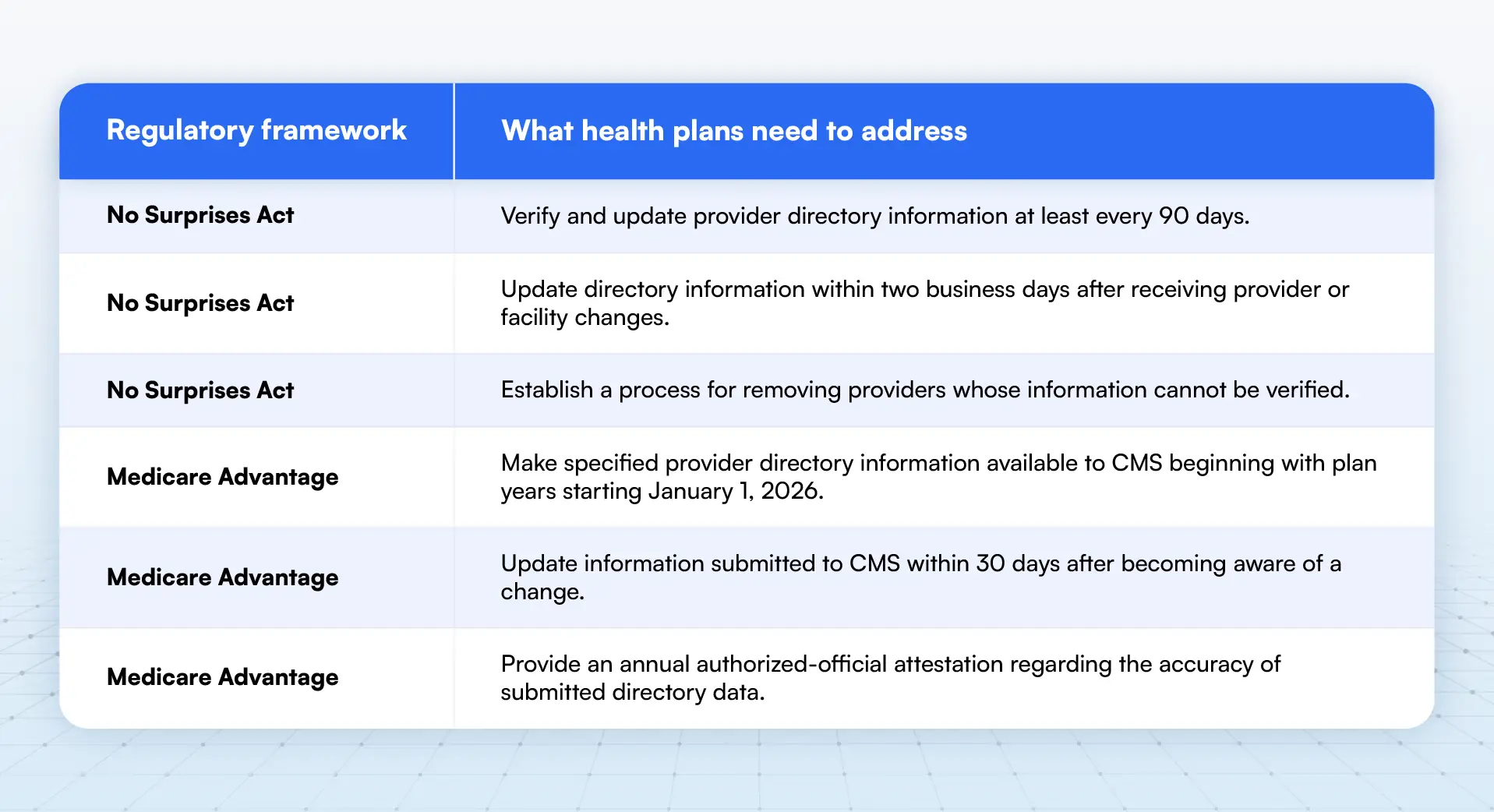
The No Surprises Act establishes a 90-day verification requirement and a two-business-day update requirement. These should not be confused with the Medicare Advantage CMS submission requirements.
What is changing for Medicare Advantage?
CMS has continued to strengthen provider directory transparency and oversight.
Its 2026 policy changes require Medicare Advantage organizations to make specified provider directory information available to CMS for publication through Medicare Plan Finder, with updates within 30 days of becoming aware of changes. CMS also finalized annual accuracy attestations by authorized officials.
Separately, CMS proposed additional requirements in October 2026, including more structured verification and accuracy measurement provisions for future contract years. These are proposals, not all currently effective requirements.
The executive implication: Health plans need to demonstrate not just that directories are published, but that provider information is maintained, verified, traceable and updated in accordance with applicable requirements.
4. How Health Plans Can Systematically Eliminate Ghost Networks
Eliminating ghost networks requires a structured approach that combines data cleansing, provider verification, automated monitoring and governance.
We recommend a five-step framework.
Step 1: Establish a unified provider data foundation
Begin by consolidating provider records across credentialing systems, claims platforms, provider rosters, contracting databases, delegated entities and external data sources.
The objective is to create a consistent provider record across the enterprise.
Key data elements should include:
- National Provider Identifier (NPI).
- Provider name and professional credentials.
- Specialty and taxonomy.
- Practice addresses and contact details.
- Group and facility affiliations.
- Contracting and participation status.
- Accepting-new-patients status.
- Provider license and credential status.
Provider identity resolution is critical. The same provider may appear across multiple systems with different identifiers, address formats or specialty descriptions.
Automated matching and deduplication can identify these inconsistencies and establish a more reliable provider record.
Step 2: Validate provider information using multiple sources
No single source provides a complete and continuously accurate picture of provider participation.
Health plans should combine information from:
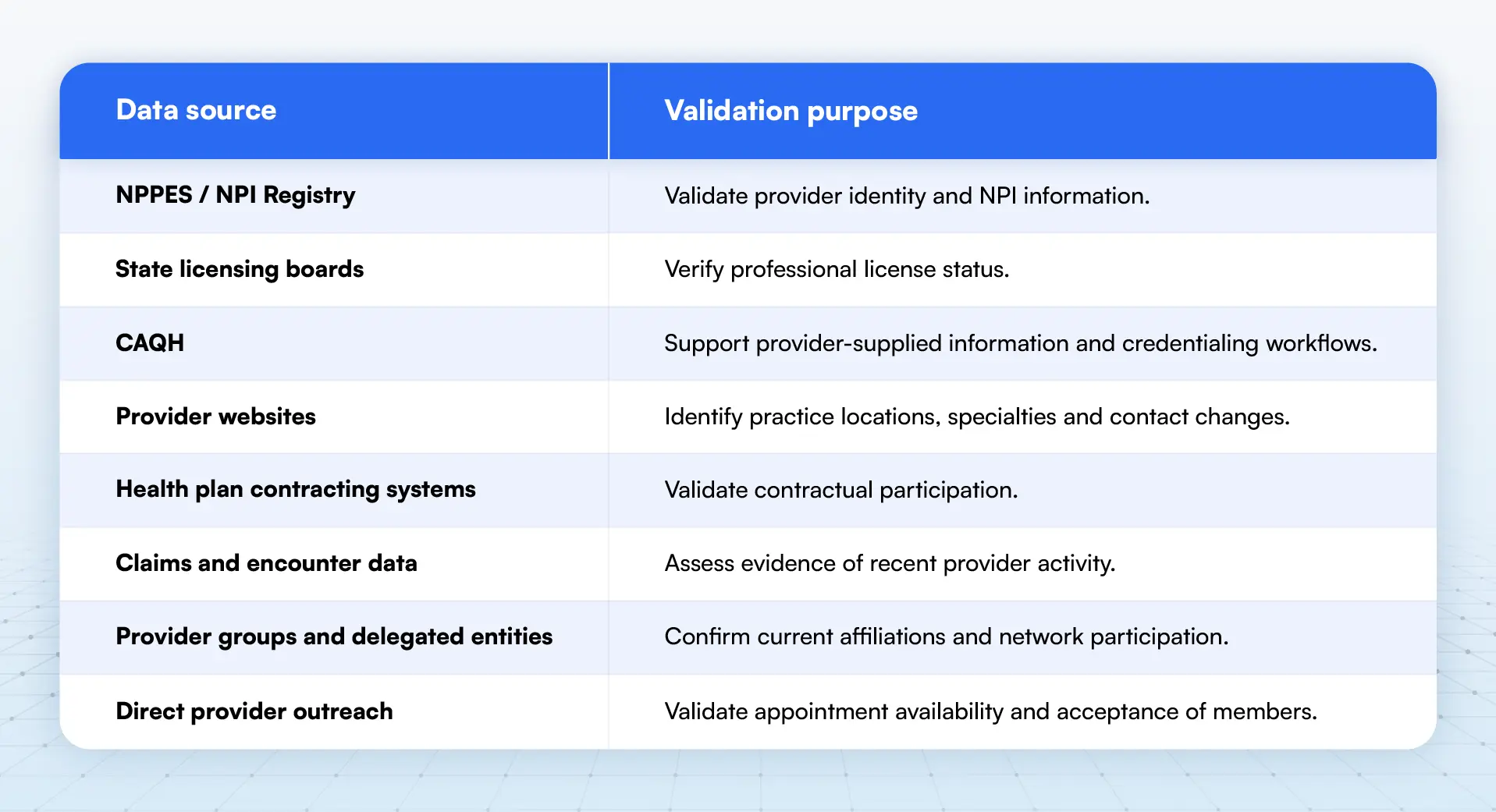
Each source provides a different level of evidence. For example, an active NPI does not establish an active health plan contract, and recent claims do not necessarily establish that a provider is accepting new patients.
A robust verification process should therefore evaluate source reliability, recency, relevance and consistency.
Step 3: Implement intelligent provider data cleansing
Once information is consolidated and verified, health plans should systematically identify records requiring correction, investigation or removal.
Automated cleansing should detect:
- Duplicate provider records.
- Inactive or expired licenses.
- Terminated provider contracts.
- Invalid or outdated practice addresses.
- Incorrect specialties and taxonomy classifications.
- Inconsistent provider affiliations.
- Missing or invalid contact information.
- Providers with conflicting participation status.
Advanced data matching and AI-assisted validation can help prioritize records based on the likelihood and potential impact of inaccuracies.
Importantly, automated systems should distinguish between confirmed inaccuracies and unresolved discrepancies. A provider should not be removed solely because an external source is incomplete or outdated.
Step 4: Establish continuous provider monitoring
A one-time directory cleanup will not eliminate ghost networks.
Provider information changes continuously as physicians relocate, change affiliations, modify specialties, leave practices or terminate contractual relationships.
Health plans should establish continuous monitoring across critical provider data elements.
An effective monitoring model should include:
- Scheduled verification aligned with applicable regulatory requirements.
- Event-based updates when providers, groups or facilities report changes.
- Automated detection of conflicting provider information.
- Prioritized verification of high-risk specialties and locations.
- Escalation workflows for unresolved discrepancies.
- Auditable records of verification, correction and publication.
The goal is to reduce the time between a provider information change and its reflection across all relevant directory channels.
Step 5: Introduce network integrity governance and accountability
Technology alone cannot eliminate ghost networks without clear operational ownership.
Health plans should establish a cross-functional governance framework involving provider network management, credentialing, compliance, provider data operations, IT and delegated network partners.
Key performance indicators should include:
- Provider directory accuracy rate.
- Percentage of provider records verified within the required period.
- Number of inactive providers identified and removed.
- Duplicate provider record rate.
- Provider data discrepancy resolution time.
- Percentage of providers with validated locations and specialties.
- Provider availability and appointment access rates.
- Time taken to publish confirmed provider changes.
These measures should be tracked at the plan, specialty, provider group and geographic market levels.
The objective should be to measure the integrity of the network members can access, not simply the number of providers listed in a directory.
5. Moving Beyond Directory Cleansing: The Role of AI and Clinical Data Intelligence
Traditional provider directory management systems are designed primarily to store, manage and publish provider information. While these capabilities are essential, they often do not address the underlying challenge: provider data is fragmented, constantly changing and difficult to validate at scale.
This is where AI-driven Provider Data Intelligence can make a meaningful difference.
Rather than treating provider verification as a periodic administrative activity, health plans can use intelligent data platforms to continuously evaluate provider information across multiple sources.

Five capabilities are particularly important:
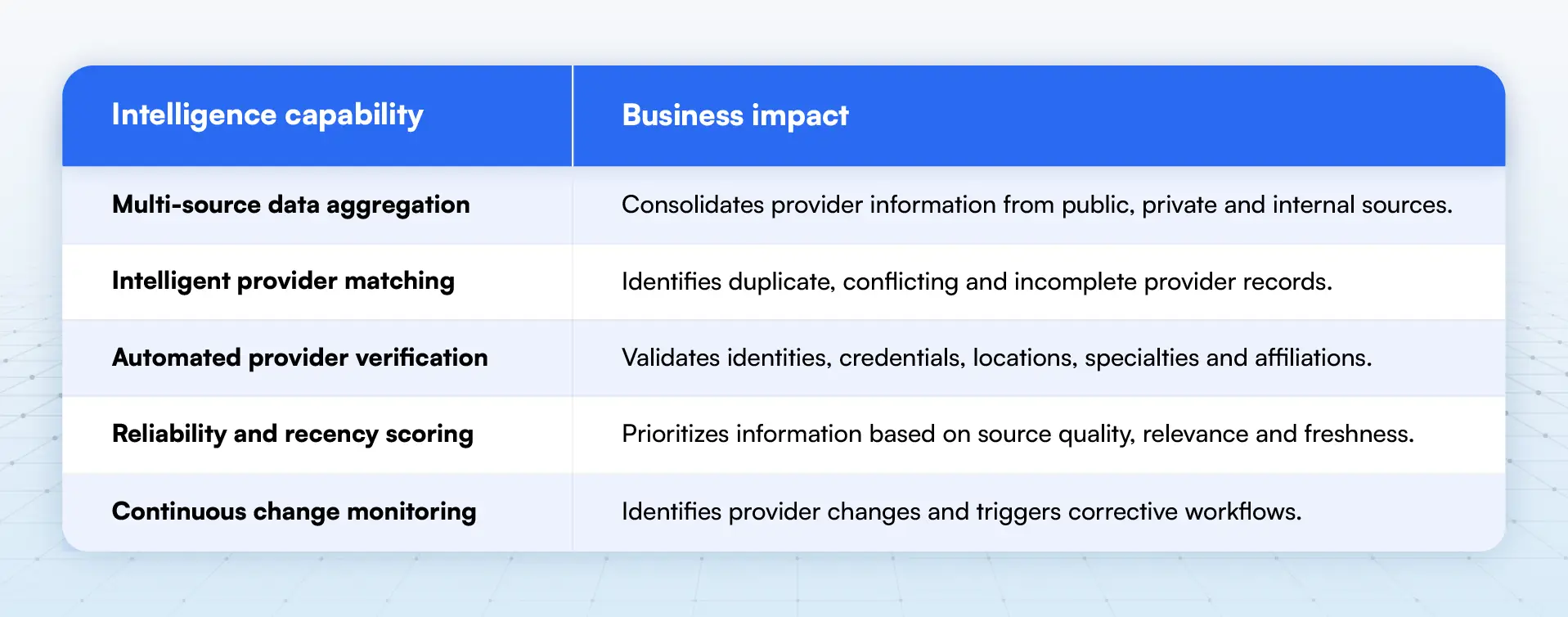
AI can also help identify patterns that traditional directory management systems may overlook.
For example, a provider listed at multiple locations may have conflicting addresses across public records, provider websites and health plan databases. An intelligent validation platform can identify the discrepancy, evaluate the supporting evidence and route the record for correction.
The result is a more proactive approach to provider network integrity.
6. How Health Plans Should Measure Success
Eliminating ghost networks should deliver measurable improvements across compliance, operational performance and member experience.
Health plan executives should evaluate their provider data management programs against the following metrics:
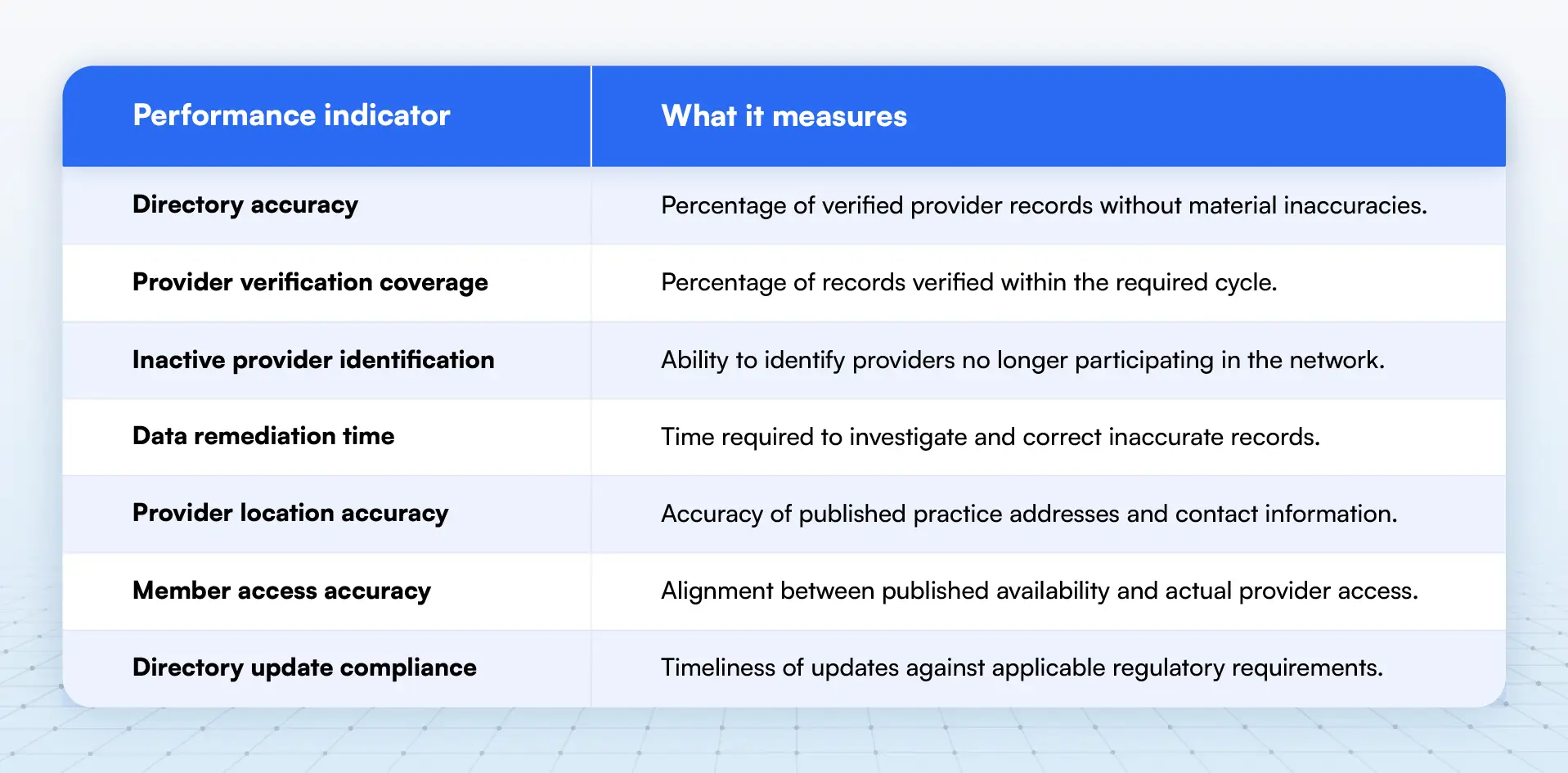
Health plans should establish baselines before setting improvement targets. Accuracy should also be measured across individual data elements, rather than relying on a single aggregate score that can conceal important gaps.
A particularly important distinction is that directory accuracy and network adequacy should be evaluated together but measured independently. A perfectly accurate directory can still reveal an inadequate network if too few providers are available in a particular specialty or geography.
7. The HiLabs Perspective: Building Intelligent, Trusted Provider Networks
At HiLabs, we believe provider network integrity starts with trusted provider data.
Our MCheck® Provider Data Accuracy (PDA) capabilities are designed to help health plans move beyond fragmented provider records and manual verification processes toward continuous, intelligence-driven provider data management.
Using AI and large language model-powered algorithms, HiLabs brings together information from public and private sources to validate provider information across critical data elements.
The platform supports:
- Multi-source provider intelligence: Aggregating information from claims, provider rosters, government databases, clinical sources and the broader web.
- Intelligent data validation: Applying more than 200 checks across 60+ critical provider data elements.
- Reliability and recency scoring: Evaluating provider information based on source relevance, reliability and freshness.
- Continuous provider monitoring: Identifying changes and discrepancies that require attention.
- Actionable data insights: Helping provider network teams prioritize remediation and improve the quality of their provider information.
The objective is not simply to maintain a cleaner provider directory. It is to give health plans a more reliable understanding of their provider networks and the information members use to access care.
Conclusion: The Future of Network Integrity Is Continuous Intelligence
Ghost networks expose a fundamental weakness in traditional provider data management: the assumption that information captured at one point in time remains accurate as healthcare networks evolve.
For health plans, eliminating ghost networks requires more than periodic provider outreach, directory audits or manual data cleansing. It requires a continuous approach to provider verification, intelligent data reconciliation and network monitoring.
As regulatory expectations evolve and members demand more reliable access to care, health plans must rethink how they manage provider information.
The new age provider network management will not be defined by how many providers appear in a directory, but by how accurately health plans understand, validate and maintain the networks members can access.