


Not all revenue leakage looks like leakage. Health plans have spent years building payment integrity teams, claims analytics platforms, and coding audits that are very good at catching money that was already paid incorrectly. Those systems are designed to catch transactions that already happened and went wrong.
There is a second category of loss that rarely shows up on a payment integrity dashboard: revenue that should have been captured but never was, because the clinical evidence behind it was never found, interpreted, or acted on in time. A diagnosis can sit inside a physician's note and never reach a structured field. A risk adjusting condition can have clear clinical support and never get reviewed. A completed cancer screening can sit buried in a scanned attachment that a quality team never opens. Evidence needed to close a HEDIS gap can technically exist in the record and still go unread. Clinical information can arrive weeks after the submission deadline it was meant to support.
For health plans, healthcare revenue leakage increasingly starts upstream, inside clinical data that is fragmented, unstructured, delayed, or simply overlooked. That is where Clinical Data Intelligence (CDI) becomes a financial capability for a health plan, not only a data capability.
Revenue leakage is bigger than a payment problem
Traditional leakage controls start too far downstream
Most payer revenue protection programs focus on what happens after a claim or chart already sits inside a structured system: payment integrity, fraud waste and abuse detection, coding validation, denial management, contract reconciliation, and overpayment recovery. These functions matter, and the dollars at stake are real. On the provider side, a 2026 benchmarking analysis of more than 2,300 hospitals found that net revenue leakage from denials and bad debt jumped roughly 25%, from $38.6 billion in 2024 to $48.4 billion in 2025, driven largely by a rise in clinical denials tied to missing prior authorizations and disputed medical necessity.
Payers sit on the other side of that same relationship, and the underlying pattern holds regardless of which side of the transaction a team sits on, most revenue protection infrastructure only examines information that has already made it into a structured system. What happens to the evidence that never gets that far?
The revenue that never becomes visible
Instead of clawing back an incorrect payment, plans need a way to find clinical evidence that already existed somewhere in their data but was never translated into an actionable diagnosis, a closed gap, or a sound utilization decision. This is health plan revenue leakage in its least visible form, and it rarely shows up until someone goes looking for it.
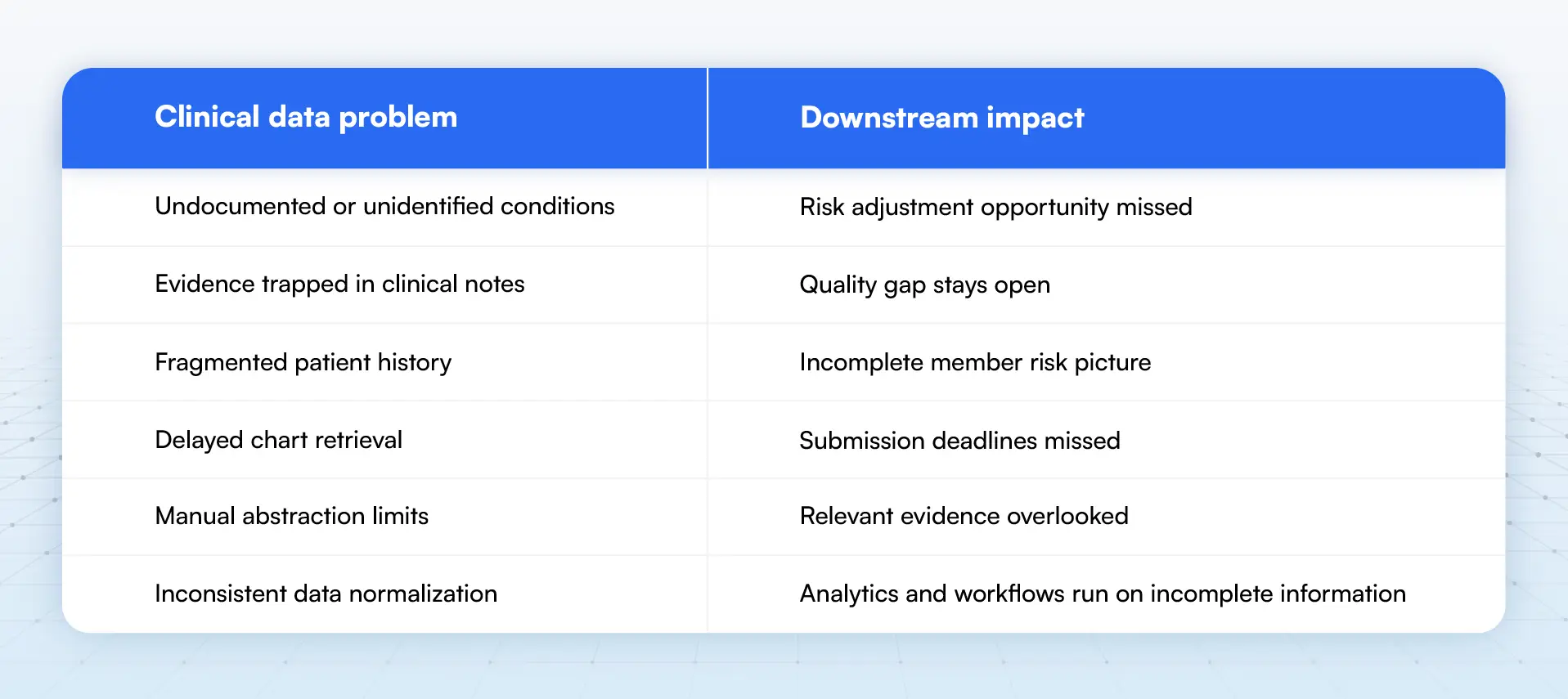
Revenue leakage often starts long before a claim is ever paid.
The hidden asset sitting inside health plan data
Health plans already sit on an enormous, diverse pool of clinical information: EHR extracts, medical charts, physician notes, lab results, discharge summaries, CCD and C-CDA documents, PDFs, scanned records, supplemental clinical data, claims, pharmacy data, encounter data, and health information exchange feeds. The limiting factor is not access to data. It is turning that raw material into usable clinical intelligence.
Having the data is not the same as understanding it
A single chart can run dozens or hundreds of pages, and the evidence a specific workflow needs might be one sentence, one lab value, one date, one diagnosis, or one medication. Research on electronic health records consistently finds that somewhere between 70% and 80% of the clinically meaningful content in a patient record lives in unstructured clinical data, meaning free text such as physician notes, imaging reports, and discharge summaries, largely outside the reach of standard clinical data analytics tools. A system can store that document perfectly and still fail to answer the questions that actually matter - which conditions are clinically supported, which quality measures already have supporting evidence, which suspected gaps are genuinely closed, which members need further outreach, and which findings should route to a human reviewer.
Data becomes financially valuable only when a plan can turn it into action.
Five places revenue can leak through clinical data blind spots
1. Risk adjustment
Incomplete clinical visibility distorts how accurately a plan's risk pool reflects the population it covers. Conditions get documented but never surfaced, relevant evidence sits scattered across multiple records, diagnosis recapture opportunities go unreviewed, and manual chart review cannot realistically cover an entire membership base on its own. The industry-level stakes are large. MedPAC estimated that differential coding practices led CMS to overpay Medicare Advantage plans by roughly $50 billion, or about 13%, in 2024, and separate projections put coding-intensity-related MA overpayments climbing toward $40 billion a year, up from $23 billion in 2023. That gap between documented risk and actual risk is risk adjustment revenue leakage in its purest form, and it cuts in both directions: some conditions go uncaptured while others get overcoded.
CDI should surface clinically supported evidence for appropriate validation, not manufacture unsupported revenue. Used correctly, it helps plans identify and validate conditions that are already documented in the chart but sitting outside structured workflows, which is a materially different exercise from aggressive upcoding, and one regulators are scrutinizing more closely through RADV audits and the phased rollout of the CMS-HCC V28 model.
2. Quality and HEDIS
Clinical evidence can prove a member already received required care, a colorectal cancer screening, an HbA1c test, a controlled blood pressure reading, an immunization, medication management, a follow-up visit, but if that evidence never reaches the quality team in a usable form, the measure stays open. A report estimates that 20% to 30% of medical records contain documentation gaps that hurt quality reporting and reimbursement. One national health plan's 2024 results illustrate the scale of what is possible: strengthening clinical data ingestion accounted for 29% of that plan's member gap closures across 11 HEDIS measures, including controlling blood pressure, HbA1c control, colorectal cancer screening, care for older adults, and breast cancer screening, an improvement that translated into an estimated $128 million in incremental annual revenue and touched 680,000 members. That is HEDIS gap closure driven almost entirely by better clinical data, not by additional member outreach.
There is a double cost to getting this wrong. Plans miss quality credit they have already earned through care that was delivered, and they spend money on outreach for care that technically already happened.
3. Chart abstraction
Traditional abstraction is still labor intensive. Large chart volumes, inconsistent document formats, reviewer fatigue, tight turnaround windows, and expensive clinical labor combine to force a trade-off: review more charts and drive up cost, or review fewer charts and risk leaving valid evidence undiscovered. AI-driven clinical data extraction changes that math by widening the volume of documents a plan can realistically analyze while routing only the relevant evidence to human reviewers. One plan that modernized its clinical data ingestion process cut business review time on ingested records by 90%, from two to three weeks down to one to two days.
4. Utilization management
Incomplete clinical context drives unnecessary manual review, slower decisions, inefficient prior authorization, avoidable back and forth with providers, and inconsistent outcomes across similar cases. The scale of that burden is significant. The AMA's 2025 prior authorization and utilization management reform progress report put annual US manual prior authorization administrative costs at roughly $35 billion, and Medicare Advantage insurers alone received nearly 53 million prior authorization requests in 2024, a 6.4% increase over 2023. New CMS interoperability rules will require standardized electronic prior authorization workflows by 2027, but the underlying clinical evidence still has to be found, interpreted, and organized around the decision at hand before any API can move it faster. CDI does that work upfront, so utilization management teams are not searching across systems for evidence that already exists somewhere in the record.
5. Member and population level opportunity identification
Leakage does not happen one chart at a time. Plans also need visibility into where opportunity concentrates across an entire membership: which populations carry unresolved evidence, where documentation gaps cluster, which members genuinely warrant chart review, which gaps can already be resolved from data the plan already holds, and where outreach is actually necessary rather than redundant. That shift moves clinical intelligence from retrospective, chart by chart abstraction toward proactive, population level analysis, and it is where payer revenue optimization stops being a project and starts being a standing capability.

How MCheck Clinical puts this into practice
The ingest, normalize, understand, validate, activate sequence described above is not a theoretical model. It's the workflow HiLabs built into MCheck® Clinical, an AI-powered clinical data standardization platform designed for exactly the blind spots described in this article.
MCheck Clinical accepts clinical files in any format, HL7 v2, CDA, flat files, PDFs, and FHIR bundles, and uses AI auto-mapping instead of static templates, so the platform adapts as provider formats change instead of breaking every time a new file layout shows up. Extracted data passes through more than 2,000 clinical and operational validation checks before it reaches a downstream system, and a single ingestion pass can produce simultaneous, tailored outputs for HEDIS, risk adjustment, care management, and utilization management, which is the "one clinical intelligence layer, multiple returns" idea running in production.
At scale, the platform has processed more than 40 billion clinical records and standardized data from over 1,300 distinct sources, at a reported 94% accuracy in file standardization. One national Blue Plan that replaced its rules-based ingestion workflow with MCheck Clinical cut internal processing costs by more than $3 million a year while moving from manual template maintenance to AI-driven mapping that keeps pace with format changes on its own.
For a health plan working through the kind of clinical data blind spots described above, this is the practical starting point: a platform built to turn fragmented clinical data into standardized, audit-ready, multi-use output without adding headcount to the abstraction team.
Book a demo of MCheck Clinical to see how it handles your plan's own clinical files.
Why traditional approaches keep missing the problem
Rules alone struggle with unstructured clinical complexity
Clinical language carries context, negation, timing, abbreviations, and sometimes conflicting information across diagnoses, procedures, medications, and results. A keyword appearing in a chart is not the same thing as clinical evidence, and rules-based logic built for structured fields tends to break down against free text.
Manual abstraction cannot scale indefinitely
Even strong clinical review teams have finite capacity. As chart volumes grow, simply adding headcount runs into cost and turnaround limits long before it solves the underlying visibility problem.
Point solutions create fragmented intelligence
Plans often run separate tools for quality, risk adjustment, utilization management, chart retrieval, coding, and clinical data analytics, even though much of the underlying clinical evidence overlaps across all of them. The same clinical record can hold information relevant to several payer workflows at once. Without a shared intelligence layer, plans end up recreating the same health plan revenue leakage problem in every department that touches clinical data instead of building something reusable.
Clinical Data Intelligence changes the economics
Clinical Data Ingestion transforms fragmented structured and unstructured healthcare data into validated, contextualized, workflow ready insight. In practice, that happens across five stages.
Ingest. Bring together structured and unstructured clinical data from the many sources a plan receives it from, often thousands of provider systems, each using a different format and schema.
Normalize. Standardize formats, terminology, member context, dates, and clinical concepts so information from different sources can be compared.
Understand. Apply AI that interprets clinical context rather than matching keywords, identifying diagnoses, procedures, medications, lab values, clinical events, dates, supporting evidence, negation, and the relationships between them.
Validate. Apply clinical logic, confidence thresholds, and human review where the evidence calls for it, rather than accepting every extracted data point automatically.
Activate. Route the resulting intelligence into the workflows that actually use it: risk adjustment, quality, chart abstraction, utilization management, and population analytics.
The goal is not simply to digitize charts faster. It is to make clinical evidence computable, reusable, and usable across every workflow that depends on it. This is where the industry's broader AI investment is heading. A Report found that 94% of payers have now adopted some form of AI, with prior authorization and claims adjudication among the highest impact use cases, and the Peterson Health Technology Institute has flagged administrative waste across health systems and plans at roughly $350 billion a year, a scale large enough that even modest gains in healthcare data intelligence translate into meaningful dollars. PHTI's April 2026 research also cautions that applying AI to a fundamentally inefficient process does not automatically produce savings, which is exactly why the sequence above, ingest, normalize, understand, validate, activate, matters more than the underlying model alone.

From finding more data to finding the revenue at risk
A mature CDI strategy should change the questions a plan asks itself. Instead of “how many charts did we process,” ask “how much actionable clinical evidence did we uncover.” Instead of “how fast can we abstract a chart,” ask “how quickly does validated evidence reach the workflow where it can actually change an outcome.”
A useful KPI framework for tracking that shift includes:
- Clinical evidence identification rate
- Chart processing turnaround time
- Manual review reduction
- HEDIS gaps resolved from existing clinical data
- Risk adjustment opportunities surfaced for validation
- Avoided unnecessary outreach
- Reviewer productivity
- Cost per chart
- Revenue or value protected
- Time from data receipt to actionable insight
Clinical Data Ingestion should ultimately be measured against financial and clinical outcomes, not against how much data got processed. A plan that abstracts more charts but surfaces no new evidence has not actually improved health plan reimbursement outcomes. It has only moved paper faster.
The real opportunity: one clinical intelligence layer, multiple returns
Health plans should not need to re-extract the same clinical information separately for every downstream function. A reusable clinical intelligence layer lets the same underlying evidence support multiple workflows at once. A single longitudinal member record can contribute evidence relevant to risk adjustment, quality, utilization management, care management, and population analytics, all from one pass through the data.
That creates compounding value. Instead of building separate pipelines around each individual use case, a plan builds one common clinical intelligence foundation and lets multiple teams draw from it. Over time, that foundation becomes durable healthcare data intelligence infrastructure for financial performance rather than a point solution tied to a single department's budget cycle, and it is the clearest path to sustainable payer revenue optimization at scale.
Healthcare revenue leakage you can't see is still revenue leakage
Health plans cannot fully protect their revenue by looking only at what already appears in claims and structured fields. Some of the most consequential evidence a plan needs may already sit inside its own clinical data, invisible to the downstream workflows that depend on it.
Three things are true at once. The data exists. The evidence exists. The real challenge is finding it at scale and putting it to work. As payer economics tighten and CMS continues to reshape risk adjustment and prior authorization rules, the more useful question is not whether a plan has enough data. It is how much value is still trapped inside the data it already owns.
CDI gives health plans a way to turn previously hidden clinical evidence into measurable financial and operational value that helps avoid healthcare revenue leakage.
