



The Context
For health plans, audit risk for health plans is no longer confined to coding accuracy, claims adjudication, or risk adjustment submissions. Increasingly, regulators are scrutinizing the underlying processes, controls, and governance mechanisms that support compliance across the enterprise. As CMS expands audit activity and oversight expectations continue to rise, health plans are discovering that inadequate healthcare contract governance remains one of the most overlooked sources of exposure within provider contracts.
Completed CMS audits have identified 5%–8% overpayments in audited contracts. This statistic reinforces why auditors are increasingly focused on governance, documentation, and operational controls.
Provider contracts govern billions of dollars in reimbursement, quality incentives, delegated responsibilities, network participation requirements, and value-based care arrangements. Yet despite their strategic importance, many organizations continue to manage contracts through fragmented repositories, shared drives, manual reviews, spreadsheets, and disconnected operational systems. The result is a governance gap that can create compliance exposure, financial leakage, operational inefficiencies, and audit vulnerability.
The stakes are growing. CMS has announced a significant expansion of its Medicare Advantage audit activities, including plans to audit all eligible Medicare Advantage contracts annually while dramatically increasing audit resources and technology investments. The agency has made it clear that it intends to strengthen oversight and ensure health plans are accurately administering and reporting program requirements. For payer executives, audit risk for health plans has shifted from a periodic compliance exercise to a continuous accountability mandate.
The Problem with Contract Governance for Health Plans
Recent audit findings illustrate the consequences of inadequate governance controls. Multiple Office of Inspector General (OIG) audits have identified widespread deficiencies in documentation, validation, and compliance processes across Medicare Advantage organizations. In one audit, OIG found that most of the sampled diagnosis codes submitted by a Medicare Advantage organization were not supported by medical records, resulting in estimated overpayments and recommendations for stronger compliance controls. Similar findings have been reported across multiple health plans, highlighting the importance of robust governance frameworks that can withstand regulatory scrutiny.
While these audits often focus on risk adjustment and payment integrity, the root cause frequently extends beyond coding. Auditors increasingly seek evidence that organizations can demonstrate how contractual obligations are interpreted, operationalized, monitored, and enforced. When provider agreements, amendments, fee schedules, delegation arrangements, and value-based care terms are scattered across disparate systems, answering seemingly straightforward audit questions becomes difficult. Which reimbursement methodology is currently active? Have all amendments been incorporated into operational workflows? Are delegated entities meeting contractual obligations? Can the organization quickly produce supporting documentation during an audit?
For many health plans, the answer requires weeks of manual effort involving legal, compliance, provider relations, finance, and operations teams. This reactive approach not only increases administrative burden but also introduces the risk of inconsistent interpretations, missing documentation, and delayed responses during regulatory reviews.
The challenge is compounded by the growing complexity of payer-provider relationships. Modern provider agreements often contain hundreds of pages of contractual language governing reimbursement methodologies, quality incentives, risk-sharing arrangements, credentialing obligations, network participation requirements, and regulatory provisions. As value-based care programs expand, contracts are becoming increasingly dynamic, requiring continuous monitoring rather than annual reviews.
Research from World Commerce & Contracting estimates that organizations lose an average of 9.2% of annual revenue due to poor contract management, missed obligations, ineffective governance, and execution failures.
The Solution
This is where healthcare contract governance is emerging as a strategic capability for leading health plans. By deploying contract intelligence tools, organizations can automatically identify and extract critical terms, reimbursement provisions, quality metrics, termination clauses, delegation requirements, and compliance obligations across their entire provider agreement portfolio. Contract amendments can be linked to parent agreements, enabling organizations to establish a single source of truth across the enterprise. Operational teams gain visibility into contractual commitments before they become compliance issues.
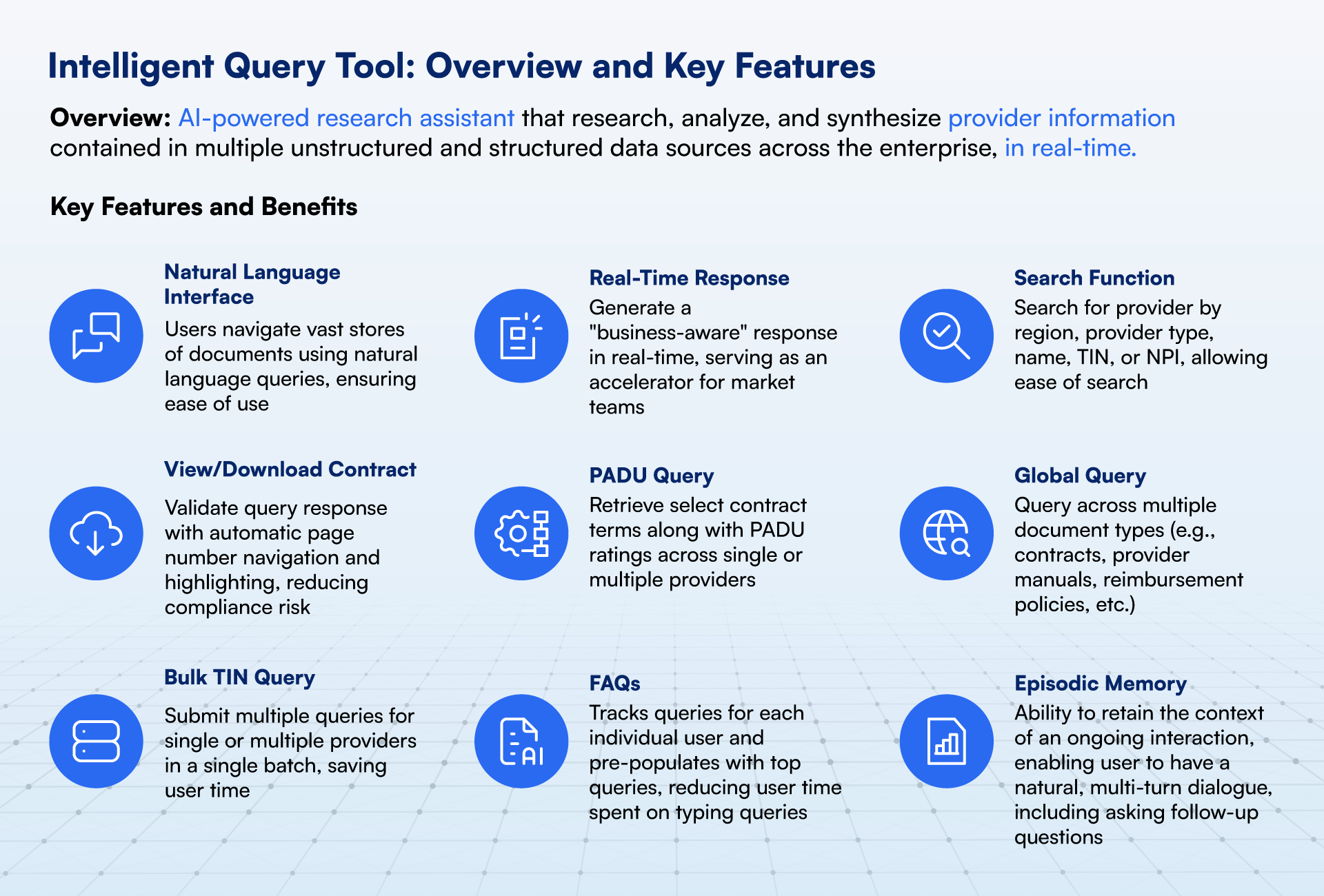
The MCheck® ContractsAI solution from HiLabs is purpose-built to drive this transformation. Its Intelligent Query Tool allows compliance, legal, and operations teams to query contract provisions in plain language — surfacing the exact terms, obligations, and reimbursement rules that matter most during audits and day-to-day operations.

Contract governance automation enables continuous compliance monitoring rather than waiting for an auditor to uncover inconsistencies. Health plans can proactively identify expired agreements, missing amendments, conflicting provisions, reimbursement discrepancies, and potential policy violations. This shift from reactive audit preparation to proactive governance significantly reduces organizational risk.
The financial implications are equally compelling. Contract ambiguity and inconsistent implementation often contribute to payment disputes, provider abrasion, administrative rework, and revenue leakage. By creating transparency between contract terms and operational execution, health plans can strengthen payment integrity, reduce manual intervention, and improve provider relationships. In an era where many payer executives are focused on margin recovery and operational efficiency, reducing avoidable administrative costs has become a strategic imperative.
The Road Ahead
Audit risk for health plans will only grow as CMS expands its annual audit program across all eligible Medicare Advantage contracts. Audit readiness is no longer a compliance exercise conducted a few months before regulators arrive — it is an operational discipline that requires continuous visibility into contractual obligations, governance controls, and business processes. Organizations that continue to rely on manual contract management approaches will find it increasingly difficult to keep pace with regulatory expectations and network complexity.
The future belongs to health plans that treat contracts not merely as legal documents, but as enterprise assets that drive compliance, financial performance, and operational integrity — and that invest in contract governance for health plans as a core operational capability. Healthcare contract governance provides the foundation for that transformation. By creating a transparent, searchable, and continuously monitored contract ecosystem, health plans can reduce audit risk, strengthen compliance, improve operational efficiency, and build greater confidence in their ability to meet the demands of an increasingly regulated environment.
The best audit outcome is not simply passing an audit. It is having the confidence that your organization is prepared every day — not just when auditors arrive.