


As quality, risk, and regulatory demands intensify, health plans must rethink medical records review as a strategic capability and not an administrative process.
For decades, medical records review has been viewed primarily as an operational necessity, a function designed to support HEDIS abstraction, risk adjustment validation, audit response, and compliance reporting. Yet that perspective is becoming increasingly outdated.
NCQA reports that over 235 million individuals are enrolled in health plans that submit HEDIS performance measures. Many HEDIS measures require clinical documentation obtained through chart review rather than claims data alone.
Today, health plans operate in an environment where clinical documentation directly influences billions of dollars in reimbursement, quality incentives, regulatory performance, and member outcomes. As value-based care expands and regulatory scrutiny intensifies, the ability to efficiently acquire, analyze, and operationalize clinical information has become a strategic differentiator.
Medical records are no longer simply evidence repositories. They are among the richest sources of clinical intelligence available to health plans.
The challenge is that most organizations remain poorly positioned to unlock this value.
The growing importance of clinical data in medical records review
Health plans have spent the last decade investing heavily in claims analytics, digital member engagement, and care management transformation. Yet claims data alone provides only a partial view of healthcare delivery.
Claims answer the question of what services were billed. Medical records answer the more important question: what happened clinically?
The distinction matters.
Clinical data extraction from medical records validates diagnoses used for risk adjustment. It provides evidence required for quality reporting. It reveals care gaps that claims data may never capture. It supports utilization management decisions, payment integrity reviews, and regulatory audits. In many cases, it is the only source capable of substantiating key business decisions.
This dependence on medical records is becoming more pronounced as CMS expands oversight of Medicare Advantage risk adjustment programs and as quality measurement programs increasingly rely on clinical evidence rather than administrative data alone.
CMS states that RADV audits are the primary mechanism for validating diagnoses submitted for Medicare Advantage risk adjustment. CMS audit findings indicate unsupported diagnoses may contribute to approximately $17 billion annually in Medicare Advantage overpayments.
For health plans, access to accurate and timely clinical documentation is no longer optional. It is foundational.
An increasingly expensive operating model for medical records review
Despite its growing strategic importance, medical records review remains one of the most fragmented and labor-intensive functions within payer operations.
Most health plans continue to rely on a complex ecosystem of provider outreach teams, chart retrieval vendors, manual chart review processes, fax-based communication channels, and disconnected workflows.
The result is a costly operating model characterized by:
- High retrieval costs
- Long cycle times
- Variable provider responsiveness
- Limited operational visibility
- Significant administrative burden
The challenge is compounded by the scale of the task. Large national health plans may request and process millions of medical records annually across risk adjustment, quality, payment integrity, and care management programs.
At the same time, providers face increasing request volumes from multiple stakeholders, creating friction throughout the healthcare ecosystem. The current model is becoming increasingly difficult to sustain.
Why are the economics of medical records review changing?
Several forces are converging to elevate medical records review from an operational concern to a boardroom issue.
First, risk adjustment continues to represent one of the largest revenue levers for Medicare Advantage organizations. As CMS expands Risk Adjustment Data Validation (RADV) audits and pursues greater payment accuracy, plans face growing pressure to ensure that every submitted diagnosis is supported by complete and compliant documentation.
CMS announced plans to significantly expand RADV oversight, increasing audits from roughly 60 Medicare Advantage plans per year to all eligible plans (approximately 550 plans annually). CMS is also increasing chart sample sizes from 35 records to as many as 200 records per plan.
Second, quality performance increasingly influences competitive positioning. Star Ratings, HEDIS measures, and value-based care arrangements all depend on accurate clinical evidence. Missing documentation can translate directly into lost quality incentives, reduced bonus payments, and diminished market performance.
Third, administrative costs remain under pressure. The healthcare industry continues to devote substantial resources to manual data exchange and record retrieval activities. Industry analyses from CAQH suggest that billions of dollars in additional savings remain available through chart review automation and broader automation of administrative workflows.
Together, these forces are fundamentally changing the economics of medical records review.
The question is no longer whether plans can retrieve records. The question is whether they can do so efficiently enough to create enterprise value.
The emergence of Medical Records Intelligence through clinical data analysis
Leading organizations are beginning to reframe medical records review through a different lens. Instead of viewing records as documents that must be collected, they are treating them as assets that must be transformed into intelligence.
This shift is giving rise to what can be described as Medical Records Intelligence — a capability that combines provider outreach, clinical data ingestion, artificial intelligence, workflow orchestration, and analytics into a unified operating model.
Under this approach, health plans focus on three strategic objectives:
- Acquire clinical information more efficiently. Advanced provider intelligence, automated outreach, and digital retrieval channels reduce retrieval costs while improving provider engagement.
- Extract insights more effectively. Clinical data extraction and analysis powered by artificial intelligence and natural language processing can identify diagnoses, quality measure evidence, clinical indicators, and care gaps from unstructured documentation at scale.
- Activate information more rapidly. Clinical insights can be integrated directly into risk adjustment, quality improvement, payment integrity, and care management workflows, accelerating decision-making across the enterprise.
The result is a transition from retrospective chart review to real-time operational intelligence.
From seasonal chart review to enterprise medical records review capability
Historically, medical records review has been organized around seasonal initiatives — HEDIS campaigns, risk adjustment projects, audit requests, and retrospective reviews.
That model is increasingly incompatible with modern healthcare operations.
The next generation of health plans will build persistent clinical intelligence capabilities that operate continuously throughout the year. These capabilities will leverage chart review automation, interoperability, and AI to create a dynamic flow of clinical information across the organization.
Rather than supporting a single department, medical records intelligence will become a shared enterprise asset supporting:
- Risk adjustment
- Quality improvement
- Network management
- Care management
- Payment integrity
- Regulatory compliance
- Population health
Organizations that successfully integrate these functions will create substantial operational leverage while improving data quality and reducing administrative burden.
MRR Transformation Driven by HiLabs
HiLabs offers a purpose-built alternative — an end-to-end AI platform named MCheck® Clinical designed specifically for payer medical records review and beyond.
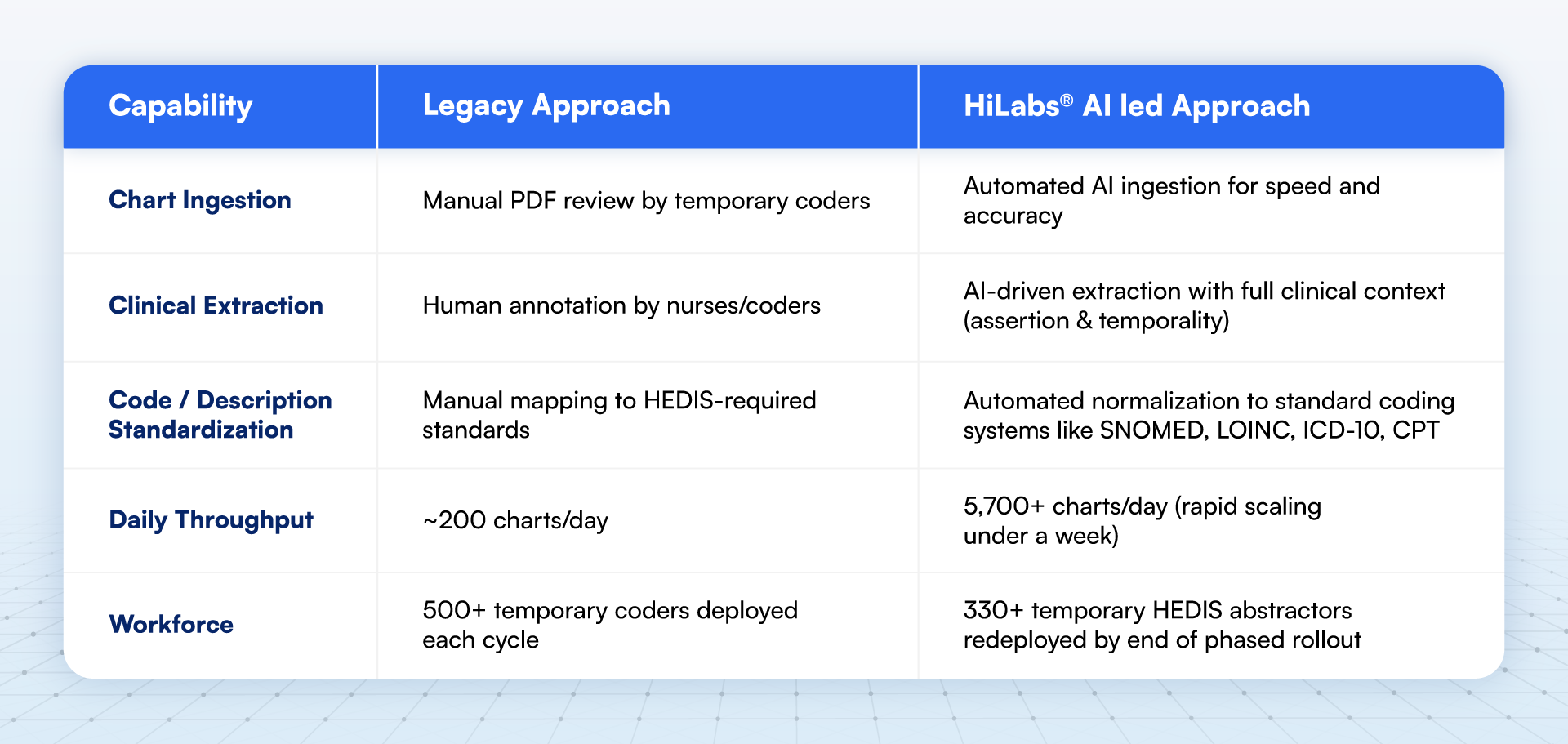
The platform handles the full workflow in a single, integrated pipeline: from intelligent clinical data ingestion of PDF medical charts (SmartOCR), through clinical data extraction and code extraction with assertion and temporality context (Codex), to normalization of all outputs against standard coding systems including SNOMED, LOINC, and ICD-10 (Term Mapping). This results in structured, HEDIS-ready clinical data produced automatically, without manual reviewer intervention at any stage.
The platform embeds directly into the plan's existing medical records review workflows. Configuration is handled by the clinical operations team, enabling the organization to tailor extraction logic to their specific measure set and schema requirements — and to adapt as those requirements evolve.
HiLabs' MCheck® Clinical Outperforms Legacy MRR Approach
The path forward
The future of payer operations will be shaped by organizations that can transform fragmented healthcare data into actionable intelligence.
Medical records review sits at the center of that transformation. What was once viewed as an administrative necessity is rapidly becoming a strategic capability with direct implications for revenue performance, quality outcomes, compliance readiness, and operational efficiency.
The leading health plans of the next decade will not distinguish themselves solely through product innovation or network scale. They will distinguish themselves through their ability to acquire, understand, and operationalize clinical information faster and more effectively than their competitors.
In that environment, medical records review is no longer a back-office function. It is a core engine of payer intelligence.
