

Moving Beyond Directory Maintenance to Continuous Provider Network Validation
For Medicare Advantage (MA) health plans, provider directory accuracy is no longer just an administrative responsibility. It is becoming a critical priority for regulatory compliance, network integrity, and member experience.
An outdated provider address, incorrect specialty, inaccurate network affiliation, or incorrect patient acceptance status can prevent members from accessing care and expose health plans to compliance risks.
The challenge is that provider information is spread across multiple systems, including credentialing platforms, claims databases, provider rosters, contracting systems, and delegated entities. Keeping this information consistent and current across all channels requires more than periodic directory updates.
In 2026, health plans need to move from managing provider directories to continuously validating provider data.
1. What Is Changing in Medicare Advantage Compliance?
CMS is increasing its focus on the availability, transparency, and accuracy of Medicare Advantage provider information.
Three developments are particularly important:
- 30-day update requirement: Under 42 CFR §422.111(m), MA organizations must update provider directory information within 30 days of becoming aware of a change, effective January 1, 2026.
- Medicare Plan Finder integration: CMS is advancing the availability of provider directory information through Medicare Plan Finder, increasing the importance of consistent and reliable provider data submissions.
- REAL Health Providers Act: CMS proposed additional provider directory verification and accuracy requirements in October 2026, including more frequent verification, accuracy reporting, and beneficiary protections. These proposed provisions are intended for contract year 2028 and beyond, subject to final rulemaking.
The direction is clear: provider directory accuracy is moving toward greater transparency, measurable accountability, and more rigorous validation.
2. Why Provider Directory Accuracy Remains a Challenge
Despite investments in provider management technology, inaccurate provider information remains a persistent challenge for health plans.
Five issues contribute to the problem:
- Fragmented data: Provider information resides across multiple systems that may not synchronize automatically.
- Delayed updates: Changes in provider locations, specialties, contact information, and affiliations may not reach directories promptly.
- Delegated network complexity: Different provider groups and delegated entities follow different data submission processes and update schedules.
- Duplicate and conflicting records: Providers may appear under different identifiers, names, locations, and affiliations across systems.
- Limited validation: Basic data checks cannot establish whether a provider is practicing at a listed location or participating in a specific MA network.
The consequences extend beyond inaccurate directories. They include member access challenges, additional provider outreach, operational inefficiencies, and potential regulatory exposure.
3. What Should Health Plans Validate?
An effective Medicare Advantage provider directory accuracy strategy must go beyond verifying names and addresses.
Health plans should focus on five critical areas:
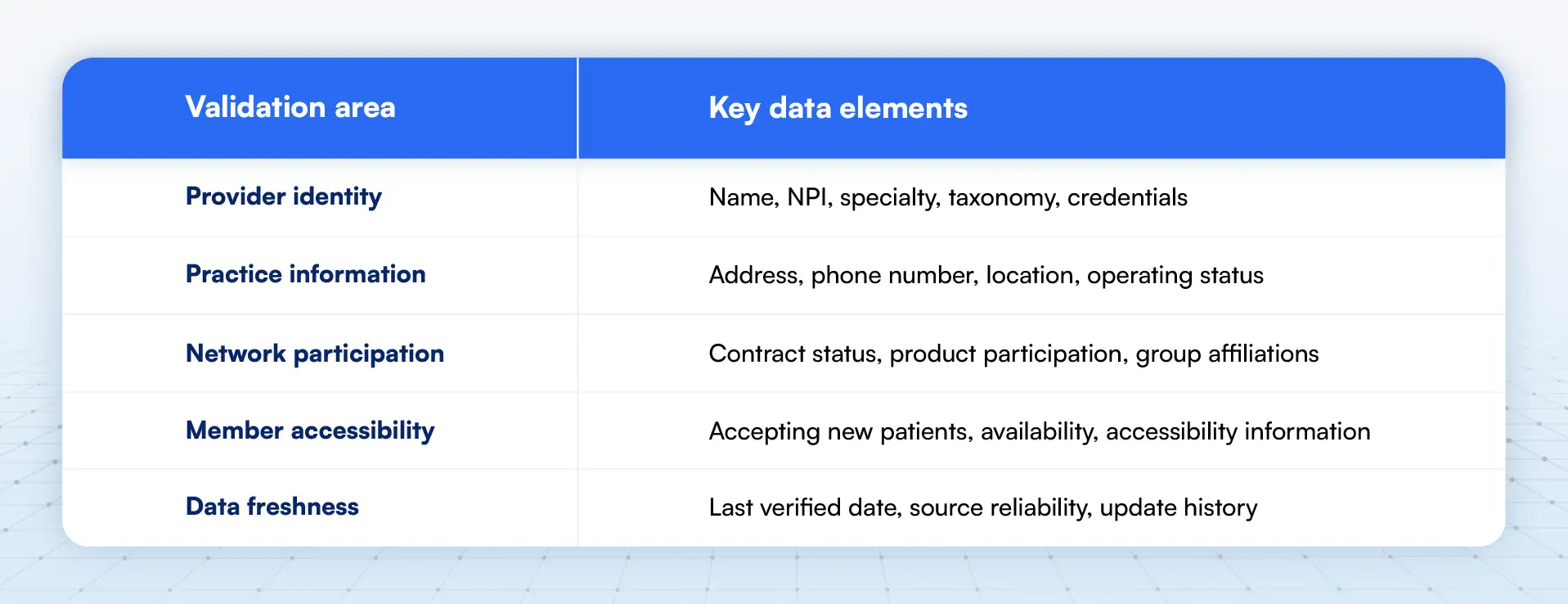
Importantly, an active NPI does not establish that a provider is currently practicing at a particular location or participating in a specific Medicare Advantage network.
Health plans must validate provider information against multiple sources to establish its accuracy and relevance.
4. Moving Toward Continuous Provider Network Validation
Periodic manual audits are difficult to scale across large and geographically distributed provider networks.
A more effective approach combines enterprise data, external sources, intelligent validation, and automated exception management.
A five-step framework can help health plans strengthen provider data accuracy:
- Consolidate provider information: Bring together data from credentialing, claims, contracting, provider rosters, and external sources.
- Validate across multiple sources: Cross-reference provider information with NPPES, licensing databases, claims, provider websites, and direct attestations.
- Resolve data inconsistencies: Use intelligent matching to identify duplicate records, conflicting information, and incorrect provider affiliations.
- Monitor changes continuously: Identify changes in provider locations, specialties, contact details, and network participation.
- Establish measurable accountability: Track accuracy, data freshness, exception resolution, and update turnaround times.
This approach shifts provider directory management from reactive correction to proactive data quality management.
5. Why Traditional Directory Management Is Not Enough
Traditional provider directory platforms primarily focus on storing, maintaining, and publishing provider information. While these capabilities remain essential, they do not necessarily address the accuracy of the underlying data.
The next generation of provider data management requires a broader set of capabilities.
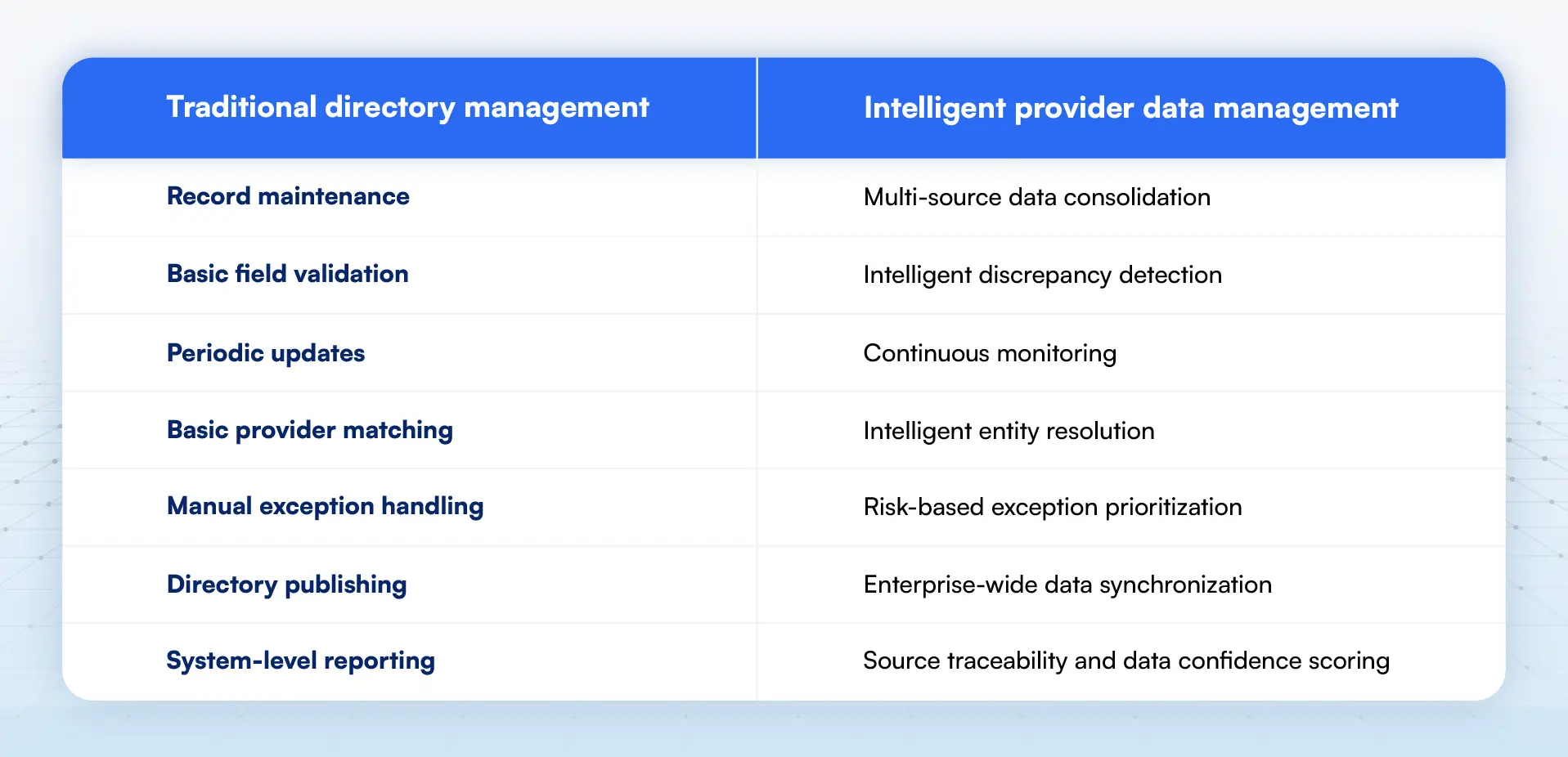
The distinction is important: a directory can be successfully published and still contain inaccurate provider information.
Health plans need solutions that improve data quality before information reaches member-facing directories.
6. How AI Can Improve Provider Directory Accuracy
AI can help health plans address the complexity and scale of provider data validation.
Key applications include:
- Intelligent data extraction: Capture provider information from rosters, PDFs, websites, and other structured and unstructured sources.
- Entity resolution: Identify duplicate providers and reconcile relationships across groups, specialties, and practice locations.
- Multi-source validation: Compare provider records against claims, government databases, credentialing systems, and external information.
- Continuous monitoring: Detect potential changes and flag records requiring validation.
- Intelligent exception management: Prioritize discrepancies based on risk, source reliability, relevance, and recency.
The objective is not simply to automate provider data processing. It is to create a more reliable and continuously updated view of the provider network.
7. What Should Health Plans Look for in a Directory Accuracy Solution?
When evaluating provider directory accuracy solutions, health plan leaders should assess more than workflow automation and directory publishing capabilities.
The following questions can help guide technology selection:
- Can the platform consolidate provider data from multiple internal and external sources?
- Can it intelligently identify duplicate and conflicting provider records?
- Can it validate provider locations, specialties, and network affiliations?
- Does it assess information based on source reliability and recency?
- Can it continuously monitor changes across provider data sources?
- Does it support configurable workflows and exception management?
- Can it integrate with existing claims, credentialing, and provider management platforms?
- Can it demonstrate measurable improvements in accuracy and operational efficiency?
The right solution should help health plans establish a trusted provider data foundation that supports compliance, network operations, and member experience.
8. The Way Forward: From Directory Accuracy to Network Intelligence
Medicare Advantage provider directory accuracy is becoming a broader measure of network integrity.
As CMS expectations evolve, health plans must move beyond periodic updates and fragmented validation processes toward a continuous, intelligence-driven approach.
This requires three fundamental shifts:
- From fragmented provider records to a trusted, consolidated data foundation.
- From periodic verification to continuous, multi-source validation.
- From manual correction to intelligent monitoring and risk-based exception management.
The future of provider directory management is not simply about maintaining accurate directories. It is about ensuring that every provider represented in a health plan's network is correctly identified, validated, affiliated, and accessible to members.
How HiLabs Helps Health Plans Strengthen Provider Data Accuracy
At HiLabs, we believe provider data accuracy starts with understanding the data—not simply managing it.
Our AI-powered MCheck® Provider Data Accuracy (PDA) capabilities help health plans consolidate, validate, and continuously monitor provider information across fragmented data sources.
With capabilities including:
- 60+ critical provider data elements to support comprehensive validation.
- 200+ validation checks to identify provider data inconsistencies.
- Multi-source intelligence across claims, rosters, government databases, and external sources.
- Reliability, relevance, and recency scoring to assess provider information.
- Continuous monitoring to identify changes and support proactive data management.
HiLabs helps health plans move beyond traditional directory management toward a more intelligent, connected, and reliable provider data ecosystem.