


It's 9:40 on a Tuesday morning, and an office manager at a mid-sized cardiology practice is on her third call of the day with the same health plan. The first call was from the credentialing team asking for a W-9 she already submitted few months back. The second was from the quality team, asking for chart notes on a patient she'd already sent records for last month. This third call is from provider data operations, confirming an address that hasn't changed in four years.
Three departments. Same health plan. Same provider. Working in Silos.
Multiply that morning by every practice in a health plan network, every week, and you start to see the real shape of a problem the industry doesn't talk about nearly enough: payer-provider friction. It isn't a single broken process. It's the accumulated weight of thousands of small, disconnected interactions that were each designed reasonably well in isolation and, together, add up to something genuinely dysfunctional.
Health plans have spent the last several years pouring money into member experience platforms, AI-powered claims tools, and next-generation call centers. Most of that investment has paid off in one form or another. But the relationship between payers and providers, the plumbing that everything else runs through, hasn't gotten meaningfully easier. If anything, it's gotten harder. The volume of information moving between the two sides keeps growing, while the systems carrying it stay just as fragmented as they've always been.
What Is Payer-Provider Friction, and Why Does It Cost So Much?
Stripping away the jargon and payer-provider friction is simple to define; it's the extra effort, delay, and cost created every time a health plan and a provider organization need to exchange information, and the exchange doesn't go smoothly.
That covers a lot of ground. A physician updates a practice location, and the change takes six weeks to show-up correctly everywhere it needs to. A credentialing file gets kicked back because a license number was transposed somewhere upstream. A contracting negotiation stalls because nobody can quickly confirm which tax ID applies to which location. A quality team requests documentation that a different department at the same plan already has sitting in a folder somewhere. A member calls to book an appointment with a doctor who, according to the directory, is still accepting new patients — except he retired last spring.
These aren't dramatic failures. They're routine, almost boring, which is exactly why they've been so easy to ignore. But routine, multiplied by scale, is how you end up with an administrative bill in the tens of billions of dollars.
Asking people to move faster won't fix any of it. What fixes it is making sure the one thing every workflow depends on, an accurate, current provider record, is trustworthy enough to build on. That's where the rest of this piece is headed.
Why Payer-Provider Friction Keeps Getting Worse Every Year
Friction has always existed in healthcare. What's changed is the math around it.
Provider networks have gotten bigger and more tangled. A single physician might now practice across three locations, hold privileges at two hospital systems, and participate in a rotating list of health plans that shifts every open enrollment period. Keeping that picture accurate isn't an annual task anymore. It's a live, continuous one, yet most organizations still treat it as a periodic cleanup project.
Regulators have also raised the bar, and not gently. CMS now requires Medicare Advantage plans to submit directory data for its Plan Finder tool and to update any change within 30 days. Network adequacy reviews increasingly ask whether members can actually get an appointment, not just whether a name appears on a list. That scrutiny isn't unreasonable. Federal audits have repeatedly found that between 45 and 52 per cent of Medicare Advantage directory listings contain at least one error, and a Senate investigation into mental health directories found that patients could successfully book an appointment only 18 per cent of the time. The regulatory pressure exists because the underlying data has genuinely earned it.
Meanwhile, both sides of the relationship are running leaner than they used to. Health plan operations teams are stretched across more responsibilities. Provider offices are managing staffing shortages of their own, with front-desk and billing staff absorbing tasks that used to belong to dedicated administrative roles. There are fewer people available on either end to catch an error before it becomes someone else's problem. All of this makes genuine payer-provider collaboration harder to sustain, not easier.
And then there's AI, which everyone assumed would be the fix. It isn't, at least not on its own. A model that drafts outreach emails or processes claims faster doesn't help if the roster it's working from is wrong. It just produces the wrong answer with more confidence and at higher volume. Automation layered on top of bad data doesn't reduce friction. It speeds up the rate at which friction causes damage.
These pressures aren't letting up. Networks will keep growing, CMS will keep tightening directory and network adequacy requirements, and staffing will likely stay lean on both sides for the foreseeable future. Waiting for conditions to ease isn't a plan. Building a data foundation that can keep pace with them is.
Where Payer-Provider Friction Costs Show Up Across Every Workflow
The tricky thing about payer-provider friction is that no single department owns it, which means no single budget ever really captures it. Every team just sees its own slice of the same underlying problem.
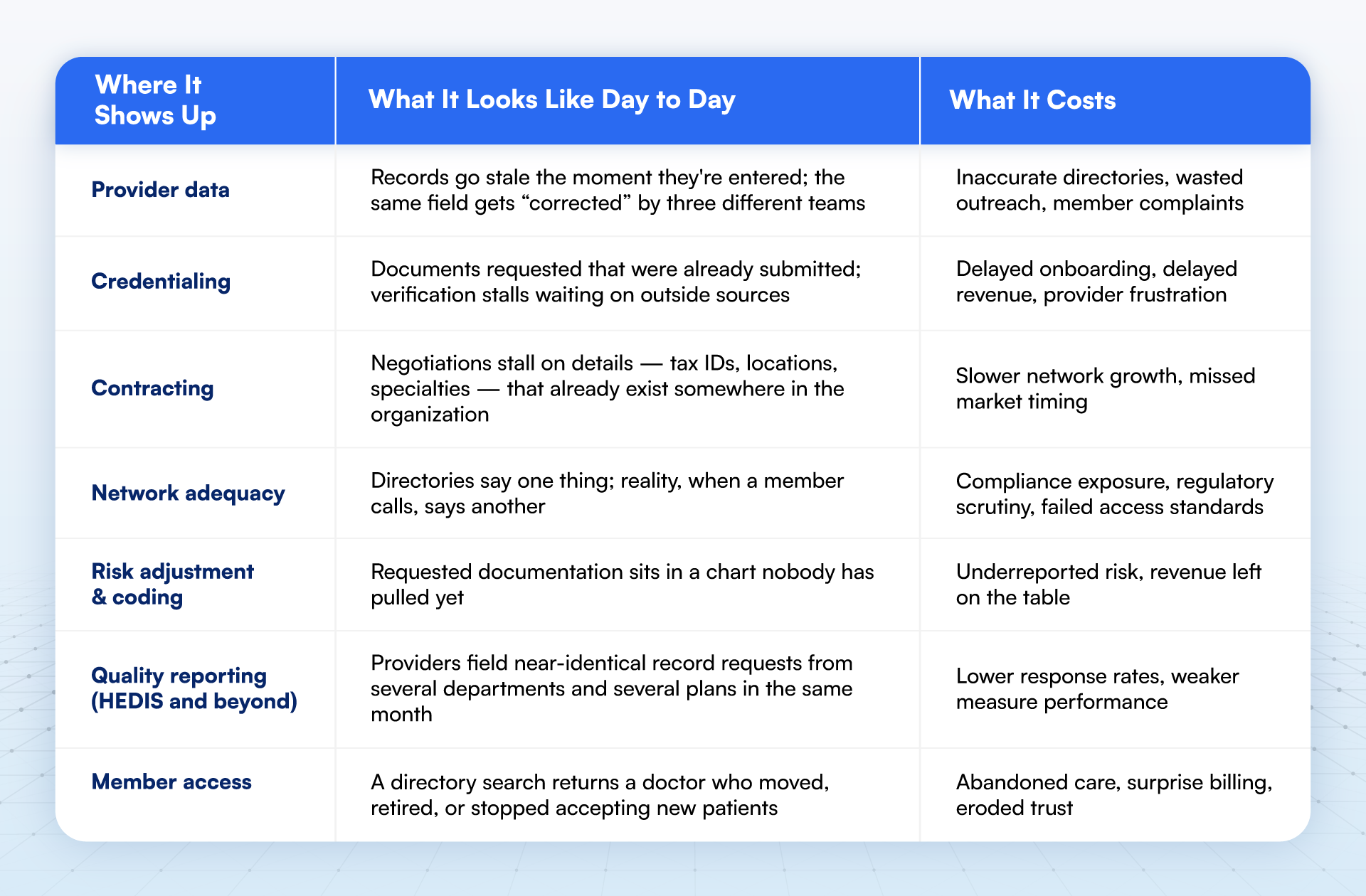
Looking at the list the pattern is obvious. These aren't seven different problems. They're seven symptoms of the same root cause: nobody in the organization is working from one current, trusted picture of who the provider is. Fix that once, and most of this table gets easier at the same time. Leave it unfixed, and every department keeps paying to solve the same problem independently, forever.
The Hidden Financial Impact of Administrative Waste in Healthcare
Most of what health plans measure as administrative cost — call center volume, vendor contracts, staffing, technology spend — is visible. It shows up on a budget line, and someone owns it.
Friction cost doesn't work that way. It hides in the seams between departments.
Take something as ordinary as one provider changing practice locations. Someone must verify the change, usually by phone or email. The directory needs updates. Contracting records may need revision. Claims configuration might need to change. Network adequacy calculations may shift. Customer service needs to know before a member calls in confusion. Quality reporting may depend on the new address being correct. One change, a dozen downstream touches, none of them individually expensive.
Multiply that by however many thousands of provider changes happen across a network in a given month, and the quiet arithmetic starts to add up to something significant. The 2024 CAQH Index puts the industry's annual spend on routine administrative transactions at roughly $90 billion, with more than $20 billion in additional savings still sitting on the table simply by moving the remaining manual and partially electronic work toward full automation. And that's before counting the costs that never make it into an index at all: providers who quietly stop returning calls from a plan they've come to see as burdensome, contracting cycles that drag on for months longer than they should, quality measures that come in soft because the documentation request got buried behind three others that same week.
Here's the frustrating part: almost none of it was inevitable. Most of the downstream costs described above exist only because the original provider record wasn't trustworthy enough to build on. Correct that one point of failure, and a large share of these costs stop recurring on their own.
Why More Staff, Vendors, and Point Solutions Don't Reduce Friction
The instinctive response, understandably, is to add capacity. Another outreach team. Another point solution for directory validation. Another audit cycle before the next compliance deadline. Another portal for providers to log into.
It rarely works, and the reason is almost mechanical. Every new tool or team is built to solve its own narrow slice of the problem, which means it also becomes one more place holding its own version of the truth about the same provider. A new credentialing platform doesn't talk to the system tracking network adequacy. A new vendor collecting quality documentation doesn't share what it learns with the team doing roster reconciliation. Each addition creates one more place where the same underlying provider record can drift out of sync with everywhere else it's supposed to live.
The result isn't less friction. It's more reconciliation work. Later, when someone finally notices the three versions of “truth” don't agree.
Health plans don't need more tools. They need fewer independent versions of the same provider record, and one shared, trustworthy version instead. That's the shift the rest of this piece gets into.

The Shift From Workflow Automation to Unified Provider Intelligence
The organizations making headway here have stopped asking, “how do we make this one workflow faster?” and started asking something more useful: how do we make every interaction with a provider count, regardless of which department initiates it?
That reframing calls for different infrastructure entirely: a single, continuously verified layer of provider intelligence that every downstream workflow draws from, rather than a collection of departmental tools each guarding its own partial view.
In practice, that starts with provider data validated against primary sources on an ongoing basis, not refreshed on a quarterly cycle that's already outdated by the time it publishes. Outreach gets targeted instead of blanket: a provider only hears from the plan when something specific has changed or needs confirmation, rather than getting swept into a campaign built for everyone regardless of what's already known about them. Information gathered once, during credentialing, say, feeds directory accuracy, network adequacy reporting, contracting, and coding review automatically, instead of getting collected from scratch by five separate teams over five separate months. And the clinical side, medical record review, coding accuracy, cost and utilization patterns, runs on that same verified foundation, so a number a health plan reports for risk adjustment or HEDIS is trustworthy for the simple reason that it was never disconnected from the underlying provider truth to begin with.
This doesn't eliminate the need for people to talk to providers. Healthcare will always require payer-provider collaboration. What changes is whether that collaboration is purposeful or repetitive.
What Low-Friction Payer-Provider Operations Look Like in Practice
Here's what changes for the people actually doing the work. A provider confirms an update once, and every relevant system reflects it automatically, instead of the same question landing on their desk five times from five departments over five weeks. Directories stay accurate because they're checked continuously rather than swept clean once a year right before an audit. Coding and risk adjustment teams pull documentation that's already organized and validated instead of chasing it down chart by chart, and a member searching for a doctor actually finds someone who's there, in-network, and taking new patients.
That's not a distant future state. It's what happens once provider data is treated as something the whole organization shares, rather than something five departments each rebuild on their own, with roster management, network adequacy, contracting, outreach, and clinical review all tracing back to the same source.
The Bottom Line: Reducing Friction Is Healthcare's Next Competitive Advantage
Healthcare has spent two decades making individual processes faster. Claims got faster, prior authorizations managed electronically, credentialing went digital. And providers still experience the system as a series of disconnected, repetitive demands on their time.
The next real gain won't come from optimizing one more workflow in isolation. It will come from finally treating payer-provider friction as the single enterprise problem it actually is, instead of a dozen departmental symptoms managed separately.
Every unnecessary interaction has a cost, in staff hours, in provider goodwill, in compliance risk, in a member who gives up looking for care. Every accurate one creates value on both sides. The health plans that figure this out first won't be the ones running the most automation projects. They'll be the ones who finally got credentialing, contracting, network, quality, clinical, and member services working off the same, trustworthy picture of who their providers actually are.
That's not a minor efficiency gain. In a market this competitive, it's becoming one of the few advantages left that actually compounds. Stronger payer-provider collaboration follows naturally once that foundation is in place, and it's a far better outcome than another round of point solutions.