



Introduction: Provider Contracts Are Becoming Financial Performance Agreements
For U.S. health plans, provider contracts are among the most consequential financial commitments they make. Every reimbursement methodology, rate schedule, payment incentive, quality threshold, and contractual amendment can influence medical costs, provider relationships, and operating margins.
But the economics of provider contracting are changing.
Traditional fee-for-service agreements primarily define how providers are reimbursed for services delivered. Value-based care (VBC) arrangements introduce a more complex set of financial commitments, linking reimbursement to quality, utilization, patient outcomes, and total cost of care.
This changes what health plans need to understand before signing a contract.
A provider agreement may look financially attractive based on negotiated rates but carry substantial exposure through shared savings arrangements, performance guarantees, risk corridors, quality requirements, and other contractual provisions.
The challenge extends beyond negotiating favourable terms. Health plans must understand how those terms will perform across their provider portfolios, how accurately they are implemented, and how they ultimately influence financial results.
Yet, contracting, actuarial modeling, claims configuration, and financial performance monitoring often operate in disconnected environments.
Health plans need to move beyond contract administration toward continuous contract economics and portfolio-level margin intelligence.
1. The Shift to Value-Based Care Is Increasing Contract Complexity
Value-based care is no longer a peripheral payment strategy. It is becoming an increasingly important part of how healthcare organization structure provider relationships and manage financial accountability.
AHIP's 2025 Alternative Payment Model (APM) Adoption Survey, conducted in collaboration with CMS, represents over 271 million people nationwide, accounting for 87.5% of covered lives across all lines of business. There were some interesting survey findings:
- 44.9% of healthcare payments were tied to APMs that hold providers accountable for quality and cost of care (HCPLAN Categories 3–4) in 2024, compared with 45.2% in 2023.
- 28.7% of healthcare payments were tied to downside-risk arrangements (HCPLAN Categories 3B–4), compared with 28.5% in 2023.
- Both Original Medicare and Medicare Advantage experienced more than two percentage points of growth in downside-risk payment models compared with 2023.
- 70% of respondents expect APM activity to increase over the next 24 months.
- 55% of respondents anticipate the greatest growth in shared-risk and procedure-based episode payment models (HCPLAN Category 3B).
The financial results are equally significant.
In its November 2026 release of Performance Year 2025 results, CMS reported that:
- 472 ACOs participated in the Medicare Shared Savings Program.
- 80% of participating ACOs, representing 84% of 10.9 million assigned beneficiaries, earned performance payments.
- Shared savings payments to ACOs totalled $4.9 billion.
- Medicare generated $2.5 billion in savings relative to benchmarks.
These are results from the Medicare Shared Savings Program, not the entire U.S. value-based care market. Nevertheless, they demonstrate the financial significance of arrangements that connect provider reimbursement with quality and cost performance.
For health plans, the implications are substantial.
Provider contracts increasingly need to account for:
- Total cost of care and financial benchmarks.
- Member attribution and eligible populations.
- Risk adjustment and patient acuity.
- Quality performance and incentive structures.
- Shared savings and shared losses.
- Performance periods and reconciliation methodologies.
- Financial risk corridors and contractual protections.
A contract can no longer be evaluated exclusively by comparing reimbursement rates. Its complete financial implications must be understood.
2. The Hidden Economics of Traditional and Value-Based Contracts
Despite investments in digital transformation, healthcare contracting remains highly dependent on complex documents, manual interpretation, spreadsheets, and disconnected systems.
A 2026 CAQH and Stanford research study examining payer-provider contracting highlighted the continuing reliance on manual and document-based processes. Its research included health plans representing approximately 63% of U.S. covered lives and more than 600 provider organizations.
This creates three important challenges for health plan executives.
A. Financial Modeling Remains Fragmented
Provider contract negotiations typically involve provider contracting, actuarial, finance, network management, and legal teams.
However, financial assessments are often performed contract by contract rather than across the entire provider portfolio.
This becomes particularly challenging in value-based care arrangements.
Consider a health plan negotiating a shared-savings agreement with a provider organization.
The financial outcome may depend on several variables:
- The attributed member population.
- Historical spending and benchmark calculations.
- Risk-adjustment methodology.
- Expected medical cost trends.
- Quality performance thresholds.
- Shared savings percentages.
- Downside risk exposure.
A change in one contractual assumption can materially influence the overall economics of the arrangement.
For example, a contract with an attractive shared-savings percentage may still create unfavourable economics if its benchmark assumptions, attributed population, or quality requirements are not adequately evaluated.
Health plans need the ability to simulate alternative scenarios before committing to these agreements.
B. Negotiated Terms and Configured Terms Can Diverge
Signing a provider agreement does not guarantee that its financial terms are accurately reflected in operational systems.
Contractual provisions must eventually be translated into claims pricing rules, reimbursement schedules, incentive calculations, effective dates, and other configuration parameters.
For value-based care agreements, the challenge becomes even more complex.
A configuration discrepancy may affect:
- Provider reimbursement rates.
- Shared savings calculations.
- Quality incentive payments.
- Risk-sharing thresholds.
- Performance periods.
- Financial reconciliation.
Even relatively small discrepancies can create recurring financial exposure when applied across large provider populations.
The underlying issue is the disconnect between what was negotiated, what was executed, and what was configured.
C. Contract Performance Is Often Evaluated Retrospectively
Many health plans continue to rely on periodic financial reports to understand provider contract performance. While retrospective analysis is necessary, it may not provide sufficient visibility into emerging financial risks.
This is particularly relevant for VBC arrangements, where performance depends on the interaction of financial, clinical, and operational variables. A provider organization may be meeting certain quality thresholds while simultaneously experiencing unfavorable total cost of care trends. Another may generate medical cost savings but fail to meet the quality requirements necessary to earn incentive payments.
Without connecting contractual provisions with actual performance, health plans may struggle to understand the underlying economics of these arrangements. The opportunity is to move from retrospective contract reporting toward continuous financial intelligence.
3. Value-Based Care Requires a Different Approach to Contract Economics
Traditional fee-for-service and value-based care agreements should not be evaluated using the same financial lens.
In fee-for-service arrangements, the primary considerations typically include reimbursement rates, utilization, payment methodologies, and contractual adjustments.
In value-based care, financial performance depends on a broader set of variables.
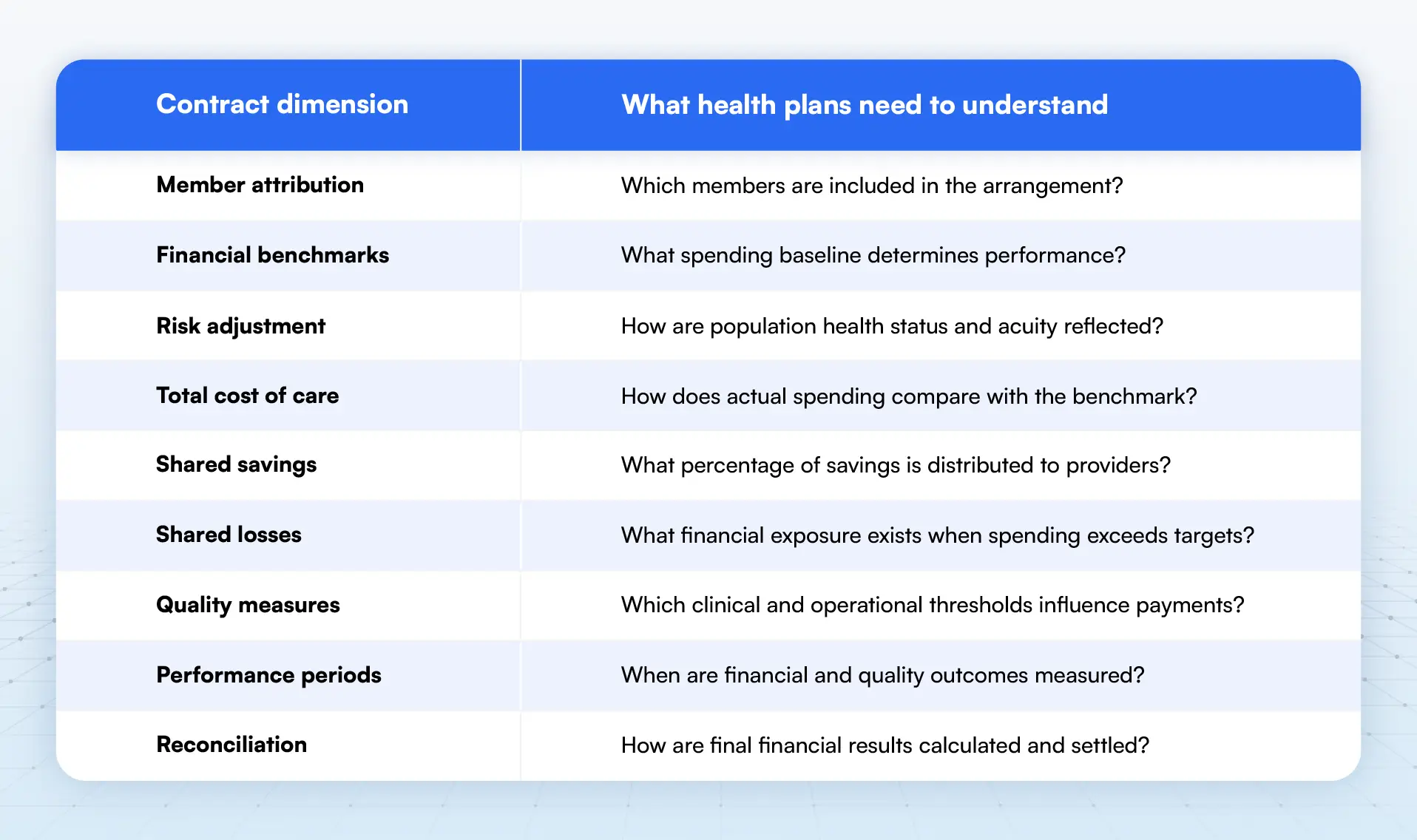
These variables are interconnected. A change in member attribution can influence the population's risk profile. A change in benchmark methodology can alter the expected financial outcome. Quality performance can determine whether an organization qualifies for shared savings.
This creates a need for more sophisticated contract modeling. Health plans should be able to simulate how different contractual assumptions affect financial performance before signing, validate the implementation of those terms, and continuously evaluate their impact.
The economics of value-based care must be understood at the contract level, the provider level, and the portfolio level.
4. Four Capabilities Health Plans Need to Protect Contract Economics
A more effective approach requires health plans to connect partner selection, contract negotiations, implementation, and ongoing financial monitoring.
Four capabilities are particularly important.
A. Choose the Right Partners: Assess Provider Readiness Before Contracting
The financial performance of a value-based care arrangement begins with the selection of the right provider partners.
Health plans need a comprehensive understanding of a provider organization's historical performance, population characteristics, and ability to manage financial risk before determining the appropriate contractual structure.
This assessment should consider:
- Historical medical expenditure and utilization patterns.
- Clinical quality and performance outcomes.
- Attributed population size and risk profile.
- Financial and operational readiness to assume risk.
- Performance relative to comparable provider organizations.
For example, two provider organizations may demonstrate comparable quality performance but differ significantly in risk-adjusted medical expenditure, utilization patterns, attributed population size, and risk readiness. Evaluating them on quality performance alone may lead to similar contractual commitments despite materially different risk profiles.
AI-powered provider scorecard can help health plans consolidate these dimensions into a comprehensive view of provider performance and risk readiness.
B. Simulate Before You Sign: Understand the Economics Before Making a Commitment
Provider contract negotiations should not rely exclusively on historical reimbursement rates or individual provider demands.
Health plans need the ability to model proposed contractual terms and understand their potential financial implications before committing.
For traditional agreements, this may involve evaluating reimbursement changes, fee schedules, and payment methodologies.
For value-based care agreements, simulation should also consider:
- Alternative total cost of care benchmarks.
- Different member attribution assumptions.
- Risk-adjustment methodologies.
- Shared savings percentages.
- Downside risk and financial exposure.
- Quality thresholds and performance incentives.
For example, a health plan considering a new VBC arrangement could evaluate how different benchmark assumptions and shared savings percentages influence its potential financial exposure.
Portfolio-level simulation also helps leaders understand the cumulative implications of multiple provider agreements rather than assessing each arrangement independently.
The objective is to bring financial intelligence into contracting decisions before commitments are made.
C. Catch Drift Before Go-Live: Validate What Was Negotiated Against What Was Configured
The next critical stage is contract implementation.
Once an agreement is executed, its terms must be accurately translated into operational systems.
Health plans need a systematic way to compare executed contractual provisions against the corresponding configured build.
For traditional agreements, this includes reimbursement rates, fee schedules, payment methodologies, and effective dates.
For VBC arrangements, validation may also extend to:
- Shared savings and shared loss provisions.
- Quality incentive calculations.
- Attribution and eligibility rules.
- Performance periods.
- Risk-sharing thresholds.
- Contractual amendments.
AI-powered contract intelligence can help interpret complex contractual language, identify relevant provisions, and compare them with structured configuration data.
This creates an important validation layer before contractual terms begin influencing claims payments and financial settlements.
The objective is straightforward: ensure that the contract being operationalized is the contract that was actually negotiated and executed.
D. Forecast the Margin: Make Contract Performance Continuously Visible
Contract intelligence should not end when an agreement goes live.
Health plans need an ongoing view of how contractual commitments influence financial performance.
Predictive analytics can help connect contractual provisions with portfolio performance, identify emerging financial trends, and support more informed decisions.
For traditional provider agreements, this may involve monitoring reimbursement trends and identifying unfavorable financial trajectories.
For value-based care arrangements, the opportunity extends to monitoring:
- Actual versus benchmark total cost of care.
- Financial exposure under shared-risk agreements.
- Quality performance against contractual thresholds.
- Potential shared savings or shared losses.
- Performance across attributed provider populations.
- Financial obligations embedded in contract language.
The ability to retrieve buried contractual provisions on demand is equally important.
Finance, actuarial, and contracting teams should be able to investigate the underlying terms behind a financial outcome without manually searching through multiple documents and amendments.
The objective is to make contract economics visible throughout the agreement lifecycle.
5. The Role of AI in Transforming Contract Economics and Value-Based Care
AI has the potential to change how health plans interpret, evaluate, and operationalize provider contracts. However, its value extends beyond extracting information from documents. For contract economics and value-based care, AI needs to connect several capabilities.
- Contract understanding: Interpret complex contractual language, reimbursement provisions, amendments, and financial obligations.
- Financial simulation: Evaluate proposed terms and model potential financial implications across provider portfolios.
- VBC contract intelligence: Make critical contractual provisions involving benchmarks, attribution, quality requirements, shared savings, and risk arrangements accessible for analysis.
- Configuration validation: Compare executed agreements with configured pricing structures and identify discrepancies.
- Predictive intelligence: Analyze financial and portfolio performance to identify potential risks and unfavourable trends.
- On-demand intelligence: Enable business users to retrieve contractual provisions and understand the context behind financial outcomes.
The real opportunity is connecting contractual intelligence with financial and operational decision-making.
This requires a combination of AI, structured data, financial modeling, and integration with relevant healthcare systems.
It also requires strong governance. Financial assumptions must be transparent, contract provisions traceable, and predictive outputs validated against actual performance.
AI should strengthen financial oversight and decision-making, not replace actuarial judgment, clinical accountability, or legal interpretation.

6. How HiLabs ValueWiz Addresses the Contract Economics Challenge
HiLabs ValueWiz is designed around a fundamental principle: health plans should identify the right provider partner followed by health plans should understand the economics of a contract before signing it, validate its implementation before go-live, and maintain visibility into its financial performance afterward.
Its approach brings together five interconnected capabilities.
Choose the Right Partners
ValueWiz leverages AI-powered provider scorecarding to evaluate historical financial and clinical performance, utilization patterns, population risk profiles, and provider readiness.
This helps health plans identify suitable contracting partners and align contractual structures and financial accountability with each provider's demonstrated capabilities and risk readiness.
Simulate Before You Sign
ValueWiz enables health plans to model proposed contractual terms across their provider portfolios rather than evaluating one agreement in isolation.
For value-based care arrangements, this creates an opportunity to evaluate the financial implications of alternative contractual structures, including benchmark assumptions, reimbursement terms, incentives, and risk-sharing provisions, subject to the availability of relevant modeling inputs.
This helps contracting, finance, and actuarial teams make more informed decisions before committing to new agreements.
Catch Drift Before Go-Live
ValueWiz cross-validates executed contract terms against the configured build, helping identify discrepancies between what was negotiated and what is being implemented.
For VBC agreements, the same discipline is important for ensuring that relevant contractual provisions and financial parameters are accurately reflected in the operational configuration.
This creates a validation layer before contractual terms influence reimbursement and financial calculations.
Forecast the Margin
ValueWiz brings predictive analytics to portfolio performance and enables users to access contractual language and financial obligations on demand.
For health plans managing VBC arrangements, this creates an opportunity to connect contract provisions with financial performance, monitor potential exposure, and understand the implications of contractual commitments.
Renew with Intelligence
ValueWiz brings together historical contract performance, realized financial outcomes, and projected risk exposure to inform contract renewal decisions.
This helps health plans identify which provider arrangements should be expanded, renegotiated, or restructured, ensuring that future contractual commitments are backed by the demonstrated economics of existing agreements.
Together, these capabilities connect five activities that are often managed separately: negotiation, implementation, and financial performance monitoring.
ValueWiz moves contract intelligence beyond document management toward financial visibility across traditional and value-based provider arrangements, enabling health plans to proactively protect margins and maximize the yield of their VBC portfolios.
7. What Health Plan Executives Should Evaluate
For health plan leadership, improving contract economics requires more than implementing another contract repository or document automation platform.
It requires evaluating whether the organization has the intelligence to understand and control the financial implications of its contractual commitments.
Five questions are worth considering:
- Portfolio visibility: Can we simulate the financial implications of proposed contractual changes across our provider portfolio?
- VBC economics: Can we model the impact of benchmarks, member attribution, risk adjustment, quality thresholds, shared savings, and downside risk before signing an agreement?
- Configuration accuracy: Can we systematically validate executed contract terms against the corresponding operational configuration before go-live?
- Margin visibility: Can finance and actuarial teams identify contracts and VBC arrangements that may be creating unfavorable financial outcomes?
- Contract transparency: Can business users quickly retrieve and understand the financial implications of complex contractual provisions and amendments?
The answers can reveal whether contract management is functioning primarily as an administrative process or as a strategic financial capability.
Conclusion: The Future of Provider Contracting Is Financial Intelligence
Provider contracting is evolving. As health plans expand value-based care arrangements, contractual commitments increasingly influence not only reimbursement but also quality performance, total cost of care, provider incentives, and financial risk.
This requires a different approach to contract intelligence. Health plans must understand what they are negotiating, validate what they are implementing, and continuously monitor what they are earning or paying.
The near future contract intelligence must connect financial modeling, contractual interpretation, operational configuration, and portfolio performance. For health plan executives, this creates an opportunity to move from fragmented contract administration toward a more intelligent and proactive approach to financial oversight.
Because protecting margins does not begin when a financial variance appears in a report. It begins when a contract is being evaluated, negotiated, and signed.
Simulate before you sign. Catch drift before go-live. Forecast the margin.