


Provider network management directly affects whether members can access care, whether networks meet regulatory requirements, and whether plans can control cost of care. Pressure on this function has grown as Medicare Advantage enrollment has expanded, and network scrutiny from CMS and state regulators has intensified.
Most health plans, however, do not manage provider networks as a unified system. Provider participation, location, specialty, and contract terms are maintained across disconnected workflows. Updates propagate slowly, leaving teams working from different versions of the same network.
That disconnect has real consequences. Gaps in member access and network performance don't happen by accident; they're a direct result of how networks are built, maintained, and validated. Provider network management is the discipline that closes those gaps by maintaining provider network accuracy, ensuring healthcare network adequacy, and enabling provider network optimization through structured, data-driven workflows.
Accurate provider networks depend on accurate provider data. Read our guide to provider data management to see how upstream data quality affects compliance, operations, and member access.
What Is Provider Network Management in Healthcare?
Provider network management is the set of processes used by health plans to design, maintain, and monitor provider networks across products, geographies, and lines of business.
It includes managing provider participation, tracking affiliations and locations, aligning contract terms with operational systems, evaluating network adequacy, and monitoring provider performance. These activities span multiple systems, including credentialing, provider data platforms, claims systems, and provider directories.
In practice, provider network management is not a single workflow. It coordinates systems and teams so that the network used for compliance reporting, contracting decisions, and member access reflects a single, consistent source of truth.
Why Provider Network Accuracy and Adequacy Matter
Provider network accuracy and provider network adequacy address different but closely linked operational risks.
Provider network accuracy determines whether the data representing the network is correct. Participation status, specialty, location, and affiliation must remain consistent across systems. When they do not, provider directories become unreliable, claims processing is disrupted, and contracting decisions are based on flawed assumptions.
Provider network adequacy determines whether the network meets required access standards across geography and specialty. These requirements are defined by CMS and state regulations and are central to compliance.
The interaction between the two creates risk. A network can appear adequate because it is built on inaccurate provider data. It can also be technically accurate yet still fail to provide sufficient access. Recent research reinforces how fragile provider data remains.
The scale of the problem is significant: a 2023 JAMA study found that only 19.4% of physicians listed across multiple insurer directories had fully consistent address and specialty information. This level of inconsistency directly affects both provider network accuracy and healthcare network adequacy.
Provider Network Accuracy vs. Network Adequacy
Provider network accuracy and network adequacy serve different roles in healthcare network management.
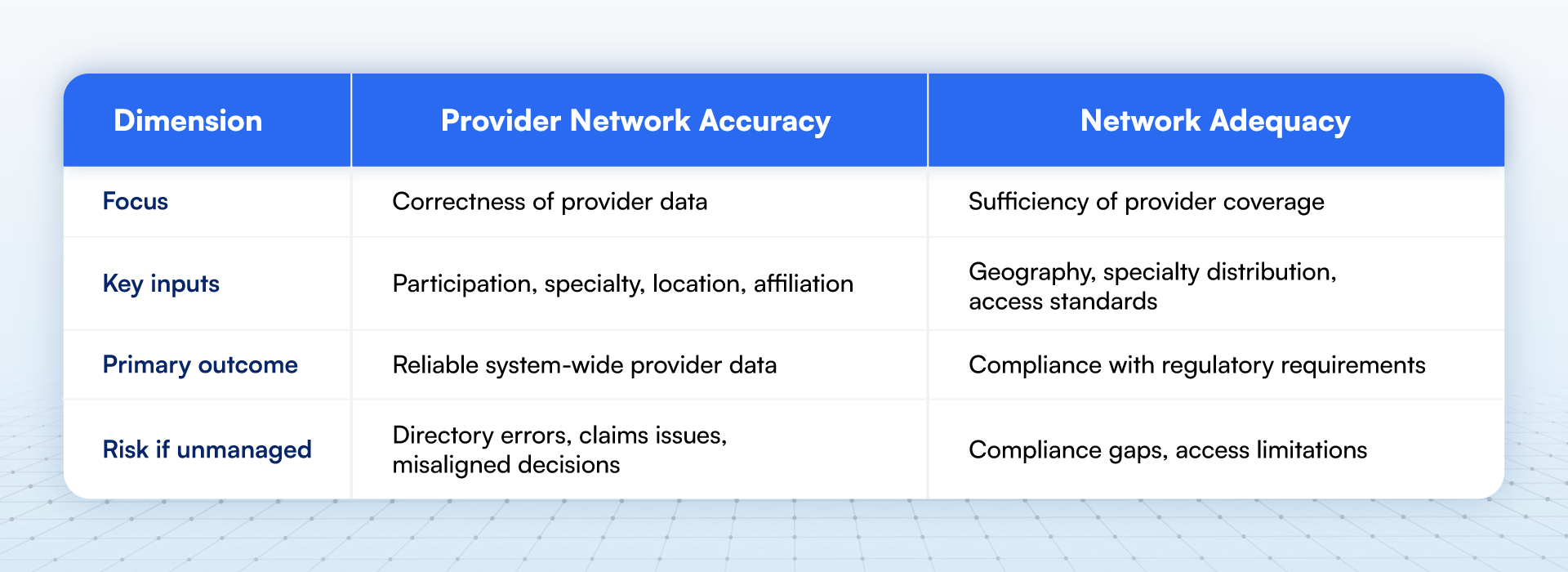
Provider network accuracy is foundational. Without it, adequacy analysis cannot be trusted. Network adequacy builds on that foundation to determine whether the network can support member access and regulatory compliance in practice.
Those two issues now carry more weight. CMS’s 2024 Medicare Advantage and Part D final rule included changes related to provider directories and network adequacy, reinforcing that these are not side issues inside plan operations. At the same time, a 2025 JAMA Health Forum viewpoint described provider directory data as “universally poor” and pointed to state efforts such as California’s Symphony system, which centralizes data submission and discrepancy reconciliation for qualified health plans.
For payer leaders, the implication is straightforward. Accuracy problems distort adequacy analysis. Adequacy problems expose the business to regulatory and market risk. Effective provider network management must address both.
Common Challenges in Provider Network Management
Most provider network management challenges stem from fragmentation across systems and workflows.
1. Fragmented Network Systems
Provider data is often stored in separate systems for credentialing, contracting, claims, and directories. Each system may maintain a different version of provider participation or affiliation. Reconciling those differences requires manual effort and slows decision-making.
2. Contract-to-System Misalignment
Contract terms are not always reflected consistently across operational systems. A provider marked as participating in a contract may still be configured incorrectly in claims or directory systems. This creates a gap between contractual intent and operational execution.
3. Delayed Network Updates
Updates to provider networks are not always synchronized. Changes from roster submissions, contract updates, or credentialing workflows may take time to propagate. During that lag, teams rely on outdated network views.
4. Limited Network Visibility
Many organizations can generate network reports but still struggle to identify where coverage gaps exist at a granular level, which provider changes will ripple into compliance filings or member-facing directories, or which updates will have the greatest operational impact.
How Network Adequacy Analysis Works
Network adequacy analysis evaluates whether a provider network meets access requirements across geography and specialty.
The process begins with assembling a consistent network dataset. Provider participation, specialty, location, and product alignment must be reconciled before analysis. Without this step, adequacy results are unreliable.
The network is then evaluated against CMS and state-specific adequacy rules. This typically involves assessing provider coverage across geographic units such as counties or ZIP codes and identifying gaps in required specialties.
The most useful adequacy workflows go beyond pass-fail reporting. They identify where gaps exist, what type of provider is needed, and how those gaps can be addressed. That may include identifying providers to recruit or validating whether existing providers meet adequacy criteria. Structured this way, adequacy analysis becomes an operational input rather than a compliance-only exercise.
Also see: Our provider roster management guide explains how roster workflows affect the speed and reliability of downstream network updates.
Continuous Provider Network Monitoring
Provider networks change continuously. Providers join or leave networks, update their locations, or change affiliations. Relying on static snapshots means compliance reports and directories are out of date the moment they're generated.
A continuous monitoring approach focuses on validating key attributes as they change. Participation status, specialty alignment, and location updates are revalidated in response to defined triggers such as roster submissions, credentialing events, contract updates, and periodic regulatory reporting cycles, ensuring the network remains accurate and adequate.
This reduces the gap between real-world provider changes and system updates. It improves directory accuracy, supports more reliable adequacy reporting, and reduces large-scale reconciliation work.
Best Practices for Scalable Provider Network Management
Scalable provider network management requires a disciplined operating model that aligns data, workflows, and decision-making.
1. Define Clear Ownership by Decision Type
Effective organizations define ownership by decision type. Contracting teams manage participation decisions, provider data teams ensure those decisions are reflected accurately across systems, and compliance teams validate adequacy requirements. Network strategy teams then use the resulting network view to guide expansion, narrowing, and provider recruitment decisions.
2. Differentiate High‑Impact Changes from Routine Updates
Organizations distinguish between routine updates and high‑impact changes. A formatting correction does not carry the same operational weight as a participation change, a specialty change tied to adequacy thresholds, or a location change in an underserved market. High‑impact changes are prioritized for faster validation because they can affect member access, network filings, and downstream contracting decisions.
3. Ensure Changes Propagate Across All Network Systems
Strong workflows ensure that provider updates propagate across all relevant systems—not just into a single repository. When a provider’s status, specialty, or location changes, those updates must reach claims systems, provider directories, and adequacy analysis workflows in a coordinated way. Without this alignment, teams act on conflicting versions of the same network, increasing operational risk and rework.
4. Validate Networks Continuously, Not Periodically
Rather than relying on periodic audits or point‑in‑time reviews, scalable organizations validate networks continuously. Validation is triggered by operational events such as roster submissions, credentialing updates, or contract changes, reducing reactive cleanup. This approach helps surface issues earlier—before they affect compliance, member access, or network performance.
The Role of AI in Provider Network Optimization
AI supports provider network optimization when applied to specific workflows within network management. In adequacy analysis, AI can reduce manual gap-identification time by analyzing provider distribution across thousands of geographies and specialties simultaneously—work that would otherwise require weeks of manual effort.
AI can also support benchmarking by comparing provider networks against market peers to reveal over- or under-coverage in specific specialties, geographies, or cost tiers. In network optimization, AI helps identify high-cost, low-performing providers and surface alternative providers who better align with cost, quality, and access objectives.
These insights are typically derived from multiple data sources, including claims, clinical, and provider data. In this context, AI adds value by processing complex network data and generating more consistent insights. It supports decision-making within defined workflows and governance structures.
How HiLabs Supports Provider Network Management
HiLabs supports provider network management through MCheck® NetworkIQ, a network management application built to help health plans address compliance, competitiveness, and cost-of-care priorities.
NetworkIQ evaluates provider networks against CMS and state adequacy requirements, identifying coverage gaps across geographies and specialties. It benchmarks networks against market peers based on provider coverage, cost, and enrollment, providing insight into competitive positioning.
The application also identifies high-cost, low-performing providers and recommends alternative providers to improve network composition. These capabilities are supported by TIN-level data and multi-source analytics, enabling more detailed and actionable network analysis.
NetworkIQ gives health plans a structured, data-driven way to build and refine networks, moving from reactive gap-filling to proactive network design, while addressing compliance, competitiveness, and cost-of-care priorities.

Real-World Impact of Better Provider Network Management
Better provider network management produces measurable compliance, operational, and financial outcomes. When plans can validate network adequacy more consistently and act on network gaps faster, those improvements show up across the workflows that matter most.
From a compliance perspective, stronger provider network management helps plans identify and close adequacy gaps faster while reducing the effort required to prepare for audits and regulatory review. From an operational perspective, it reduces manual reconciliation across contracting, provider data, and compliance workflows by giving teams a more reliable and current view of the network.
A national health plan using HiLabs® MCheck® NetworkIQ has achieved 95%+ accuracy in adequacy gaps closure within 30 days of implementation, and reduced audit preparation effort by 70%. This allowed national health plans to achieve nearly 40% cost savings over legacy vendor workflows for manual network analysis.
These outcomes matter because they move provider network management beyond a periodic compliance task. They show what happens when plans can validate adequacy more consistently, act on network gaps faster, and make provider decisions from a more reliable network view.
Conclusion
Provider network management determines whether health plans can trust the network view behind their compliance filings, contracting decisions, and market strategy.
Fragmented workflows and inconsistent data make that difficult. More structured and continuous approaches improve visibility, reduce risk, and support better network decisions.
As CMS scrutiny intensifies and member expectations rise, health plans that treat provider network management as an integrated operating discipline are better positioned to maintain compliance, improve member access, and manage cost effectively.
Explore how HiLabs supports provider network management to close adequacy gaps and improve network performance. Learn More →