


The most expensive part of manual roster management may not be the people processing the files. It is the cumulative cost of rework, delayed updates, inconsistent data, and operational capacity consumed by a process that should be increasingly automated.
For health plan CEOs, CFOs, COOs, and CIOs, provider roster management deserves a closer look—not simply as an administrative function, but as an operating-margin opportunity.
Provider rosters connect delegated provider groups, medical practices, behavioural health organizations, and other network partners with a health plan's provider data systems. When those rosters are inaccurate, incomplete, inconsistently formatted, or processed late, the consequences can extend into provider directories, claims operations, network management, compliance, and member experience.
The question for executive leadership is straightforward:
How much of your operating expense is being consumed by maintaining provider data rather than improving the performance of your network?
1. The hidden economics of manual roster management
Roster management is often treated as a routine operational responsibility: receive a file, check its format, reconcile provider records, resolve exceptions, upload the data, and confirm completion.
But the process becomes significantly more expensive when each step depends on manual intervention.
A single roster may require teams to:
- Reformat files received in different layouts and naming conventions.
- Match providers across internal systems using identifiers and demographic attributes.
- Investigate missing, conflicting, or outdated information.
- Contact delegated provider groups to resolve discrepancies.
- Reprocess rejected files and validate corrections.
- Coordinate updates across provider data platforms, directories, and downstream systems.
The cost is not limited to the initial processing effort. Every exception can generate additional work across multiple teams, creating a cycle of review, correction, resubmission, and reconciliation.
Research published by CAQH on provider data quality highlights the structural nature of this challenge. A review of roster templates from 10 health plans found overlap in the data elements collected, but variation in how the information was requested—including five different formats for a provider's last name.
That variation is more than a formatting inconvenience. It illustrates why provider data exchange can remain labour-intensive even when health plans have invested in technology.
The executive implication: if the operating model depends on people to normalize incoming data, identify discrepancies, and repeatedly correct errors, processing costs will continue to grow with network complexity.
2. Where manual roster management erodes operating margin
The financial impact typically appears across five cost categories.
- Direct labor and processing costs
Staff hours are consumed by downloading files, checking formats, comparing records, updating systems, and manually resolving routine exceptions. As roster volumes increase, organizations may need additional capacity simply to sustain existing service levels.
- Rework and exception handling
Inconsistent identifiers, missing fields, duplicate records, and conflicting values create additional review cycles. The same record may be handled by multiple employees before it is ready for use.
- Delayed data availability
A roster that takes days to validate and process can delay the availability of updated provider information in downstream systems. The business impact depends on the data element, the affected workflow, and the time taken to resolve the issue.
- Quality assurance and compliance exposure
Manual processing increases dependence on repeat checks and detective controls. Incomplete or stale data can create additional remediation work and increase the difficulty of demonstrating timely, reliable updates.
- Opportunity cost of constrained capacity
Skilled operations employees spend time on repetitive data handling rather than network optimization, provider relationship management, performance improvement, and strategic initiatives.
These costs should not automatically be added together as independent savings opportunities. For example, labor spent correcting an error may already be included in exception-handling costs. A credible business case must distinguish direct costs, overlapping activities, and downstream financial exposure.
3. What does manual roster management actually cost?
The most useful starting point is not an industry benchmark. It is your own operating data.
The following illustrative model shows how a health plan can estimate its annual processing burden. The assumptions are examples—not industry averages or a prediction of achievable savings.
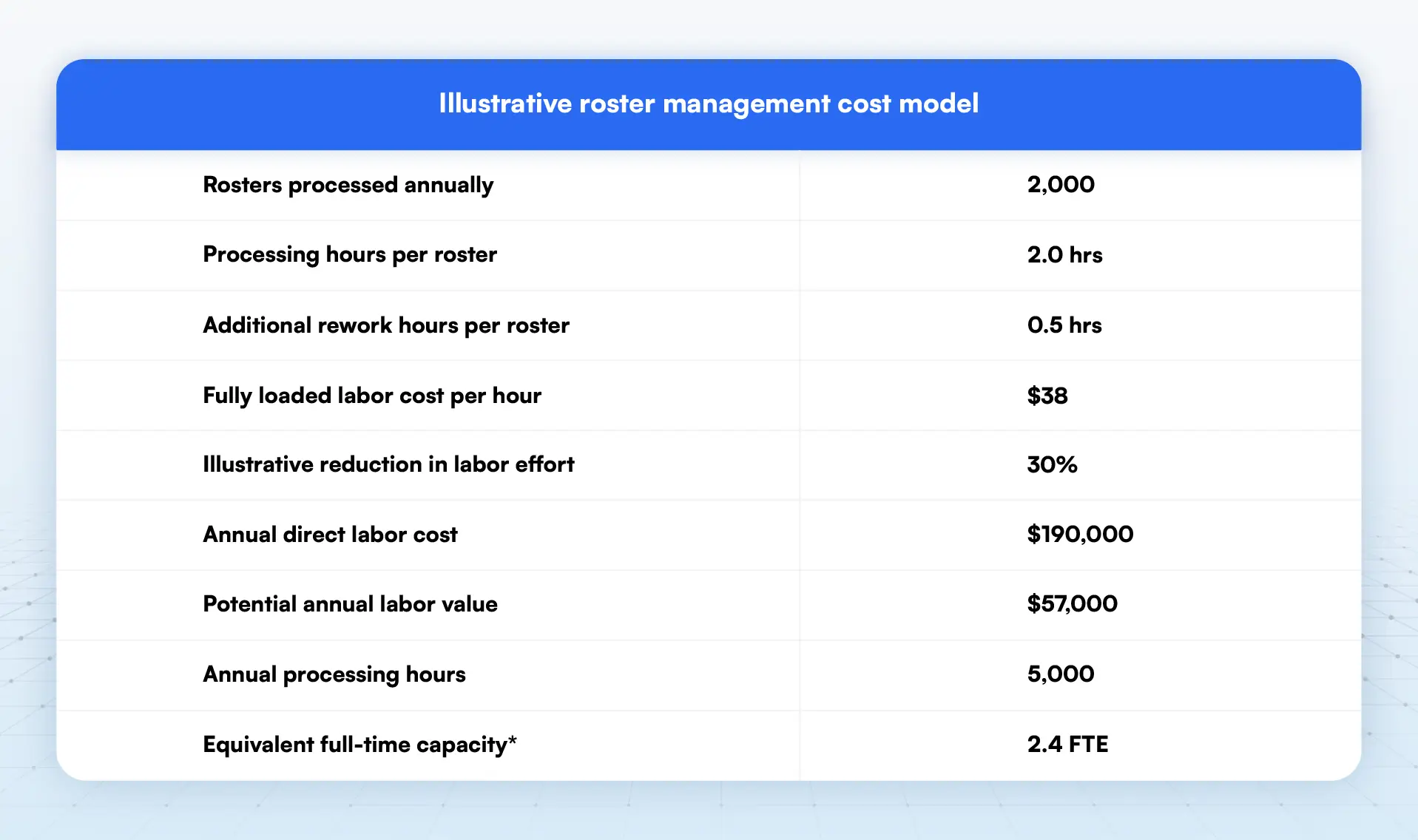
*Uses 2,080 hours per FTE annually. Potential labor value is a modeled opportunity, not guaranteed cash savings. Actual benefits depend on automation performance, implementation costs, adoption, and whether released capacity reduces spending or is redeployed.
How executives should interpret the numbers
Three distinctions matter:
- Current cost: What the plan actually spends on roster processing, validation, exception handling, and rework.
- Recoverable capacity: The staff time that could be released through standardization and automation.
- Realized financial benefit: The portion that translates into lower expenditure, avoided hiring, reduced outsourcing, or measurable additional output.
The third number—not the theoretical value of all processing hours—is what should underpin an investment decision.
4. The regulatory dimension: provider data is becoming an executive accountability issue
The financial case for modernizing roster management is reinforced by growing expectations around provider directory accuracy, timely updates, and data transparency.
Three developments are particularly relevant to health plan leadership.
- Provider directory requirements: The Consolidated Appropriations Act, 2023 established additional provider directory requirements for Medicaid and CHIP programs, effective July 1, 2025.
- Timely publication of updates: CMS states that impacted Medicare Advantage and Medicaid/CHIP programs must make specified provider directory information available through public-facing APIs, with directory information updated within 30 calendar days of receiving provider information or an update. Requirements vary by payer type and program.
- Increasing accountability for Medicare Advantage: A CMS proposed rule published October 20, 2026, addresses new provider directory verification, accuracy analysis, reporting, and accountability provisions under the REAL Health Providers Act, with requirements proposed for contract year 2028. These provisions should be distinguished from finalized requirements.
For executives, the implication is clear that the provider data management cannot remain solely a back-office processing function. It is part of the operating infrastructure supporting network integrity, member access, and regulatory readiness.
Automation alone does not ensure compliance. Health plans still need appropriate verification, auditability, exception management, and controls over changes to provider records.
5. Why adding more staff is not a sustainable answer
When roster volumes increase, adding staff can provide immediate relief. But it does not necessarily address the underlying causes of operational cost.
A predominantly manual model tends to retain three structural constraints:
Fragmented intake. Provider groups submit rosters in different formats, forcing teams to normalize data before processing can begin.
Rules-based processing without sufficient intelligence. Traditional scripts and rigid templates can handle predictable formats but often struggle with inconsistent fields, ambiguous values, and complex exceptions.
Limited visibility across the workflow. If intake, validation, correction, and downstream delivery are managed through disconnected processes, leaders may lack a consolidated view of turnaround time, recurring errors, and the cost of exceptions.
The result is an operating model that can become increasingly expensive as the provider network expands.
The strategic alternative is not simply to process files faster. It is to reduce the amount of manual intervention required to turn incoming roster data into reliable, usable provider information.
6. What a modern roster management operating model should look like
Health plans should evaluate modernization against six practical capabilities.
- Standardized intake
Accept roster files across supported formats and normalize data without repeated manual reformatting.
- Intelligent provider matching
Match records using appropriate identifiers and attributes, flagging ambiguous matches for review rather than forcing uncertain decisions.
- Automated validation
Apply configurable business rules to identify missing, inconsistent, duplicate, or potentially outdated information.
- Exception-based workflows
Route genuine exceptions to the right teams with context, rather than requiring staff to inspect every record manually.
- Controlled downstream delivery
Support approved updates to relevant provider data systems, with reconciliation, audit trails, and clear error handling.
- Operational performance measurement
Track cost per roster, processing time, first-pass acceptance, rework, exception rates, and on-time delivery.
The objective is to establish a controlled, measurable workflow in which automation handles repeatable work and employees focus on exceptions requiring judgment.
7. The HiLabs perspective: move from roster processing to roster intelligence
At HiLabs, roster automation is part of a broader approach to provider data intelligence: helping health plans transform fragmented provider information into accurate, actionable operational data.
A modern roster automation capability should do more than ingest files. It should help health plans standardize incoming information, validate records, manage exceptions, and deliver approved updates into downstream workflows.
The value proposition is particularly relevant for plans managing large delegated networks, multiple provider groups, frequent roster submissions, and complex provider data environments.
For example, HiLabs has reported the following outcomes from a roster automation deployment* for a leading behavioral health payer:
- ~2,000 - Provider rosters in scope
- 86% -Active adoption among delegated groups live on the platform
- 100% - On-time delivery reported for the deployment
- 100+ - Provider groups across the delegated network
*HiLabs-reported deployment metrics. These are specific implementation outcomes, not independently verified industry benchmarks or guaranteed results for other health plans.
These metrics illustrate why automation should be evaluated through both operational performance and adoption. Technology creates value when it is embedded into the actual workflows used by provider groups and health plan teams.
8. The executive scorecard: what should you measure?
Before approving a transformation initiative, leadership should establish a baseline and agree on the measures that will determine success.
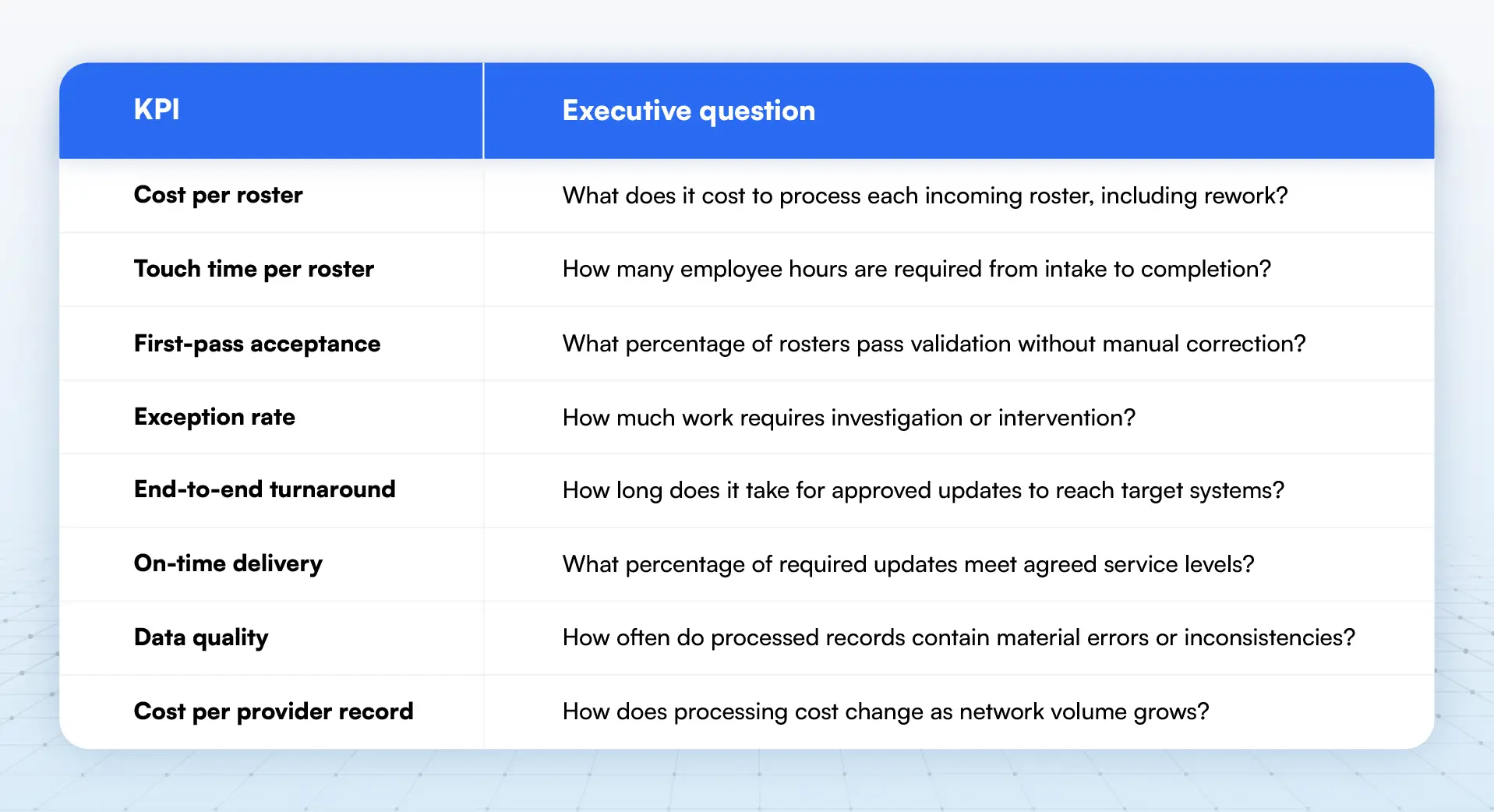
These KPIs should be segmented by roster source, provider group, file format, and workflow wherever possible. Otherwise, an improving average can obscure persistent inefficiencies in the most complex parts of the network.
Conclusion: Protect the margin by redesigning the work
Manual roster management may appear to be a small operational expense when viewed one file at a time. Across thousands of submissions, multiple provider groups, and interconnected systems, it can represent a recurring drain on labor capacity and operational performance.
The opportunity is not to eliminate human oversight. It is to reserve that oversight for the work that genuinely requires it.
For health plan executives, the starting point is a simple question:
If your provider network grows by 20%, will your roster management costs grow by 20% as well—or can your operating model absorb that growth without a proportional increase in resources?
The answer depends on how effectively the plan standardizes intake, automates validation, resolves exceptions, and measures performance.
The next step is to quantify the current cost, identify the largest sources of rework, and build a business case around measurable improvements—not assumed savings.