


Buying the software is the easy part. Making it work across the health plan is where the real challenge begins.
Provider network management rarely gets the attention it deserves until something goes wrong. A provider directory contains outdated information. A roster takes weeks to process. A network operations team spends hours reconciling records across systems. Or a provider's information is corrected in one application but remains unchanged in another.
For many health plans, these are not isolated incidents. They are symptoms of a larger problem: provider information is spread across systems, teams, and processes that do not always work well together.
New software is often seen as the solution. Yet even after a significant technology investment, many of the same problems can persist.
Why? Because implementing provider network software is not just a technology exercise. It requires getting the data right, connecting existing systems, rethinking workflows, and making sure people use the new platform.
For health plan leaders, the question should not be simply, Which provider network platform should we buy? It should be, What will it take to make provider network operations more accurate, efficient, and easier to manage?
1. Better software cannot compensate for poor provider data
Provider information comes from many places: credentialing systems, claims platforms, provider rosters, contracts, government databases, and information submitted directly by providers. Each source serves a purpose, but the information does not always match.
A provider may have a new practice location in one system and an old address in another. A group affiliation may have changed without being updated everywhere. Two systems may contain separate records for the same provider.
When a new platform imports this information without properly identifying and resolving these discrepancies, the problems simply move into the new system.
The interface may look better, but the underlying data remains unreliable.
This matters because provider data supports much more than directory maintenance. It influences network adequacy assessments, member access, provider communications, claims-related processes, and regulatory reporting.
The challenge is also consistent with broader industry research. The CAQH Index has documented the financial and operational benefits of automating healthcare administrative transactions. Its 2025 Index, published in February 2026, estimated that electronic transactions and improved data exchange helped the U.S. healthcare system avoid $258 billion in administrative costs in 2024. This is an industry-wide estimate, not a measure of savings from provider network software alone. It nevertheless highlights the value of improving administrative processes and information exchange. Source: CAQH, 2025 Index announcement.
What should health plans look for?
Before selecting a platform, teams should understand how it handles conflicting records, duplicate providers, changing affiliations, and outdated information. They should also ask how the system validates data against authoritative sources, tracks changes, and flags records that need human review.
Most importantly, vendors should demonstrate these capabilities using the health plan's own representative data—not just a carefully prepared product demonstration.
2. Automating one task does not fix the entire workflow
Provider network operations involve a chain of activities. A provider may need to be onboarded, credentialed, contracted, added to a roster, validated, and published in a directory. Each step may involve a different team or system.
Automating one part of this process can help, but it does not necessarily eliminate the delays around it.
For example, a platform might ingest provider rosters automatically, yet still require employees to investigate exceptions manually, chase approvals over email, and update downstream systems separately. The initial task becomes faster, but the overall process remains slow.
This is one reason technology implementations sometimes struggle to deliver the expected return on investment. The organization has automated a task without addressing the wider process.
The more useful question is whether the software can help teams move work from intake to completion with fewer handoffs, less rework, and better visibility into outstanding issues.
Before buying, health plans should ask vendors to walk through real operational scenarios. How does the platform handle an incomplete roster? What happens when two records conflict? Can an exception be assigned, tracked, resolved, and documented without moving between multiple applications?
These details often reveal more about a platform's value than a long list of features.
3. Integration problems can turn a promising implementation into a prolonged project
Provider network software must work alongside the systems a health plan already uses. These may include credentialing applications, claims platforms, contracting tools, enterprise data environments, and provider directories.
The difficulty is not simply connecting these systems. It is ensuring that information moves between them correctly, at the right time, and with clear accountability when something fails.
An update might be accepted by one application but rejected by another. A batch transfer may be delayed. A custom interface may work under normal conditions but struggle with peak volumes.
When these dependencies are not understood early, implementation teams can end up spending considerable time troubleshooting interfaces and maintaining workarounds.
This is particularly important for health plans with established technology environments, multiple business units, or delegated provider networks.
Before committing to a vendor, IT and operations teams should agree on which system owns each data element, how updates will be exchanged, and how errors will be handled. Integration testing should include rejected records, duplicate messages, high-volume processing, and recovery from failed transactions.
A realistic implementation plan should also make responsibilities clear. Not every delay originates in the software itself; some depend on customer infrastructure, third-party applications, or operational readiness. Those dependencies need to be identified before they become project risks.
4. Employees and providers may continue using the old process
A new platform can be technically sound and still struggle to gain traction.
Consider a network operations team that has spent years working with spreadsheets and familiar applications. If the new platform introduces additional steps, requires duplicate data entry, or makes exceptions harder to resolve, employees may continue using the old process alongside the new one.
Providers and delegated entities can face similar challenges when they are asked to use different portals or submit information through unfamiliar workflows.
The result is a frustrating middle ground: the health plan has paid for new technology but has not fully moved away from its previous way of working.
Adoption needs to be considered from the beginning. That means understanding how different users work today, identifying unnecessary steps, and involving frontline teams in testing and process design.
It also means measuring whether the new platform is being used or not. Training attendance and user account creation are not enough. More meaningful indicators include active usage, completed workflows, reduced manual work, and the gradual retirement of legacy workarounds.
The best implementation is not necessarily the one with the most sophisticated interface. It is the one that makes the right way of working easier for people to follow.
5. Compliance cannot depend on periodic data clean-up
Provider information is closely tied to directory accuracy, network adequacy, and members' ability to find appropriate care. Inaccurate or outdated information can create operational problems and regulatory exposure.
Government requirements make this an ongoing responsibility rather than an occasional clean-up exercise.
For example, CMS has established provider directory API requirements for specified payer programs, including Medicare Advantage and Medicaid managed care. Applicable rules include requirements for making covered provider directory information available through APIs and updating information within specified timelines. For covered directory information, the relevant update requirement generally includes a 30-calendar-day timeframe following receipt of provider information or an update, subject to the applicable program rules. Source: CMS, Provider Directory API FAQs.
For health plans, the practical challenge is making sure provider changes are identified, validated, and reflected in the appropriate systems without relying on repeated manual intervention.
A platform should help teams track changes, flag discrepancies, assign corrective actions, and retain evidence of what was changed and when. It should also support the applicable data formats and reporting requirements.
During vendor evaluation, compliance teams should be involved alongside IT and operations. They can help determine whether the proposed solution supports the organization's actual regulatory obligations rather than simply offering a generic compliance dashboard.
6. Go-live is not the same as success
Technology projects are often judged by whether the platform was delivered on time, integrations were completed, and users were trained.
These are important milestones, but they do not tell executives whether the investment has improved the business.
Has provider onboarding become faster? Are fewer records being returned for correction? Has the time spent reconciling rosters declined? Can the organization identify data discrepancies earlier? Are teams spending less time on repetitive administrative work?
Without answers to these questions, it is difficult to know whether the new platform is delivering the intended value.
Health plans should establish baseline measures before implementation and agree with the vendor on how progress will be assessed.
Useful measures include:
- Processing efficiency: Time required to process provider rosters and complete onboarding.
- Data quality: Duplicate records, incomplete information, validation accuracy, and outdated records.
- Workflow performance: Exception rates, rework, outstanding backlog, and time to resolve discrepancies.
- Adoption: Active usage, workflow completion, and reduction in manual workarounds.
- Compliance: Timeliness of required updates and the ability to trace and document corrections.
- Financial impact: Verified reductions in processing effort, cost per record, and avoidable administrative expense.
Financial benefits should be calculated using the health plan's actual costs and operating volumes. Savings should not be based solely on vendor projections, and potential benefits should not be counted twice across different workflows.
A clear measurement framework helps executives distinguish a successful deployment from a genuinely successful transformation.
What should health plans evaluate before choosing a provider network platform?
There are no shortage of platforms promising automation, improved data quality, and greater efficiency. The challenge is determining which capabilities will address the health plan's specific operational problems.
A practical evaluation should cover six areas:
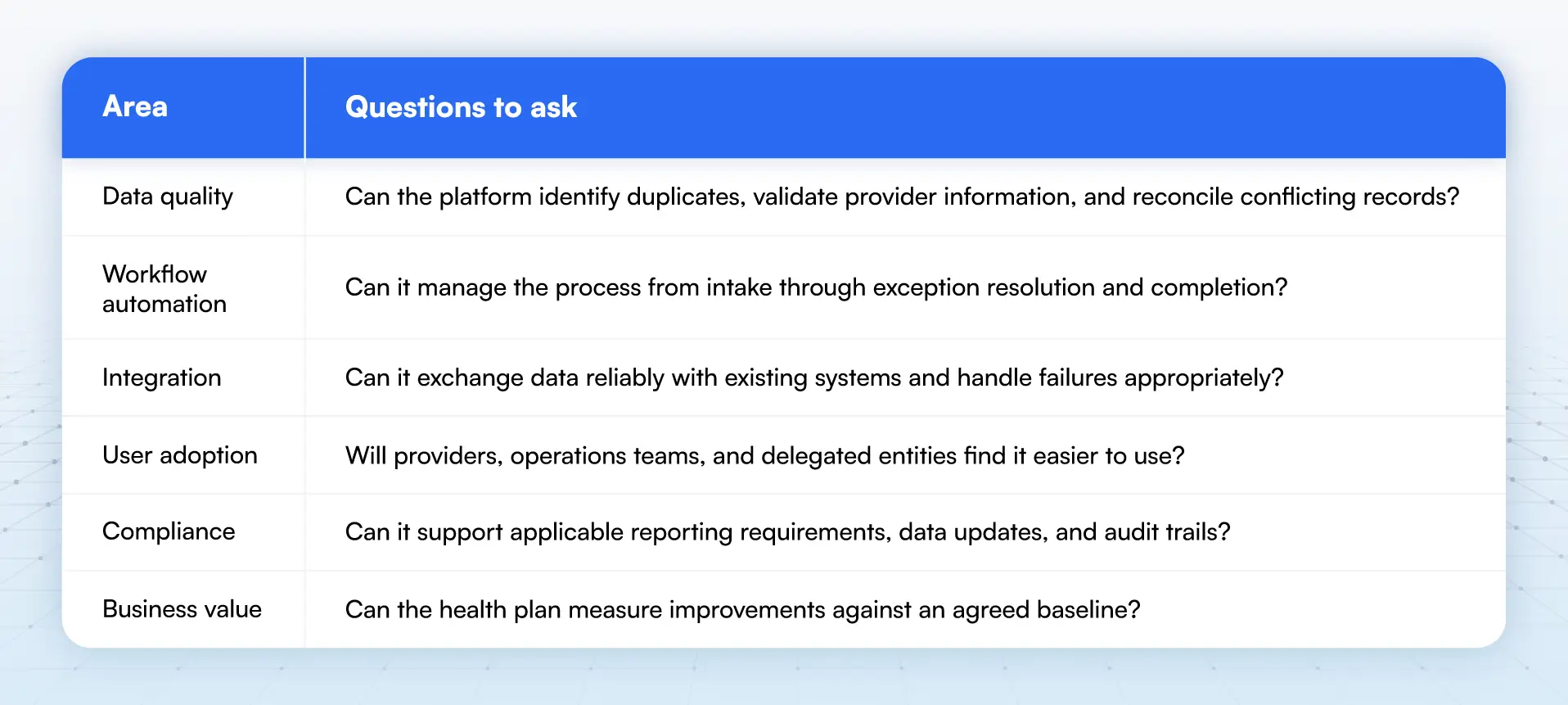
A proof of concept should use realistic data and operational scenarios. It should include incomplete submissions, conflicting records, exceptions, and integration failures—not just the straightforward cases that every platform is designed to handle.
It is also worth involving operations, IT, compliance, and provider-facing teams in the decision. Each sees a different part of the problem, and overlooking any of them can create difficulties after implementation.
The bigger opportunity: From managing provider records to improving network operations
Provider network management is often treated as a back-office function. In practice, it affects how well a health plan understands its network, maintains provider relationships, supports member access, and manages administrative costs.
The opportunity is to move beyond repeatedly correcting provider information and toward an operating model in which data is validated earlier, changes are tracked more effectively, and exceptions are easier to resolve.
That requires more than installing another application. It requires trusted data, well-designed workflows, reliable integrations, and a clear understanding of what success looks like.
For health plan executives, the takeaway is clear that the right provider network software should make operations measurably better, not simply make existing processes digital.
How HiLabs can help?
At HiLabs, we believe better payer operations start with better data intelligence.
Our approach focuses on helping health plans improve provider data quality, reduce manual reconciliation, strengthen network integrity, and make provider information more useful across operational workflows.
The goal is to help health plans move from repeatedly fixing data problems to identifying them earlier and managing them more intelligently.