



Provider networks do not sit still. Providers retire, relocate, change specialties, stop accepting new patients, or leave a group altogether, often without telling every payer they are contracted with. Multiply that churn across a national network of tens of thousands of providers, and it becomes clear why provider data management has become one of the most consequential operational functions inside a health plan.
The stakes are no longer just administrative. Growing provider networks, tightening CMS oversight, and rising member expectations have turned fragmented provider data into a strategic liability. A single wrong phone number in a directory can mean a member cannot find care. A stale panel status can trigger a compliance finding. A duplicate record can slow a credentialing cycle by weeks. None of this is new, but the tolerance for it has disappeared.
This is why more health plans are moving away from one-off directory clean-ups and toward a formal provider data management framework: a repeatable, governed system for how provider information is captured, validated, standardized, and published across every downstream system.
Why Provider Data Management Matters More Than Ever
Three forces have converged to make accurate, well-governed provider data a board-level concern rather than a back-office task.
Growing provider networks. Health plans have expanded their networks to meet member demand and regulatory network adequacy requirements, but larger networks mean more sources of change, more contracted entities, and more room for records to drift out of sync. Provider directory management that once relied on a small team making periodic phone calls simply cannot keep pace with networks of this size and treating it as a side task rather than a core discipline is no longer a viable posture.
Regulatory pressure has intensified sharply. CMS's own national review found that nearly half of provider locations in Medicare Advantage online directories contained at least one inaccuracy — wrong phone numbers, incorrect addresses, or outdated acceptance status. In response, oversight has tightened on multiple fronts: the No Surprises Act requires 90-day verification cycles and rapid directory updates, Medicaid managed care programs must now update directories within 30 days of a known change, and beginning with the 2027 plan year, Medicare Advantage plans will be required to submit their provider directories directly to CMS for publication on the Medicare Plan Finder. Provider data accuracy is no longer an internal compliance exercise. It is about to become publicly visible and directly comparable across plans.
Operational inefficiency compounds the problem. Manual verification across the industry costs billions annually, and the 2024 CAQH Index estimates the healthcare industry spends roughly $90 billion a year on administrative transactions between payers and providers, with more than $20 billion in additional savings available simply by automating the manual and partially electronic work still on the table. Provider data quality problems do not stay contained to the directory team. They ripple into claims accuracy, network adequacy reporting, member experience, and provider abrasion, since providers who are repeatedly contacted for the same verification request tend to disengage from the process altogether.
Taken together, these pressures explain why a growing number of health plans are re-architecting how they manage provider data from the ground up rather than patching the same manual processes year after year.

Common Challenges Health Plans Face Managing Provider Data
Most health plans do not lack the desire to fix their provider data. They lack a structural approach to doing it. A few challenges show up repeatedly.
Multiple disconnected data sources
Provider information typically enters a health plan through credentialing systems, claims data, contracting documents, provider portals, and direct outreach, each maintained by a different team with its own format and update cadence. Without a single source of truth, these systems drift apart, provider directory management becomes fragmented across teams, and provider data governance becomes nearly impossible to enforce consistently.
Frequent provider changes
Providers change practice locations, panel status, and affiliations constantly, and most of these changes are never proactively reported to every payer they are contracted with.
Manual outreach and verification
Traditional verification still relies heavily on phone calls and faxes. Manual phone verification alone averages roughly 4.22 minutes per provider at a cost of about $4 per provider per location — a cost structure that simply does not scale to a 90-day verification cycle across a large network.
Inaccurate provider directories
The consequences of the above show up directly in what members see. Fifty-eight percent of health plan members report encountering incorrect information in a provider directory, such as a wrong address or outdated availability, at least once, and a broader consumer survey found that 33% of provider directory users have encountered outdated or incorrect information when searching for care. These are the "ghost network" listings that regulators and members alike have grown far less tolerant of.
Duplicate provider records
The same provider frequently exists as multiple records across different systems and data feeds, each slightly different, which undermines any attempt at a single authoritative provider master data management approach.
Lack of governance
Without clear ownership of who is accountable for provider data accuracy, corrections happen inconsistently, error rates creep back up after clean-up projects, and provider data governance becomes reactive rather than continuous.
Left unaddressed, these challenges do not stay static. They compound as networks grow, which is exactly why a scalable, componentized framework matters more than another one-time remediation effort.
The 7 Core Components of a Scalable Provider Data Management Framework
A durable provider data management framework rests on seven interdependent components. Each addresses a specific failure point identified above, and together they form a system rather than a series of disconnected fixes.
1. Provider Data Governance
Governance establishes who owns provider data decisions, how disputes between conflicting sources are resolved, and what standards a record must meet before it counts toward provider data accuracy. Without this foundation, every other component in the framework eventually erodes, because there is no clear authority to enforce consistency across teams.
2. Master Provider Record
A master provider record consolidates every provider's information into a single authoritative profile, resolving duplicates and conflicting entries from credentialing, claims, contracting, and outreach systems. This is the foundation of provider master data management, and the reference point every downstream system should draw from.
3. Automated Provider Data Validation
Automated provider data validation applies rules-based and AI-driven checks to catch errors — mismatched NPIs, invalid addresses, inconsistent specialties — before they ever reach a published directory, rather than relying on downstream complaints to surface them.
4. Continuous Provider Verification
Rather than treating verification as a periodic project, continuous provider verification builds outreach into a rolling cycle aligned to regulatory cadence. Industry guidance has shifted decisively in this direction, with MA, Marketplace, and Medicaid programs now requiring provider data verification every 90 days, moving away from the older quarterly framing, and with an expectation that plans act on data changes as soon as they are identified rather than waiting for the next verification window.
5. Data Standardization
Standardization normalizes formats, taxonomies, and identifiers across every source system, so a specialty coded one way in a claims feed matches the same specialty coded differently in a credentialing system. This step is what makes automated validation and matching reliable at scale.
6. Workflow Automation
Workflow automation routes flagged records, outreach responses, and approvals through defined paths automatically, removing the bottlenecks created by manual hand-offs between credentialing, network operations, and compliance teams.
7. Analytics & Compliance Monitoring
The final component closes the loop, tracking accuracy rates, verification completion, and audit readiness on an ongoing basis so that leadership has visibility into provider data quality before a regulator or a member finds the gap first.
Each of these components can be implemented independently, but their real value compounds when they operate together as a single, governed system rather than as isolated point solutions bolted onto legacy processes.

The Provider Data Lifecycle
A useful way to visualize how these seven components function together is as a continuous lifecycle rather than a linear project:
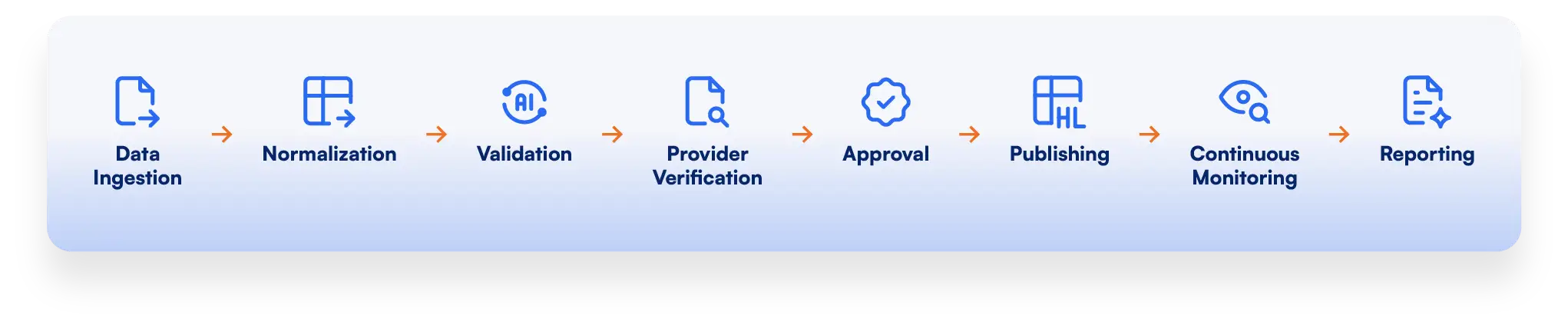
Provider data enters the system from multiple channels, gets standardized into a common format, passes through automated and human validation, is confirmed directly with the provider, receives approval against governance rules, is published to directories and downstream systems, and then re-enters continuous monitoring so the cycle begins the moment new information surfaces again. Treating provider data management as a lifecycle rather than a one-time cleanup — and treating provider directory management as its most visible output — is what allows a health plan to sustain accuracy rather than repeatedly re-earning it.
How AI Is Transforming Provider Data Management
Manual processes were never built to operate at the speed regulators and members now expect, which is precisely where AI has started to change what is operationally realistic.
AI matching resolves duplicate and conflicting provider records across disparate systems far faster than manual reconciliation, directly supporting provider master data management at scale.
AI voice agents and automated outreach can conduct provider verification calls around the clock, working through IVR systems and following up automatically, which shortens the time between a provider change occurring and it being reflected in the directory.
Field-level verification allows AI systems to confirm individual data points — an address, a phone number, a panel status — rather than requiring a full manual review of an entire provider record every time one detail changes.
Continuous monitoring and intelligent workflows flag anomalies as they emerge and route them for review automatically, shifting provider data verification from a scheduled event to an always-on process.
This shift matters because the compliance environment has already moved past what manual capacity can support. Ghost network findings illustrate the scale of the gap: a 2025 review of behavioral health networks across Medicare Advantage and Medicaid managed care found that 72% of a sample of inactive providers should not have been listed in the insurer's network at all, and a separate KFF analysis found that Medicare Advantage plans include just 48% of the doctors who accept traditional Medicare in their directories. Closing gaps at this scale through phone calls alone is not a viable long-term provider data management strategy. AI does not replace governance or human judgment, but it removes the volume constraint that has kept most health plans reactive.
Best Practices for Building an Enterprise Provider Data Management Program
Health plans that succeed at sustaining accuracy over time tend to follow a consistent set of practices:
- Establish clear ownership for provider data decisions rather than leaving accountability spread across teams.
- Build governance before investing in tooling, so technology reinforces a defined standard rather than automating inconsistency.
- Validate continuously, not on a periodic clean-up cycle that allows error rates to creep back up between projects.
- Automate outreach to meet 90-day verification requirements without proportionally scaling headcount.
- Measure data quality with defined, trackable metrics rather than anecdotal complaint volume.
- Integrate downstream systems so a correction made once propagates to every directory, claims system, and provider-facing portal that depends on it.
- Track KPIs on an ongoing basis so leadership can see accuracy trends before an audit does.
None of these practices are exotic. What separates health plans that sustain accuracy from those that keep re-running the same clean-up project is discipline in applying all seven consistently, rather than treating any single one as sufficient on its own.
KPIs Every Health Plan Should Track
A provider data quality program is only as strong as the metrics used to monitor it. At minimum, health plans should track:
- Provider data accuracy rate — the share of records free of material errors
- Verification rate — the percentage of the network confirmed within the required cycle
- Directory accuracy — accuracy as experienced by members using public-facing directories
- Time to validate — how long it takes a flagged change to move from identification to correction
- Provider outreach completion rate — the percentage of outreach attempts that reach resolution
- Duplicate rate — the proportion of provider records identified as duplicates within the master record
- NPI accuracy — the rate of correctly matched and validated National Provider Identifiers
- Panel status accuracy — how reliably a provider's stated acceptance of new patients matches reality
Tracking these consistently turns provider data quality from a subjective impression into a measurable, auditable discipline that can be reported to leadership and regulators alike.
How HiLabs Helps Health Plans Modernize Provider Data Management
HiLabs supports health plans across every stage of the provider data lifecycle, combining AI matching, voice AI, and automated verification with the governance structure needed to sustain accuracy over time. This includes AI-driven provider verification built for continuous, high-volume outreach; roster automation that ingests and standardizes provider files from disparate delegated groups; and directory validation that catches errors before they ever reach a published, member-facing directory. Structured outputs and compliance-ready reporting give health plan teams the audit trail they need as CMS oversight continues to tighten, without requiring a proportional increase in manual review staff.
Health plans working with HiLabs can move away from periodic, reactive clean-up projects and toward a sustained provider data management framework that keeps pace with network growth and regulatory expectations alike.
