


The AI Inflection Point in Healthcare
Artificial intelligence has entered healthcare with unprecedented momentum. Across payer, provider, and healthcare technology organizations, leadership teams are actively evaluating how AI can reduce administrative burden, improve operational efficiency, accelerate decision-making, and create more intelligent member and provider experiences. However, as AI adoption matures, the industry is confronting a far more strategic question: will generalized horizontal AI platforms be enough for healthcare, or will the future belong to vertical AI in healthcare — systems purpose-built for the operational complexity of the industry itself?
Horizontal AI platforms have demonstrated extraordinary value across industries. These generalized systems excel at content generation, workflow assistance, enterprise productivity augmentation, summarization, and automation. Their scalability and broad applicability have made them foundational to the current AI wave. According to McKinsey's 2025 healthcare AI research, more than 80% of healthcare organizations are already exploring or implementing generative AI capabilities, with many rapidly moving from pilot programs toward enterprise-scale deployment. The value proposition is compelling: faster workflows, lower friction, improved workforce productivity, and accelerated digital transformation.
Why Is Healthcare Different?
Healthcare is fundamentally different from most industries. It is not simply a workflow problem — it is a context problem.
Healthcare operates within one of the most fragmented and operationally complex data ecosystems in the global economy. Provider data alone spans credentialing systems, claims platforms, provider directories, delegated entities, contracting systems, clinical systems, and regulatory reporting environments — all operating across different formats, governance models, identifiers, and interoperability standards. The result is operational fragmentation at massive scale.
According to CAQH, the U.S. healthcare industry avoided approximately $258 billion in administrative costs through automation and electronic workflows in 2024, yet has more than $21 billion in additional savings opportunity through further automation and interoperability improvements. At the same time, more than 50% of health plans are already leveraging AI in administrative workflows, signaling that AI healthcare operations automation is quickly becoming mainstream.
However, the industry's core challenge is not simply automation. It is the ability to operationalize trusted intelligence across deeply fragmented systems. Provider directory inaccuracies continue to create regulatory exposure, member dissatisfaction, network friction, and administrative inefficiencies across payer organizations. Disconnected systems, inconsistent data lineage, and poor data governance continue to undermine operational agility. In this environment, generalized AI models frequently struggle because they lack the domain-specific context required to navigate healthcare's operational realities.
Horizontal AI vs. Vertical AI in Healthcare
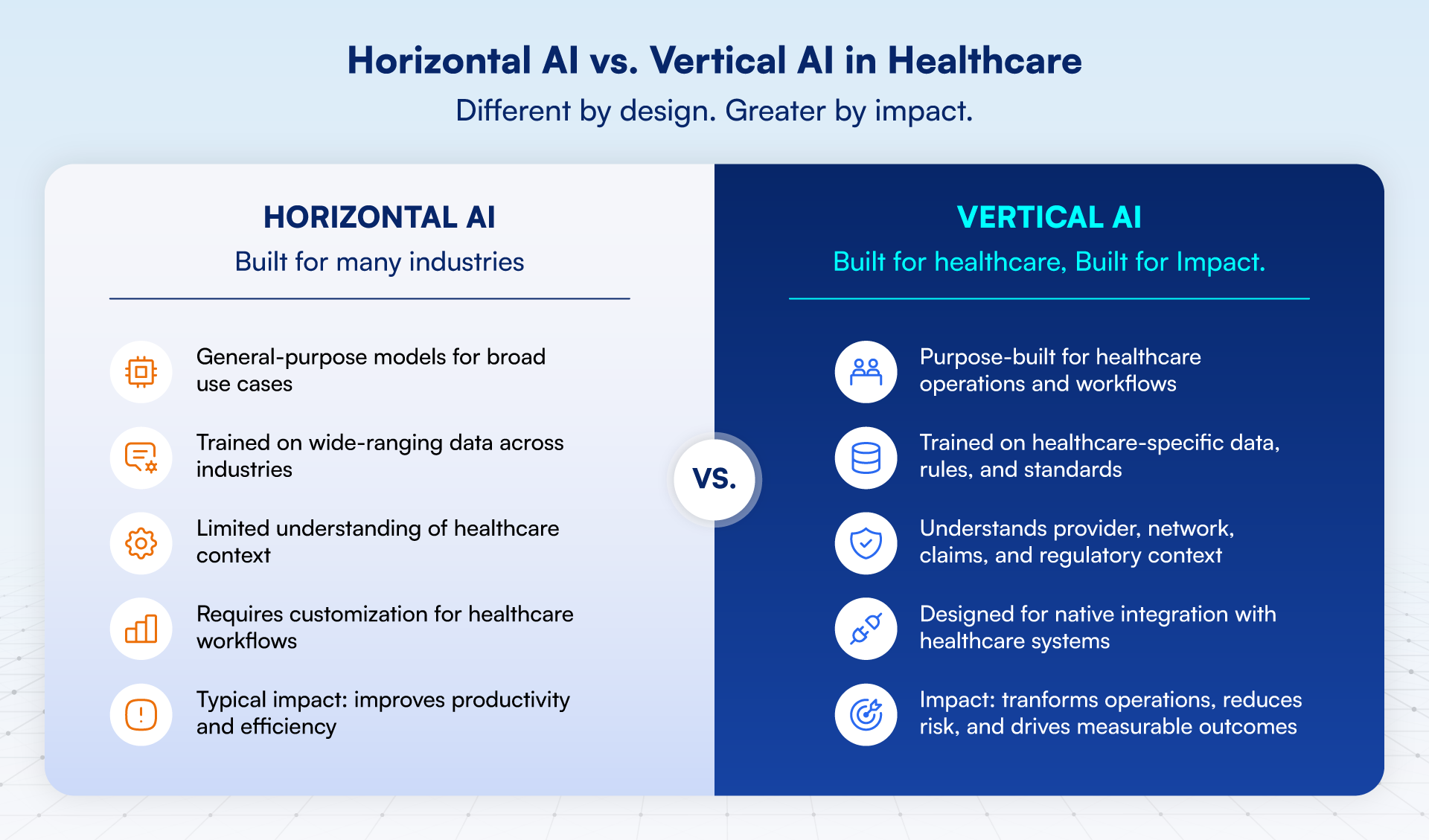
This is where vertical AI in healthcare becomes strategically important. Unlike horizontal AI, vertical AI systems are purpose-built for a specific industry domain. In healthcare, these systems understand provider hierarchies, NPI relationships, claims logic, clinical terminology, interoperability standards, contract structures, network adequacy requirements, value-based care workflows, and regulatory obligations. The horizontal AI vs. vertical AI healthcare debate is therefore not merely academic — it has direct implications for operational outcomes, compliance performance, and enterprise agility.
This distinction matters because healthcare AI effectiveness is not driven solely by model sophistication. It is driven by operational context.
The organizations generating the greatest enterprise value from AI are increasingly those embedding AI directly into operational infrastructure rather than layering generic productivity tools on top of fragmented systems. Boston Consulting Group recently noted that only a small percentage of organizations are currently generating meaningful enterprise-scale value from AI investments, with leading organizations differentiating themselves through workflow redesign, operational integration, and strong data governance. Healthcare is likely to amplify this divide even further — making a clear healthcare AI strategy for payers an urgent priority.
The Rise of Healthcare-Native AI Platforms
This is precisely why purpose-built healthcare AI platforms are emerging as a critical strategic layer within the industry. Companies such as HiLabs are building vertical AI in healthcare specifically designed to solve operational data integrity challenges across the payer ecosystem.
Rather than applying generalized AI models to healthcare workflows, HiLabs focuses on roster automation, provider directory accuracy, network adequacy and optimization, contract intelligence, clinical intelligence, value-based care, and beyond. Through its MCheck® platform, the company applies healthcare-trained AI and machine learning models to ingest, clean, standardize, validate, enrich, and operationalize fragmented healthcare data environments.
The scale of the underlying problem is significant. A four-million-member health plan may spend nearly $20 million annually manually correcting provider data errors and operational inconsistencies.
These are not isolated operational inefficiencies. They directly impact compliance performance, network adequacy, member experience, provider relationships, administrative cost structures, and revenue integrity.
In this environment, vertical AI in healthcare becomes more than a technology capability — it becomes operational infrastructure.
A Concrete Example of Vertical AI in Healthcare
A strong example of vertical AI in healthcare is HiLabs' application of AI and machine learning to provider data management and healthcare AI payer operations.
Unlike horizontal AI systems designed for generalized productivity tasks, HiLabs has built healthcare-native AI models specifically trained to understand the complexity of provider data ecosystems within health plans. This includes provider rosters, NPI relationships, credentialing records, network participation data, claims systems, provider directories, contracts, and regulatory reporting requirements.
For example, a national or regional health plan may receive provider roster updates from hundreds of delegated entities, provider groups, hospitals, and ancillary networks — often in inconsistent formats with incomplete, duplicate, or conflicting information. Traditional manual workflows require significant operational effort to validate, normalize, and reconcile this data across systems, frequently resulting in directory inaccuracies, delayed updates, compliance risk, and provider abrasion.
HiLabs addresses this challenge through its MCheck® platform, which applies purpose-built vertical AI in healthcare to automatically ingest, cleanse, standardize, enrich, and validate provider data across fragmented systems. The platform uses healthcare-specific entity resolution and relationship intelligence to identify duplicate providers, map provider affiliations, validate network participation, detect inconsistencies, and continuously monitor data quality.
This is vertical AI in healthcare because the intelligence layer is specifically designed around healthcare operational logic rather than generalized automation. The system understands healthcare-specific constructs such as:
- National Provider Identifier (NPI) relationships
- Provider hierarchies and affiliations
- Specialty mappings and custom business rules
- Delegated roster workflows
- CMS provider directory requirements
- Contract participation logic
- Healthcare interoperability standards
The business impact is significant. Provider directory inaccuracies affect approximately 81% of provider records, while more than 95% of Medicare Advantage plans fail CMS directory audits due to data quality issues. By automating provider data quality management, health plans can reduce administrative overhead, improve compliance performance, accelerate provider onboarding, enhance member experience, and strengthen network accuracy.
This illustrates how vertical AI platform health plans adopt moves beyond generic AI productivity tools and becomes operational infrastructure embedded directly into payer workflows.

The Future: AI-Native Healthcare Operations
The next phase of healthcare transformation will likely not be led by organizations deploying AI as standalone copilots. It will be led by organizations building AI-native operating models where intelligence is embedded directly into payer operations, provider data ecosystems, compliance workflows, and decision-making infrastructure.
Real-time workflow orchestration, continuous compliance monitoring, intelligent contract analysis, automated roster ingestion, and healthcare-specific entity resolution will increasingly become foundational operational capabilities rather than future-state aspirations. Supporting these capabilities requires a well-defined healthcare AI strategy for payers — one that distinguishes where generalized tools are sufficient and where vertical AI in healthcare is essential.
Importantly, recent healthcare AI research reinforces that success in healthcare AI depends far more on domain-specific data ecosystems, workflow integration, governance structures, and operational alignment than on model capability alone. This is why the future of healthcare AI will likely not be a binary choice between horizontal and vertical. It will be foundational AI models enhanced by vertical intelligence layers purpose-built for healthcare operations — the most effective healthcare AI payer operations will combine both.
Foundational models may eventually become commoditized. Operational healthcare intelligence will not.
Strategic Implications for Healthcare Leaders
For healthcare executives, the strategic question is no longer whether to adopt AI. The more important question is where AI can remain generalized and where it must become healthcare-native.
Generalized AI may improve productivity, but vertical AI in healthcare has the potential to fundamentally transform operations, compliance, network management, administrative efficiency, and enterprise agility. Health plans that adopt a purpose-built vertical AI platform stand to gain a durable competitive advantage — not just through incremental productivity gains, but through the kind of systemic operational improvements that redefine what is possible in AI healthcare operations automation.
In an industry defined by fragmented data, operational complexity, and regulatory scrutiny, organizations that build trusted vertical intelligence infrastructure will likely create the greatest long-term enterprise value.
Healthcare AI succeeds not because it processes data faster, but because it understands the complexity behind the data.
