


Healthcare roster management remains one of the most manual and error-prone processes in payer operations. Delegated entities submit files in a dozen different formats. Providers change practices, drop specialties, and update addresses on their own timelines. Somewhere between submission and downstream update, data errors accumulate — quietly, until they surface as a compliance citation, a claims denial, or a member calling a number that rings to a disconnected line.
As provider networks grow and regulatory requirements become more demanding, health plans are moving away from spreadsheets and legacy workflows toward purpose-built healthcare roster management software. But not every platform that claims automation delivers it in practice. Choosing the right solution requires understanding what capable roster management actually looks like — and what separates genuine automation from a digitized version of the same manual process.
In this guide, we cover the key capabilities to look for, the common pitfalls to avoid, and how provider roster automation helps health plans improve efficiency, data quality, and provider satisfaction at scale.
Why Traditional Roster Management Is No Longer Sustainable
The Growing Complexity of Provider Rosters
A mid-sized health plan might manage roster submissions from dozens of delegated entities every month — each arriving in a different format, each using different field conventions, each operating on its own submission cadence. Behind every file is a provider network that changes constantly: practitioners joining and leaving groups, billing addresses updated, specialties added or dropped, mid-cycle terminations submitted without context.
The scale of that churn is significant. Roughly 26% of providers experience information changes every 90 days — physicians relocating, retiring, changing practice affiliations, or updating their names — which means a meaningful share of any health plan's network is in flux at any given time. For plans still relying on periodic batch processing, that velocity guarantees a gap between the network on paper and the network in practice.
For Medicare Advantage plans, the compliance stakes have sharpened considerably. CMS directory accuracy requirements and the No Surprises Act's mandate for 48-hour directory updates have made roster latency a regulatory issue, not just an operational one. A provider who left a network three weeks ago but still appears in the member directory isn't just a data quality problem — it's an enforcement exposure.
The consequences play out at scale. A 2023 US Senate Finance Committee secret shopper study found that more than 80% of providers contacted across 12 Medicare Advantage health plan directories were either unreachable, not in-network, or not accepting new patients. For every 10 calls placed to a listed in-network provider, only two resulted in a possible appointment.
The Cost of Manual Roster Processing
The visible costs of manual roster operations are easy to estimate - staff hours per file, error correction cycles, provider inquiry volume. The full picture is harder to model but consistently more significant. Health plans that have accounted for compliance exposure, claims impact from stale provider data, and the opportunity cost of operations staff tied up in routine data hygiene find that the true cost of doing nothing is substantially higher than it appears on the surface.
The scale of that burden is well-documented: the US healthcare industry spends $83 billion annually on staff time for routine administrative transactions between providers and health plans, according to the CAQH 2023 Index. Roster processing is a significant and addressable slice of that figure.
One national Blue plan that modernized its roster operations realized over $80M in operational savings within twelve months — a result that reflects not just processing efficiency but the downstream impact of cleaner data across credentialing, claims, and directory management.
Read the full case study here: KLAS Point of Light
Manual processes also don't scale. Adding roster volume means adding headcount or accepting longer processing cycles — neither of which is sustainable for plans growing through acquisitions, expanding into new markets, or taking on new lines of business. Research published in the American Journal of Managed Care found that provider directory inaccuracies persisted for over 40% of providers for at least 540 days after being identified — well over a year — even after the No Surprises Act took effect. The longer a plan operates without automated roster management, the deeper that backlog grows.
What Is Healthcare Roster Management Software?
Healthcare roster management software is a purpose-built platform that automates the end-to-end lifecycle of provider roster data — from ingestion and standardization through validation, reconciliation, augmentation, and downstream distribution. It's designed specifically for the volume, variability, and compliance demands that health plans face, sitting at the intersection of provider data management and operational workflow automation.
Core Functions of a Modern Roster Management System
A modern roster management system does several things that spreadsheets and generic workflow tools fundamentally cannot:
- Automated ingestion across any file format, eliminating the manual pre-processing step that consumes hours before a roster can even enter the workflow
- Intelligent field mapping that normalizes incoming data against a standard schema without column-by-column manual matching
- Real-time validation against authoritative sources including NPPES, state licensure databases, and internal provider master records
- Exception routing that flags anomalies and directs them to the right reviewer — without holding up the rest of the batch
- A complete audit trail with timestamped data lineage for every change, every source, and every action taken
- Downstream distribution to credentialing systems, claims platforms, and member-facing directories in real time
How Modern Platforms Differ from Legacy Systems
Legacy roster tools were built for a simpler operating environment — smaller networks, more uniform submission formats, and a compliance landscape that predates current CMS and NCQA requirements. Modern healthcare roster management software is architected differently: cloud-native infrastructure that scales with network volume, AI-assisted matching that resolves ambiguous provider records, and configurable business rules that can accommodate the specific logic of individual health plan networks rather than applying generic healthcare data standards.
The practical difference is significant. A legacy system processing a non-standard delegated entity submission may reject it, queue it for manual review, or silently accept it with errors intact. A modern platform handles the variability automatically, routes genuine exceptions to a reviewer, and processes everything else without intervention.
Key Features to Look for in a Healthcare Roster Management Software Solution
Automated Roster Ingestion
The first test of any roster platform is whether it can handle what your delegated entities actually send. That means native support for any file format — Excel, CSV, pipe-delimited, fixed-width, proprietary layouts — without requiring your operations team to reformat submissions before ingestion. Look for intelligent mapping logic that learns from prior submissions and flags deviations automatically rather than failing silently or requiring manual correction on every non-standard file.
Data Standardization and Validation
Ingestion without standardization is a faster way to accumulate the same errors. A capable roster management system normalizes incoming records against a consistent internal schema — harmonizing field names, address formats, specialty codes, and effective dates across submissions from multiple sources — and then validates the result against authoritative external sources before anything reaches a downstream system. Passive ingestion that accepts whatever arrives without active validation is, effectively, a fancier spreadsheet.
Provider Roster Automation
True provider roster automation means the system handles routine processing end-to-end — ingestion, mapping, validation, augmentation, reconciliation, and distribution — without a human touching every record. The measure that matters here is the auto-adjudication rate: what percentage of records process cleanly without manual intervention. A high auto-adjudication rate is the operational efficiency number that actually reflects how much time and cost the platform saves in practice. Exceptions are routed for review with structured data that makes resolution faster; everything else flows through.
Audit and Compliance Readiness
For health plans subject to CMS, NCQA, or state insurance department oversight, audit readiness is a baseline requirement, not a differentiating feature. The platform needs to maintain a complete, timestamped record of every roster change: what changed, when, from which source, and what action the system took. When a regulator asks for documentation of a directory update, the answer should be a clean report — not a reconstruction project across shared drives and email threads.
Integration Capabilities
Roster data is only as valuable as its reach. A platform that processes rosters accurately but can't distribute clean data in real time to your credentialing system, claims platform, and member directory has solved half the problem. Look for native connectors or well-documented APIs to major provider data management platforms and credentialing systems — not custom integration work that creates a new maintenance burden every time a downstream system updates.
Benefits of Provider Roster Automation for Health Plans
Lower Administrative Costs
When the system handles routine processing automatically, the labor economics change materially. Staff hours shift from repetitive data normalization to exception review, vendor management, and network strategy — higher-value work that rarely gets done when the team is tied up cleaning files. The cost reduction compounds over time as submission quality from delegated entities improves through structured feedback.
Faster Processing Cycles
Processing cycles that used to run over days now complete in hours. For plans receiving high-frequency submissions from large-delegated entity networks, that compression has a direct impact on directory accuracy and network adequacy posture. Every hour, the roster processing cycle shortens the time directory spends reflecting current data rather than stale records.
Improved Data Quality
Automated validation catches errors that manual review misses — transposed NPIs, expired licenses, address mismatches, duplicate records introduced by inconsistent formatting across submissions. Consistent validation against authoritative sources builds a cleaner provider master file over time and reduces the downstream cost of data quality issues in credentialing and claims adjudication.
Better Provider Relationships
Providers notice when their updates don't take effect. A practice that submits a roster change and watches the wrong information persist in a plan's directory for weeks will escalate — or disengage from the relationship altogether. Faster, more reliable processing reduces that friction directly. Platforms that close a feedback loop with submitting entities, sharing structured information about errors and corrections, also help delegated entities improve their submission quality over time — reducing error rates on both sides.
Reduced Compliance Risk
Sub-48-hour processing turnarounds satisfy No Surprises Act requirements. Real-time NPPES validation reduces ghost network exposure that draws CMS enforcement attention. A complete audit trail with timestamped data lineage provides the documentation needed for network adequacy attestations and regulatory reviews. These aren't features that independently reduce compliance risk — they work together to build the infrastructure that makes consistent compliance achievable rather than aspirational.

Evaluating the Best Roster Management Software for Health Plans
Most vendor evaluations get derailed by demos optimized to show platforms at their best. These questions are designed to surface how a platform actually performs when a delegated entity sends a non-standard file, when an NPI validation fails, when a mid-cycle termination arrives without context:
- What is your documented auto-adjudication rate from existing health plan customers? A projected rate is not the same as a verified average across production deployments.
- How do you handle mid-cycle terminations from delegated entities? This is where most platforms reveal the gap between their demo environment and operational reality.
- What happens when an NPI validation fails and the provider resubmits? Exception workflow design — not clean-record workflow — is where operational efficiency is actually determined.
- Can you demonstrate a compliance audit trail from a prior customer review? Any platform claiming compliance readiness should be able to show what that documentation looks like in practice.
- Is sub-48-hour turnaround a contractual SLA? For No Surprises Act compliance, the distinction between a typical range and a committed SLA matters considerably.
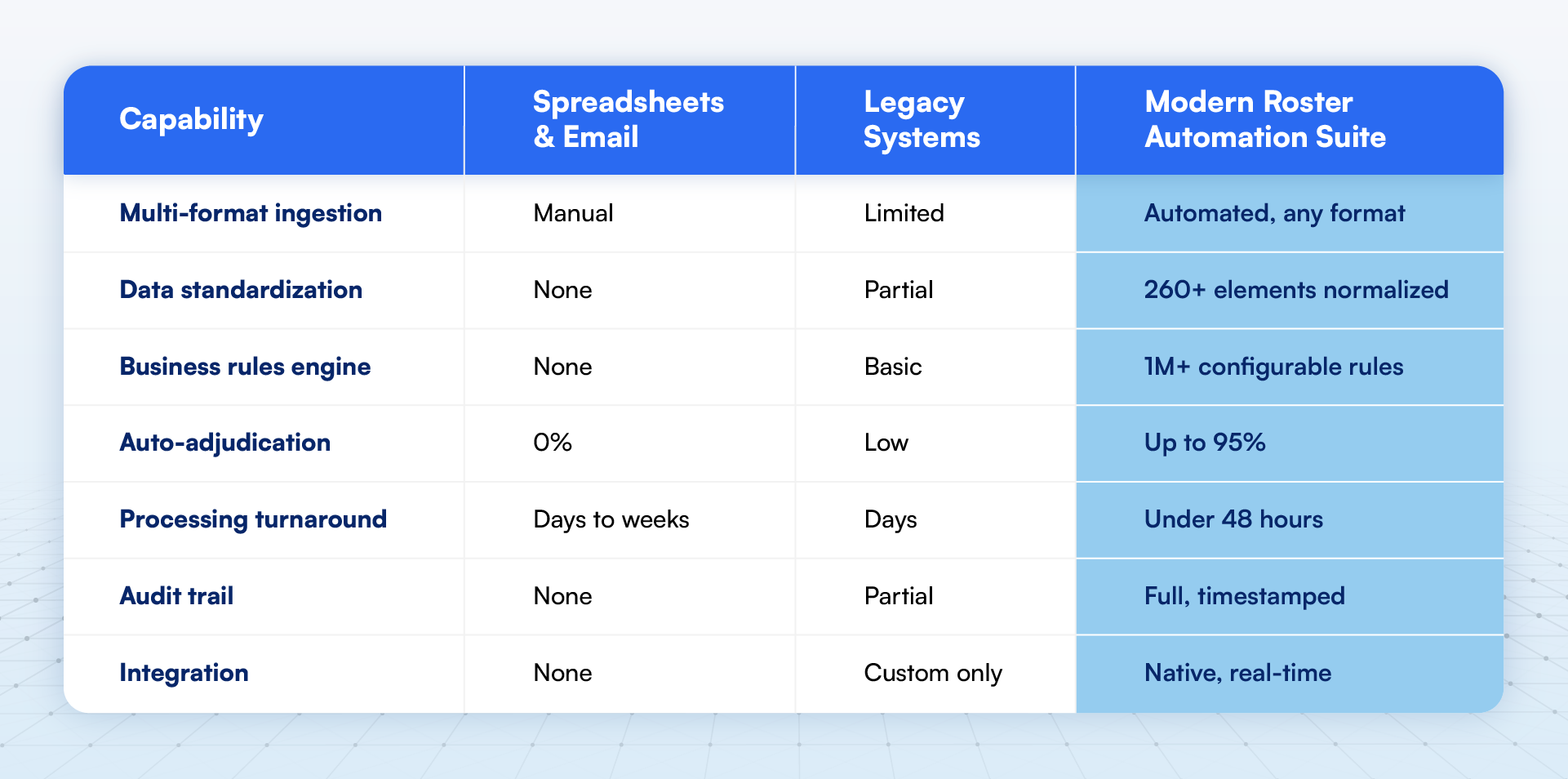
Use the framework below to pressure-test platform capabilities against the criteria that reflect how health plans actually operate:
Why Health Plans Are Moving Toward Provider Roster Automation Suites
Point solutions that address one piece of the roster problem have a short operational shelf life. A platform that handles ingestion but not validation creates a quality problem downstream. A platform that validates but can't distribute data to credentialing and claims systems adds an integration burden that offsets whatever efficiency it generates. As health plans scale — through acquisitions, new lines of business, or expanded geographies — the cost of assembling a roster workflow from disconnected tools compounds quickly.
A provider roster automation suite addresses the full lifecycle in a single workflow: submission intake, format normalization, business rules processing, validation against authoritative sources, exception routing, downstream distribution, and the feedback loop that improves delegated entity submission quality over time. It also generates operational intelligence that point solutions can't — entity-level submission quality metrics, processing time trends, error rate analysis — that enables data-driven conversations with underperforming delegates rather than reactive ones.
For health plans under regulatory scrutiny on directory accuracy and network adequacy, the compliance case for a consolidated suite is equally strong. A single, unified audit trail across all roster submissions is a far cleaner answer to a regulator's question than a reconstruction project across multiple systems and file archives.
The operational advantages compound as networks grow. Processing capacity scales with the platform rather than the headcount. Compliance infrastructure is built into the workflow rather than retrofitted after the fact. And the institutional knowledge embedded in configurable business rules — plan-specific logic, delegated entity handling, effective date conventions — is maintained in the system rather than living in the heads of two or three operations staff.
How MCheck® Roster Automation Simplifies Healthcare Roster Management
For health plans evaluating a modern provider roster automation suite, MCheck® Roster Automation by HiLabs is purpose-built for the operational reality of payer roster management — high submission volume, heterogeneous file formats, health plan-specific business logic, and compliance requirements that don't accommodate manual workflows or weekly batch cycles.
Touchless End-to-End Processing
MCheck® Roster Automation ingests roster files as submitted, in any format, without pre-processing. An automated pipeline handles mapping, normalization, validation, and downstream distribution — achieving up to 95% auto-adjudication across production health plan deployments. Exception workflows surface the records that need human review; clean records flow through in under 48 hours, satisfying No Surprises Act update requirements by design.
Automated Validation and Standardization
Every record is validated against NPPES, state licensure databases, and the health plan's provider master in real time. MCheck® Roster Automation standardizes across 260+ data elements per provider record and applies over one million configurable business rules calibrated to the specific requirements of individual health plan networks — covering network logic, pricing requirements, directory formatting, and effective date handling. What reaches downstream systems has already been verified against the sources that matter.
Improved Provider Experience
Faster processing means providers see roster updates reflected sooner. A continuous feedback loop shares structured information about submission errors and corrections back to delegated entities — reducing error rates over time and removing the friction that damages provider relationships when data management feels opaque or unresponsive.
Faster Time to Accurate Data
The window between when a roster change occurs and when it's reflected in a health plan's systems is a risk window — for compliance, for claims accuracy, for directory integrity. MCheck® Roster Automation closes that window consistently across production deployments, processing submissions in under 48 hours at scale.
Reduced Operational Costs
A national Blue plan using HiLabs’ Roster Automation realized over $80M in operational savings within one year, processed thousands of backlog rosters at a 99% adjudication rate, and scaled across 30+ markets and 10+ data sources without increasing operational overhead. The platform is built to deliver those outcomes at enterprise scale — not as a pilot result but as a production standard.
