



Health plans are being pulled in four directions at once. Members expect fast, convenient access to care. Regulators expect networks that meet strict adequacy standards. Finance teams expect a lower cost of care. And provider relations teams are expected to keep contracts, credentials, and directories current across tens of thousands of practitioners. Balancing network adequacy, provider performance, member access, and cost of care has never been simple, and it is getting harder as networks grow larger and more complex.
For years, provider network management at most health plans has been reactive. Teams pull provider counts once a quarter, patch gaps when a state regulator flags them, and rely on data that is fragmented across claims systems, credentialing platforms, contracting tools, and directory feeds that rarely agree with one another. That approach worked when networks were smaller, and oversight was lighter. It does not work now.
Provider network optimization is the discipline that replaces this reactive posture with continuous, data-driven decision-making. Instead of asking "does our network technically meet the minimum requirement," this approach asks a harder question: is the network actually designed to deliver the right access, quality, performance, and cost for the populations it serves? Getting this right requires payers to continuously understand where their networks are strong, where gaps exist, and which providers create the most value.
This guide walks through what healthcare network optimization means for payers, why it matters more today than it did even two years ago, the metrics that prove it is working, and seven network optimization strategies that health plans can put into practice immediately.
What Is Provider Network Optimization?
Provider network optimization is the ongoing process of designing, monitoring, and adjusting a health plan's network so that it delivers the right mix of access, quality, cost efficiency, and compliance. It goes beyond simply having enough providers under contract. It means understanding provider network performance, closing specialty and geographic gaps before they become compliance findings, and continuously validating that the providers listed in a directory are actually available to see patients.
Provider Network Optimization vs. Network Adequacy
Network adequacy and network optimization are related, but they are not the same thing.
Network adequacy answers a narrower question: can members access the required providers and services within a defined distance, drive time, or appointment wait? It is a compliance floor, typically expressed as a time-and-distance standard or a minimum provider-to-enrollee ratio.
Network optimization asks a broader question: is the network designed to deliver the right access, quality, performance, and cost, not just the minimum required to pass an audit? A network can technically satisfy provider network adequacy standards while still being poorly built: full of low-performing providers, ghost listings, duplicate records, or specialists concentrated in the wrong ZIP codes. That is precisely why adequacy alone is an incomplete measure of network health, and why optimization is the layer that must sit on top of it.
Why Provider Network Optimization Matters for Payers
Several forces are converging to make this a strategic priority rather than a back-office function.
Cost of care. Referral leakage and out-of-network utilization quietly erode margins. Independent research on referral patterns suggests that roughly a quarter of physician referrals in the United States go to out-of-network specialists, with the financial impact per physician estimated between $821,000 and $971,000 annually, and total organizational losses in the $200 million to $500 million range for large systems. A well-run network keeps more of that volume, and that revenue, inside contracted relationships.
Member access. Members do not experience network adequacy as a percentage on a compliance filing. They experience it as whether they can get an appointment. When directories are wrong, members lose trust fast. A recent report found that 58% of members had encountered incorrect information in a provider directory at least once, and 80% of those members said the error decreased their trust in the health plan. Worse for payers, 71% of members said they now use a general search engine instead of the plan's own directory to find a provider, and 40% believe that search result is more accurate than what the plan publishes.
Provider performance. Not all in-network providers deliver equal value. Some drive lower total cost of care and stronger outcomes; others drive utilization and referral leakage without improving quality. A structured approach to provider network performance gives payers the visibility to tell the difference and act on it.
Network adequacy. Network adequacy remains firmly on the regulatory agenda, even as oversight models evolve. In 2026, State-Based Marketplaces must apply quantitative time-and-distance standards at least as stringent as federal Marketplace standards. Beginning in 2027, CMS will give states greater flexibility in how they evaluate provider access, while retaining the underlying requirement that QHP networks provide sufficient access to care. For Medicare Advantage, 42 CFR § 422.116 establishes quantitative time-and-distance standards for contracted provider networks, generally requiring at least 90% of beneficiaries in a county to reside within the applicable maximum time and distance for specified provider and facility types, with lower thresholds applying in certain county types. CMS also requires MA organizations to continuously monitor their contracted networks throughout the contract year to ensure compliance. Network adequacy management, therefore, is a year-round responsibility, not simply an annual filing exercise.
Regulatory compliance. Directory accuracy is no longer a side issue from adequacy; the two are converging. A Department of Health and Human Services Office of Inspector General report released in late 2025 found that 55% of listed behavioral health providers in Medicare Advantage plans, and 28% in Medicaid managed care plans, were inactive despite appearing in plan directories. CMS requires Medicare Advantage organizations to update provider directory information within 30 days of becoming aware of a change. Beginning in 2026, MA organizations must also make provider directory data available directly to CMS for online publication, with CMS integrating searchable provider network information into Medicare Plan Finder. This means directory inaccuracies that once remained confined to individual plan directories will become visible to beneficiaries on a federal comparison platform, raising the stakes for maintaining accurate provider data.
Competitive differentiation. Payers that can demonstrate a genuinely optimized, accurate, high-performing network have a real advantage in RFPs, star ratings, and member retention, especially as purchasers and regulators grow more skeptical of networks that look adequate on paper but fail in practice.

7 Provider Network Optimization Strategies for Payers
The following seven strategies represent the core building blocks payers are using to move from reactive network management to a continuous, intelligence-driven model of network optimization for health plans.
1. Establish a Single Source of Truth for Provider Data
Most health plans manage provider information across five or more disconnected systems: credentialing, claims, contracting, rosters, and public directories. Each system often has its own version of the truth, and none of them automatically reconcile with the others.
The first and most foundational step is consolidating this data into a single, continuously validated source of truth. That means:
- Consolidating provider, claims, credentialing, roster, and directory data into one authoritative record
- Resolving duplicate and conflicting records at the individual provider and location level
- Continuously validating provider information against primary sources rather than accepting self-reported updates at face value
Without this foundation, every other part of provider network management inherits the same fragmented, unreliable data. For a deeper look at what this involves operationally, see our guide on provider data accuracy.
2. Continuously Monitor Network Adequacy
Network adequacy has traditionally been measured on a quarterly or even annual cycle, using a snapshot of the network at a single point in time. That approach is structurally incapable of catching gaps as they form, because provider networks change constantly: providers retire, relocate, close panels, or leave contracts every week.
Modern network adequacy management shifts from periodic snapshots to continuous monitoring:
- Identifying geographic and specialty gaps as they emerge, not months later
- Monitoring time-and-distance requirements against the current, not historical, provider footprint
- Tracking adequacy as networks changes, county by county and specialty by specialty
Moving from periodic analysis to always-on monitoring that flags issues before a regulator does
This shift matters because CMS's own oversight has moved in the same direction: network adequacy provider data validations for plan year 2027 introduce new limits, such as capping providers at a maximum of ten practice locations, and applying a new specialty-compatibility framework. Payers that are still validating quarterly are, by design, always working from stale data. For more detail on how continuous monitoring works in practice, see our resource on provider network adequacy.
3. Identify High-Value Providers
Once data is centralized and adequacy is monitored continuously, payers can move to a more strategic question: which providers should the network actually be built around?
High-value providers can be identified using a combination of:
- Quality performance and outcomes data
- Total cost of care
- Utilization patterns
- Patient access and appointment availability
- Market availability relative to member demand
This analysis helps payers prioritize which providers to pursue for network expansion, which to renegotiate contracts with, and which underperforming providers to reconsider. Rather than growing a network by volume alone, payers can grow it by value, which directly supports provider network performance and member outcomes together.
4. Optimize Provider Mix by Market and Specialty
A network can have plenty of providers overall and still be badly mismatched to the populations it serves. Over-supplied specialties in one market can sit alongside critical shortages in another, particularly in behavioral health and certain surgical subspecialties.
Optimizing provider mix means:
- Identifying over- and under-supplied specialties at the market level
- Analyzing provider distribution geographically, not just in aggregate
- Balancing broader access against network cost, since adding providers indiscriminately increases cost without necessarily improving outcomes
- Accounting for the fact that different markets and populations have different needs, so a one-size-fits-all design rarely works
This is one of the more nuanced pieces of healthcare network management because it requires blending demand data, claims patterns, and demographic information rather than relying on provider counts alone.
5. Detect and Remove Ghost Providers
Ghost providers, meaning listed providers who are not actually practicing, not accepting new patients, or not truly in-network, are one of the most persistent problems in provider network management today. A federal report released by HHS-OIG in late 2025 found that in Medicare Advantage plans, 55% of listed behavioral health providers were inactive, and in Medicaid managed care plans, 28% were inactive. A separate secret-shopper investigation by Senate Finance Committee staff found that 80% of mental health provider listings across a sample of Medicare Advantage plans were inaccurate or unavailable, and a third had phone numbers that were disconnected or simply went unanswered.
Detecting and removing ghost providers requires payers to:
- Validate whether providers are actually practicing at the listed location
- Confirm active network participation rather than assuming a contract from years ago still holds
- Check real-time availability and new-patient acceptance status
- Remove or remediate inaccurate listings promptly, rather than waiting for the next scheduled audit
This is not a cosmetic fix. It directly affects member trust, regulatory exposure, and, increasingly, litigation risk, as several major insurers have faced lawsuits over directories in which the overwhelming majority of listed mental health providers turned out to be unreachable or not actually in-network.

6. Use Performance and Cost Intelligence to Guide Network Decisions
Network strategy is incomplete if it stops at adequacy and directory accuracy. The next layer is using performance and cost intelligence to actively shape network decisions, rather than just monitor them.
That means bringing together:
- Total cost of care by provider and provider group
- Quality performance against benchmarks
- Claims utilization patterns
- Referral patterns, including where leakage is occurring
- Value-based care performance
- Provider efficiency relative to peers in the same specialty and market
Payers that connect this intelligence directly to contracting and network design decisions see a very different level of provider network performance than those still managing networks primarily on adequacy compliance. Denials and revenue-cycle friction are a useful proxy for how much this matters: hospital net revenue leakage from denied claims rose 25% in a single year, from an estimated $38.6 billion in 2024 to more than $48 billion in 2025 across a large multi-hospital analysis, driven largely by clinical denials tied to prior authorization and medical necessity disputes. Networks with poor performance visibility are far more exposed to this kind of friction.
7. Automate Network Monitoring and Optimization
Manual network analysis simply cannot keep pace with how fast provider networks change. Automation and AI change the economics of network optimization for health plans by making continuous monitoring operationally realistic rather than a resource-draining exercise.
AI and automation can:
- Continuously monitor provider changes across thousands of records, in near real time
- Surface network gaps as they open up, rather than at the next scheduled review
- Recommend specific providers to pursue for gap closure, based on quality, cost, and access criteria
- Prioritize the highest-impact opportunities first, rather than treating every gap equally
- Reduce the manual analyst hours required for network adequacy management, freeing teams to focus on strategy rather than data reconciliation
This is the strategy that makes the other six sustainable at scale. Without automation, continuous monitoring, ghost provider detection, and performance-based decision-making all remain aspirational for any network with more than a few thousand providers.
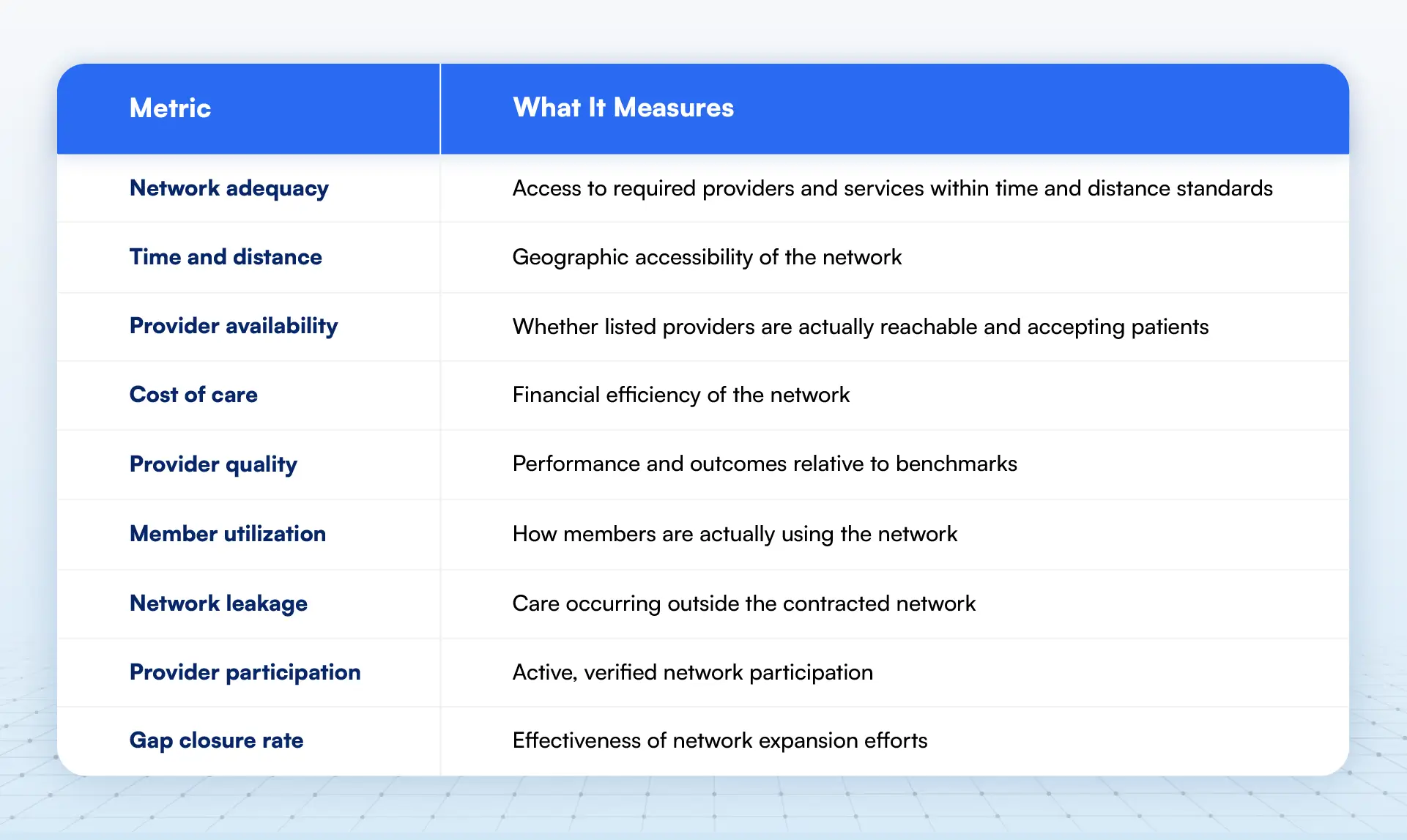
Key Metrics for Measuring Provider Network Optimization
Health plans that treat this work as a program, not a project, track a consistent set of metrics over time.
Common Challenges in Provider Network Optimization
Even payers with strong intentions run into recurring obstacles.
Fragmented Provider Data
Provider information is scattered across credentialing, claims, contracting, and directory systems that rarely reconcile automatically, which is the exact problem the single source of truth strategy above is designed to solve.
Inaccurate or Stale Provider Information
Providers change practices, retire, or leave networks constantly, and directories often lag behind reality by weeks or months, feeding directly into the ghost provider problem discussed earlier.
Limited Visibility into Provider Performance
Many payers can report on adequacy but cannot easily answer which providers are actually delivering better outcomes at a lower total cost of care.
Manual Network Adequacy Analysis
Quarterly, spreadsheet-driven analysis cannot keep pace with networks that change daily, which is why network adequacy management is shifting toward continuous, automated monitoring across the industry.
Balancing Cost and Access
Adding providers to close an access gap can increase cost without necessarily improving quality, and removing underperforming providers to control cost can create new access gaps if it is not modeled carefully.
Managing Multiple Markets and Regulatory Requirements
National and multi-state payers must satisfy different network adequacy standards across state Medicaid programs, Medicare Advantage rules, and marketplace regulations simultaneously, each with its own reporting cadence and definitions, making healthcare network management a genuinely cross-functional effort.
How AI Is Changing Provider Network Optimization
AI is not simply making existing processes faster. It is changing what is operationally possible.
Real-time provider data intelligence replaces static snapshots with continuously refreshed records, pulling from claims activity, licensing databases, and provider-submitted updates. AI-powered provider validation can cross-reference multiple sources to flag a listing as likely inaccurate long before a member complaint or a secret-shopper audit surfaces the same problem. Network adequacy monitoring becomes an ongoing process rather than a quarterly compliance exercise, and geospatial analysis can model access gaps down to the ZIP code and specialty level.
Provider performance intelligence, layered on top of this cleaner data, lets payers connect network design decisions directly to cost and quality outcomes. Automated gap identification and high-value provider recommendations turn network expansion from a manual research exercise into a prioritized, data-backed action list. And because all of this runs continuously, payers get always-on network monitoring instead of a single audit that is out of date within weeks.
None of this replaces human judgment in contracting and network strategy. What it does is remove the guesswork and lag from day-to-day provider network management, so that human decisions are based on current, validated data rather than a quarterly snapshot that was already stale the day it was pulled.
Provider Network Optimization: From Reactive Management to Continuous Intelligence
The shift underway across the industry can be summarized simply.
Traditional approach: Periodic, manual, data-fragmented, reactive.
Modern approach: Continuous, AI-powered, data-driven, predictive.
A genuinely optimized network requires continuously connecting four things: provider data, adequacy, performance, and cost, all feeding into network decisions in something close to real time. Effective healthcare network optimization is not a single project with an end date. It is an operating model, and health plans that treat it that way are the ones building durable advantages in access, cost, and compliance.
How HiLabs Enables Provider Network Optimization
HiLabs brings together the capabilities discussed throughout this guide into a single, connected approach to network optimization through its MCheck® NetworkIQ.
Provider Data Intelligence
A continuously validated, single source of truth for provider data, resolving conflicts across credentialing, claims, rosters, and directories.
Continuous Network Adequacy Monitoring
Ongoing, AI-powered tracking of geographic and specialty gaps, rather than a quarterly compliance snapshot.
Ghost Network Detection
Automated identification of inactive, unreachable, or inaccurately listed providers before they become a compliance finding or a member complaint.
High-Value Provider Sourcing
Data-driven identification of providers who improve access, quality, and cost simultaneously, to guide network expansion and contracting priorities.
Network Performance Intelligence
Ongoing visibility into cost, quality, utilization, and referral patterns to support smarter network decisions.